3D Printing Info
Where it is used
Decorative and model-making prints that are sanded and stained like timber
Sources
- Bambu Filament Technical Data Sheet — PLA Wood · 2026-08 · tds
- woodFill technical data sheet · 2026-08 · tds
PLA carrying 10–18 wt% wood powder: it sands and stains like timber, absorbs 1.25 % water — the most of any PLA grade — and loses about a third of plain PLA's tensile strength.
Open in interactive comparison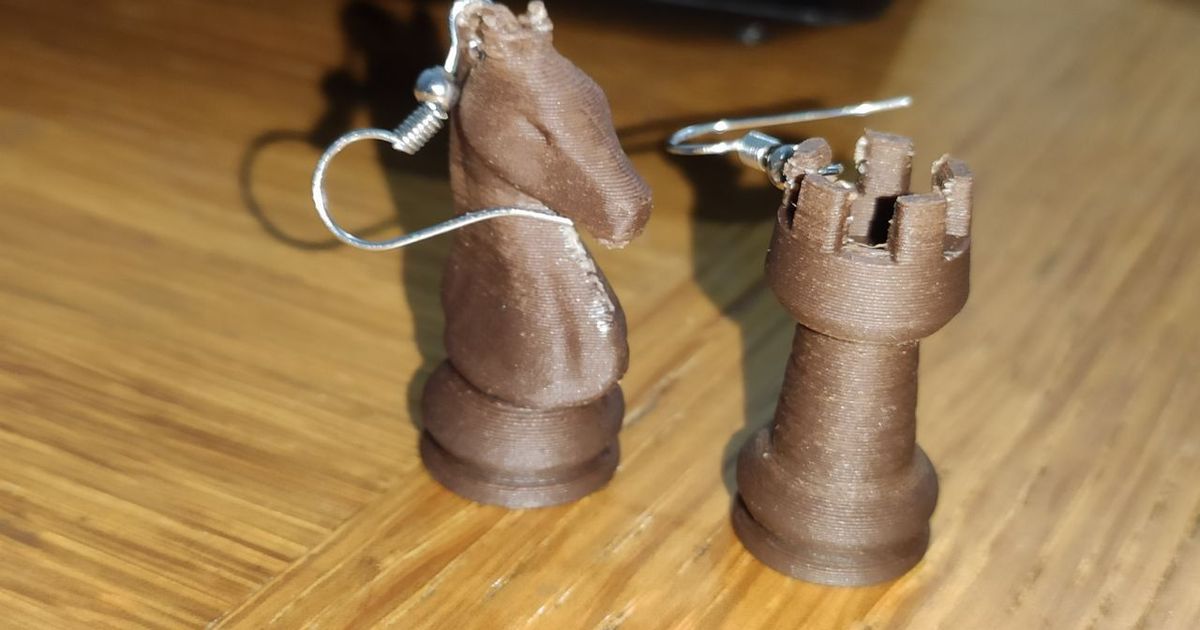
Decorative and model-making prints that are sanded and stained like timber
PLA carrying 10–18 wt% wood powder: it sands and stains like timber, absorbs 1.25 % water — the most of any PLA grade — and loses about a third of plain PLA's tensile strength.
Wood-filled PLA is valuable in model making and decorative work because it can be sanded and stained to resemble timber. The filler contributes to the surface itself, allowing a printed ornament or miniature to take a wood-like finish without recreating every visual cue in paint. colorFabb’s woodFill uses wood fibre in a PLA/PHA base, while other listed grades use different formulations.
The material does not gain wood’s directional structural behavior from the appearance. The representative printed data show reduced strength, and moisture sensitivity plus particle-related clogging make preparation more demanding than plain PLA. Its most convincing applications use the printed geometry and timber-like finish together, while leaving highly loaded connections and repeated-impact duties to a better suited material.
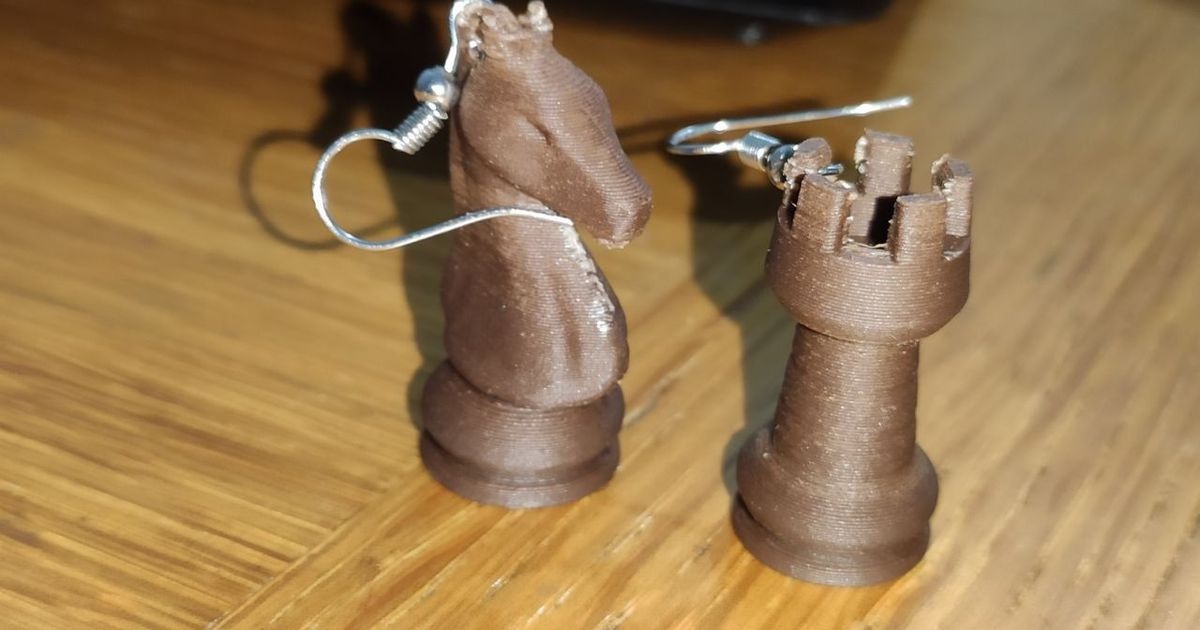
Knight and rook earrings photographed with metal earring hooks. The printed chess pieces are uploader-reported wood PLA.
Listing note: “Printed with wood PLA with 0.6 nozzle”
Printables listing uploaded by Array · CC BY-NC 4.0Original listing · Checked 2026-10-17. This is an uploader report, not an independent material test.Source image · Image bytes unchanged; displayed in full. Noncommercial reuse only.
Representative catalog values. Check the exact grade and its linked conditions before using a setting.
190–240 (Bambu Lab); colorFabb advises 195–220 for its PLA/PHA base
190–240 (Bambu Lab); colorFabb advises 195–220 for its PLA/PHA base
35–45 (Bambu Lab); 50–70 (Fiberlogy)
35–45 (Bambu Lab); 50–70 (Fiberlogy)
Open frame is fine
Open frame is fine
55 °C for 8 h in a forced-air dryer; Bambu Lab lists pre-drying as required
55 °C for 8 h in a forced-air dryer; Bambu Lab lists pre-drying as required
Open a topic to explore the complete data. Each value keeps its original conditions, units and dated sources.
| Property and unit | Published value and conditions | Sources and dates |
|---|---|---|
| Base polymer / chemistry | PLA filled with wood powder — 10–18 wt% (Bambu Lab SDS); colorFabb woodFill uses a PLA/PHA base with recycled wood fibre | 2 sources
|
| Density (g/cm³) | 1.15 (colorFabb) to 1.23 (Fiberlogy), ISO 1183; Bambu Lab 1.21 | 3 sources
|
| Typical price (USD/kg) | 1 kg spools cluster near 25; counting the 0.5 kg specialty spools the middle of the market is about 34 | 3 sources
|
| Price range across brands (USD/kg) | 14–76 across brands; SUNLU 14, ELEGOO 19, Bambu Lab 25, Prusament 44, Filament PM 49 on 0.5 kg spools, colorFabb 76 | 6 sources
|
| Market availability (1–5) | Stocked by most mainstream brands | 4 sources
|
| Spool sizes & diameters | 1.75 and 2.85 mm; 0.6, 0.85 and 1 kg spools | 3 sources
|
| Typical applications | Decorative and model-making prints that are sanded and stained like timber | 2 sources
|
| Diameter tolerance (± mm) | ±0.03 (Bambu Lab) | 1 source
|
| Property and unit | Published value and conditions | Sources and dates |
|---|---|---|
| Nozzle temperature (°C) | 190–240 (Bambu Lab); colorFabb advises 195–220 for its PLA/PHA base | 2 sources
|
| Bed temperature (°C) | 35–45 (Bambu Lab); 50–70 (Fiberlogy) | 2 sources
|
| Enclosure / chamber requirement (1–5) | Open frame is fine | 1 source
|
| Part cooling fan | Fan on | 1 source
|
| Warping tendency (1–5) | None | 1 source
|
| Overall printing difficulty (1–5) | Easy — minor profile tuning; pre-drying is required and the wood content chars if it sits hot | 2 sources
|
| Extruder requirement | Nozzles below 0.4 mm are not compatible; Bambu Lab does not recommend the AMS lite | 1 source
|
| Property and unit | Published value and conditions | Sources and dates |
|---|---|---|
| Nozzle hardness required (1–4) | Brass acceptable; hardened steel for volume work — Bambu Lab's PLA compatibility table lists no hardened-nozzle requirement, but its nozzle guide names wood among the abrasive filaments hardened steel exists for | 2 sources
|
| Abrasiveness (1–5) | Moderately abrasive — wood fill | 1 source
|
| Nozzle clog risk (1–5) | Moderate — needs dry filament and a clean nozzle; wood particles char and block small nozzles | 1 source
|
| Property and unit | Published value and conditions | Sources and dates |
|---|---|---|
| Moisture absorption (hygroscopicity) (1–5) | High — 1.25 % saturated at 25 °C / 55 % RH, the highest in the PLA family | 1 source
|
| Equilibrium moisture content at ~50 % RH (%) | 1.25 saturated at 25 °C / 55 % RH (Bambu Lab) | 1 source
|
| Drying temperature & time | 55 °C for 8 h in a forced-air dryer; Bambu Lab lists pre-drying as required | 2 sources
|
| Symptoms when wet | Bambu Lab flags pre-drying and ventilation as specific requirements for this grade | 1 source
|
| Effect of moisture on strength | No dry-versus-conditioned figures are published. At 1.25 % saturated uptake the practical loss shows as poor layer adhesion, rough surface and weak layers | 2 sources
|
| Property and unit | Published value and conditions | Sources and dates |
|---|---|---|
| Tensile strength (XY) (MPa) | 26 ± 5 (Bambu Lab) and 28.4 (colorFabb) printed XY, ISO 527; Fiberlogy quotes 35 at yield | 3 sources
|
| Young's modulus (MPa) | 2360 ± 190 (Bambu Lab) and 2479 (colorFabb) printed XY, ISO 527; Fiberlogy 2950 | 3 sources
|
| Elongation at break (%) | 4.5 (colorFabb) to 15.3 (Bambu Lab) printed XY, ISO 527; Fiberlogy 6.5 | 3 sources
|
| Flexural strength (MPa) | 55 ± 4 printed XY, ISO 178 (Bambu Lab) | 1 source
|
| Flexural modulus (MPa) | 2780 ± 120 printed XY, ISO 178 (Bambu Lab) | 1 source
|
| Charpy impact, notched (kJ/m²) | 3.81 (colorFabb) and 6.3 ± 2.2 (Bambu Lab) printed XY, ISO 179, notched | 2 sources
|
| Other impact data | Charpy unnotched 12.28 (colorFabb) and 15.7 (Bambu Lab), printed, ISO 179 | 2 sources
|
| Layer adhesion / Z tensile (MPa) | 15 ± 4 printed Z, ISO 527 (Bambu Lab); flexural Z falls to 28 against 55 in XY | 1 source
|
| Brittleness (1–5) | Brittle — snaps with little warning | 1 source
|
| Creep resistance / sustained load (1–5) | Poor — no wood-filled creep test; plain printed PLA sagged from 12 to 16.2–21.8 mm over 5 days at 1.25 kg | 3 sources
|
| Fatigue / repeated-flex resistance (1–5) | Poor — no grade-specific S-N curve; plain printed PLA ran 38 000–49 000 cycles at 30 % of tensile strength and the wood filler cuts elongation and the parts snap without warning | 2 sources |
| Elasticity / flexibility (1–5) | Rigid | 1 source
|
| Z strength as % of XY (%) | 58 by tensile, 51 by flexural (printed, Bambu Lab) | 1 source
|
| Property and unit | Published value and conditions | Sources and dates |
|---|---|---|
| HDT at 0.45 MPa (°C) | 60 (ISO 75, 0.45 MPa) | 1 source
|
| HDT at 1.8 MPa (°C) | 57 (ISO 75, 1.8 MPa) | 1 source
|
| Glass transition (Tg) (°C) | 54 (Bambu Lab, DSC); Fiberlogy quotes 55–60 | 2 sources
|
| Melting point / Vicat (°C) | 156 peak melt (DSC) | 1 source
|
| Property and unit | Published value and conditions | Sources and dates |
|---|---|---|
| UV resistance (1–5) | Degrades within weeks outdoors | 1 source
|
| Property and unit | Published value and conditions | Sources and dates |
|---|---|---|
| Fume toxicity (1–5) | Low hazard — minimal VOC and particle emission | |
| Ventilation / filtration requirement (1–5) | None needed in a normal room; Bambu Lab specifically advises ventilation for this grade | 1 source
|
| Property and unit | Published value and conditions | Sources and dates |
|---|---|---|
| Sanding & machining | Sands and stains like timber — the usual reason for choosing it | 1 source
|
| Support material pairing | Support for PLA (Bambu Lab) | 1 source
|
| Dimensional accuracy & detail | Wood grain hides layer lines; colour darkens with nozzle temperature | 2 sources
|
| Property and unit | Published value and conditions | Sources and dates |
|---|---|---|
| Soluble in | Chloroform dissolves the PLA matrix (10 % w/v, 2–4 h at 23 °C) and leaves the filler as loose sludge; laboratory reagent. | 1 source |
| Softened or crazed by | Acetone, ethyl acetate and toluene plasticise the matrix but dissolve <1 % even at 65 °C; acetone submersion crazes parts. | 2 sources
|
| Solvent welding & smoothing agent | Chloroform vapour attacks only the resin fraction, so the filler is left standing proud; no workshop-safe agent exists. | 2 sources |
Values describe representative grades, not every spool. Manufacturer datasheets and independent tests retain their source labels and dates. Printed orientation, test method, conditioning and formulation can change results. Unknown values are —. A listed use is not a certification. Shore A, Shore D and Rockwell hardness are separate scales.
Historical USD/kg snapshots. Read each listing’s sale/from qualifiers, spool mass, source date, shipping and tax notes. Product figures are separate from the material summary.
$13.99 / 1 kg spool (plain Wood; $14.99-$15.99 for walnut, cherry and maple) at the listing's 3 kg minimum order, store.sunlu.com, Aug 2026 (list $20.99)
15 % wood powder. Walnut, cherry and maple variants. Minimum order 3 kg.
Open product listing ↗| Base polymer / chemistry | PLA filled with 15 % wood powder |
|
|---|---|---|
| Spool sizes & diameters | 1 kg net, about 330 m; 1.75 and 3.0 mm |
|
| Diameter tolerance (± mm) | +/-0.03 |
|
| Nozzle temperature (°C) | 195-260 (195-205 at 50-100 mm/s, 215-260 at 150-400 mm/s) |
|
| Bed temperature (°C) | 60-65 |
|
| Drying temperature & time | 55–65 °C for 6–8 h (drying required) |
$18.99 / 1 kg spool, us.elegoo.com product catalogue, Aug 2026
Handle pla-wood. ELEGOO publishes printed X-Y and Z strength figures without naming a test standard, so they are recorded here rather than as specs: tensile 41 ± 2 MPa XY / 24 ± 1 MPa Z, impact 32 ± 1.4 kJ/m² XY.
Open product listing ↗| Density (g/cm³) | 1.21 (ELEGOO published spec table) |
|
|---|---|---|
| Nozzle temperature (°C) | 200–240 |
|
| Bed temperature (°C) | 35–65 |
|
| Recommended chamber temperature (°C) | 20–45 |
|
| Nozzle hardness required (1–4) | Hardened steel required, 0.4 mm or larger |
|
| Drying temperature & time | 50 ± 5 °C for 8 h; drying required |
|
| Elongation at break (%) | 7.5 ± 1.1 (printed XY); 5.7 printed Z |
|
| HDT at 0.45 MPa (°C) | 55 (0.45 MPa) |
|
| Melting point / Vicat (°C) | 158 melting; Vicat 60 |
|
$24.99 / 1 kg spool, us.store.bambulab.com, Aug 2026
10–18 wt% wood powder per the SDS. Saturated water absorption 1.25 %, the highest in the PLA family.
Open product listing ↗| Density (g/cm³) | 1.21 (ISO 1183) |
|
|---|---|---|
| Nozzle temperature (°C) | 190–240 |
|
| Bed temperature (°C) | 35–45 |
|
| Equilibrium moisture content at ~50 % RH (%) | 1.25 saturated at 25 °C / 55 % RH |
|
| Tensile strength (XY) (MPa) | 26 ± 5 (printed XY, ISO 527) |
|
| Young's modulus (MPa) | 2360 ± 190 (printed XY, ISO 527); Z 1770 |
|
| Elongation at break (%) | 15.3 ± 3.1 (printed XY, ISO 527); Z 4.5 |
|
| Flexural strength (MPa) | 55 ± 4 (printed XY, ISO 178); Z 28 |
|
| Flexural modulus (MPa) | 2780 ± 120 (printed XY, ISO 178); Z 1975 |
|
| Charpy impact, notched (kJ/m²) | 6.3 ± 2.2 (printed XY, ISO 179, notched) |
|
| Other impact data | Charpy unnotched 15.7 kJ/m² XY, 5.6 kJ/m² Z (printed, ISO 179) |
|
| Layer adhesion / Z tensile (MPa) | 15 ± 4 (printed Z, ISO 527) |
|
| Z strength as % of XY (%) | 58 (printed Z 15 vs XY 26, ISO 527) |
|
| HDT at 0.45 MPa (°C) | 60 (ISO 75, 0.45 MPa) |
|
| HDT at 1.8 MPa (°C) | 57 (ISO 75, 1.8 MPa) |
|
| Glass transition (Tg) (°C) | 54 (DSC) |
|
| Melting point / Vicat (°C) | 156 melting (DSC); Vicat 64 (ISO 306) |
|
$43.99 / 1 kg spool with NFC, printedsolid.com product catalogue, Aug 2026
Handle prusament-woodfill-linden-light-1kg-nfc.
Open product listing ↗| Spool sizes & diameters | 1 kg spool; 1.75 mm |
|
|---|---|---|
| Diameter tolerance (± mm) | 0.04 |
|
| Nozzle temperature (°C) | 195 ± 10 |
|
| Bed temperature (°C) | 60 ± 10 |
|
| Bed surface & adhesion aid | Satin steel sheet recommended |
|
EUR 22.76 incl. 21 % VAT / 0.5 kg spool = EUR 45.52/kg = $49.16/kg at 1.08 USD/EUR, shop.filament-pm.com, Aug 2026
Bamboo-filled PLA+; the maker specifies a 0.4 mm nozzle or larger. The sheet's flexural modulus row reads 53.1 MPa, which is not a credible modulus, so it is omitted.
Open product listing ↗| Density (g/cm³) | 1.19 (ISO 1183/B) |
|
|---|---|---|
| Diameter tolerance (± mm) | 0.1 |
|
| Nozzle temperature (°C) | 200–215 |
|
| Bed temperature (°C) | 20–60 |
|
| Other impact data | 10.2 kJ/m² impact strength, ISO 179 (notch type and specimen not stated) |
|
| HDT at 0.45 MPa (°C) | 55 (ISO 75, load not stated) |
|
| Melting point / Vicat (°C) | 55 (Vicat, ISO 306) |
|
$45.84 / 600 g spool = $76.40/kg, colorfabb.us, Aug 2026
PLA/PHA base with recycled wood fibre. The EU store lists EUR 41.13 for the same 600 g spool.
Open product listing ↗| Density (g/cm³) | 1.18 (ISO 1183, raw-material supplier data) |
|
|---|---|---|
| Diameter tolerance (± mm) | ±0.05 max roundness deviation |
|
| Nozzle temperature (°C) | 210–230 |
|
| Bed temperature (°C) | 50–60 |
|
| Tensile strength (XY) (MPa) | 26.9 (printed XY, ISO 527-1A); injection-moulded 28.4 |
|
| Young's modulus (MPa) | 2390 (printed XY, ISO 527-1A) |
|
| Elongation at break (%) | 4.0 (printed XY, ISO 527-1A) |
|
| Flexural strength (MPa) | 51.2 (printed XY, ISO 178) |
|
| Flexural modulus (MPa) | 2350 (printed XY, ISO 178) |
|
| Charpy impact, notched (kJ/m²) | 3.38 (printed XY, ISO 179, notched) |
|
| Other impact data | Izod notched 3.81 kJ/m² (injection-moulded, ISO 180) |
|
| HDT at 0.45 MPa (°C) | 53 (printed XY, HDT-B, ISO 75) |
|
| Melting point / Vicat (°C) | Vicat 60 (ISO 306) |
|
PLA with a raised melt index and tuned crystallisation so it can be extruded at roughly 24 mm³/s, about 30 % more flow than…
10 product listingsPLA compounded with a chalk-type mineral filler for a diffuse finish; density rises to 1.31–1.38 g/cm³ and flexural strength…
10 product listings
A familiar starting point for models, prototypes and everyday prints at room temperature.
25 product listings