3D Printing Info
Where it is used
Functional parts and enclosures that need impact tolerance but not heat resistance
Sources
- PolyMax PLA Technical Data Sheet V5.4 · 2024-11 · tds
- Bambu Filament Technical Data Sheet V3.0 — PLA Tough+ · 2026-08 · tds
PLA blended with impact modifiers: notched impact strength rises five- to nine-fold while stiffness and tensile strength fall below plain PLA.
Open in interactive comparison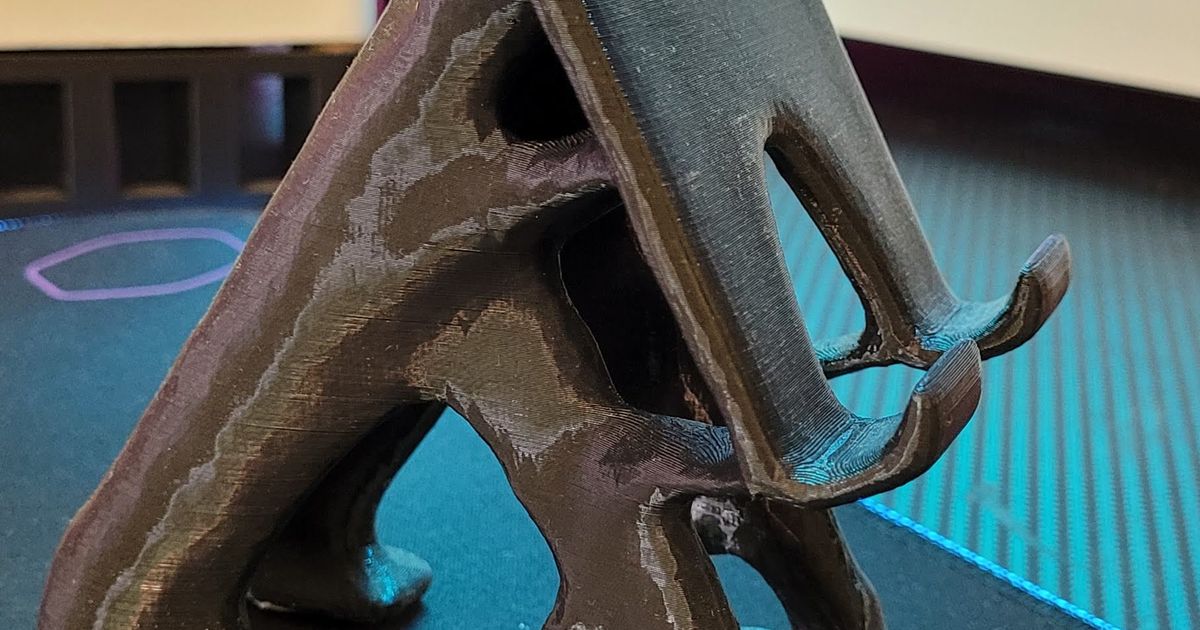
Functional parts and enclosures that need impact tolerance but not heat resistance
PLA blended with impact modifiers: notched impact strength rises five- to nine-fold while stiffness and tensile strength fall below plain PLA.
PLA+ and tough PLA are aimed at the gap between a brittle appearance model and a part that has to tolerate handling. Impact modifiers allow the tested grades to absorb more energy before breaking, which matters for enclosures and other functional prototypes that get knocked or dropped during use. They retain the relatively straightforward printing behavior that makes PLA attractive for iteration.
The trade is often lower stiffness and tensile strength. A tough part may survive a bump better yet deflect more under the same load. “PLA+” is also a supplier label rather than one standardized composition, so the individual product data matter. Published creep and heat-deflection results show why toughness alone does not make these grades suitable for hot or continuously loaded parts.
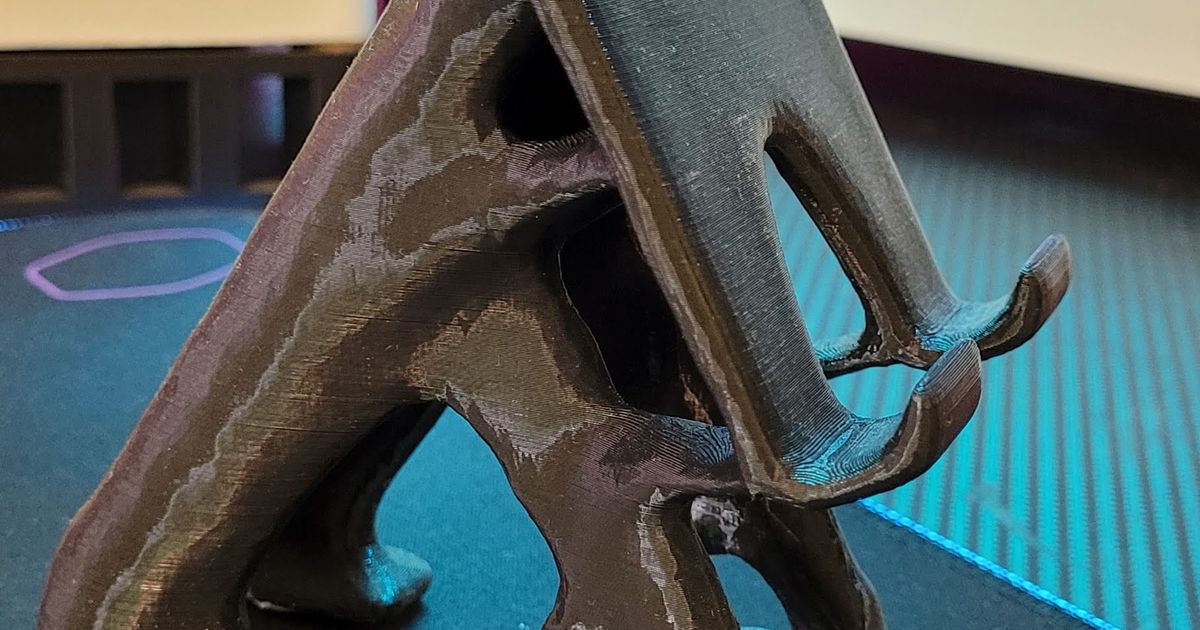
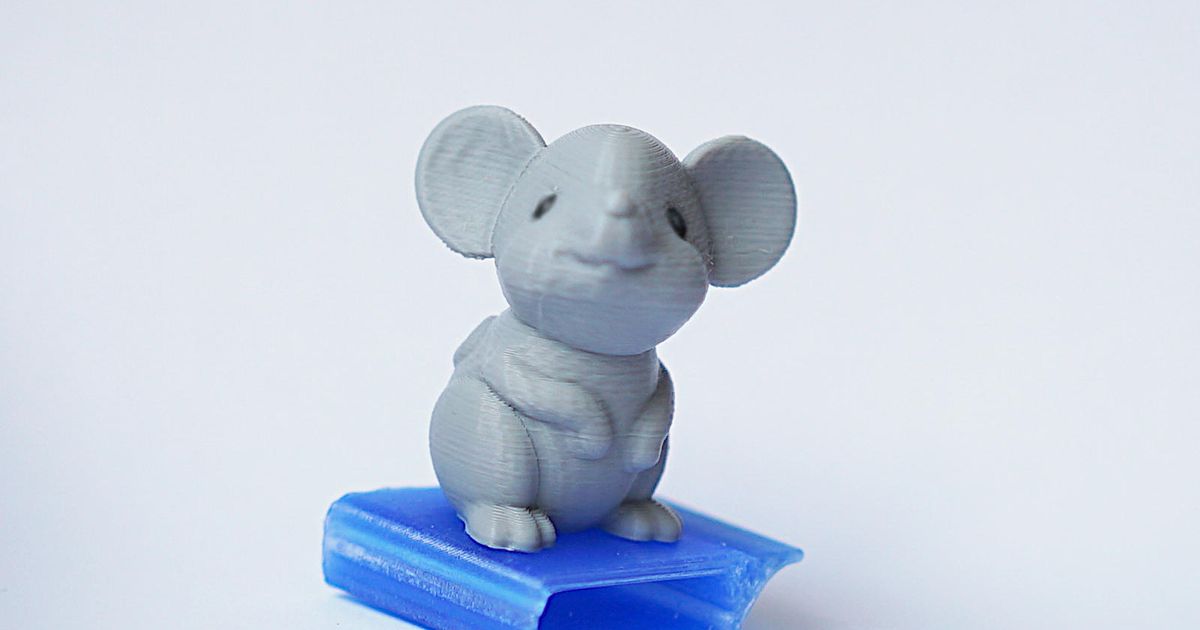
A sculpted phone stand. The uploader reports eSUN PLA+, 0.23 mm layers and 20% infill for this print.
Listing note: “This model was printed at .23mm layer height with Esun PLA+ with 20% infill”
Printables listing uploaded by Sharmo · CC0 1.0Original listing · Checked 2026-10-17. This is an uploader report, not an independent material test.Source image · Image bytes unchanged; displayed in full.
Representative catalog values. Check the exact grade and its linked conditions before using a setting.
190–230 (Polymaker); Bambu Lab Tough+ needs 220–250
190–230 (Polymaker); Bambu Lab Tough+ needs 220–250
25–60 (Polymaker); 35–65 (Bambu Lab Tough+)
25–60 (Polymaker); 35–65 (Bambu Lab Tough+)
Open frame is fine
Open frame is fine
55 °C for 6–8 h; 65–75 °C for 12 h on a Bambu Lab X1 heatbed
55 °C for 6–8 h; 65–75 °C for 12 h on a Bambu Lab X1 heatbed
Open a topic to explore the complete data. Each value keeps its original conditions, units and dated sources.
| Property and unit | Published value and conditions | Sources and dates |
|---|---|---|
| Base polymer / chemistry | PLA compounded with impact modifiers; suppliers publish the base as polylactic acid only | 2 sources
|
| Density (g/cm³) | 1.17–1.24 (Polymaker); 1.21 (Bambu Lab, ISO 1183) | 2 sources
|
| Typical price (USD/kg) | Mainstream 1 kg spools cluster near 16 | 2 sources
|
| Price range across brands (USD/kg) | 10–40 across brands; budget house brands 10–17, Sakata 3D HR-870 26, Polymaker and Fiberlogy 36–40 | 5 sources
|
| Market availability (1–5) | Stocked by most mainstream brands | 5 sources
|
| Spool sizes & diameters | 1.75 and 2.85 mm; 0.75, 0.85, 1 and 1.1 kg spools | 3 sources
|
| Typical applications | Functional parts and enclosures that need impact tolerance but not heat resistance | 2 sources
|
| Diameter tolerance (± mm) | ±0.03 (Bambu Lab) | 1 source
|
| Property and unit | Published value and conditions | Sources and dates |
|---|---|---|
| Nozzle temperature (°C) | 190–230 (Polymaker); Bambu Lab Tough+ needs 220–250 | 2 sources
|
| Bed temperature (°C) | 25–60 (Polymaker); 35–65 (Bambu Lab Tough+) | 2 sources
|
| Enclosure / chamber requirement (1–5) | Open frame is fine | 2 sources
|
| Part cooling fan | Fan on | 2 sources
|
| Bed surface & adhesion aid | Textured or smooth PEI; Bambu Lab recommends glue stick or liquid glue for Tough+ | 2 sources
|
| Warping tendency (1–5) | None | 1 source
|
| Bed-adhesion difficulty (1–5) | Sticks to anything | 1 source
|
| Stringing / oozing tendency (1–5) | Slight — 1–3 mm retraction handles it | 2 sources
|
| Overall printing difficulty (1–5) | Easy — minor profile tuning; Tough+ wants a hotter nozzle than plain PLA | 2 sources
|
| Property and unit | Published value and conditions | Sources and dates |
|---|---|---|
| Nozzle hardness required (1–4) | Brass fine indefinitely | 1 source
|
| Abrasiveness (1–5) | Non-abrasive | 2 sources
|
| Nozzle clog risk (1–5) | Very low | 1 source
|
| Heat-creep / jam sensitivity (1–5) | Moderate — good heatbreak cooling needed; softens below 60 °C like plain PLA | 1 source
|
| Hotend requirement | No special hot-end required | 1 source
|
| Property and unit | Published value and conditions | Sources and dates |
|---|---|---|
| Moisture absorption (hygroscopicity) (1–5) | Low — 0.27 % saturated at 25 °C / 55 % RH | 1 source
|
| Equilibrium moisture content at ~50 % RH (%) | 0.27 saturated at 25 °C / 55 % RH (Bambu Lab Tough+) | 1 source
|
| Drying temperature & time | 55 °C for 6–8 h; 65–75 °C for 12 h on a Bambu Lab X1 heatbed | 2 sources
|
| Symptoms when wet | Bubbling and popping at the nozzle, stringing, rough surface and weak layers | 1 source
|
| Effect of moisture on strength | Polymaker rates PLA low-sensitivity and publishes no dry-versus-conditioned figures for the modified grades; the loss shows as poor layer adhesion rather than a strength number | 1 source
|
| Storage requirement | Sealed with desiccant below 20 % RH; shelf life at ambient is long | 2 sources
|
| Property and unit | Published value and conditions | Sources and dates |
|---|---|---|
| Tensile strength (XY) (MPa) | 35–43 (printed XY, ISO 527); 53 on My Tech Fun 4×4 mm bars for Bambu Lab Tough | 4 sources
|
| Young's modulus (MPa) | 1860–2150 (printed XY, ISO 527) — below plain PLA at 2300–3427 | 4 sources
|
| Elongation at break (%) | 5.1–5.7 (printed XY, ISO 527) | 2 sources
|
| Flexural strength (MPa) | 62–65 (printed XY, ISO 178) — below plain PLA at 76–87 | 4 sources
|
| Flexural modulus (MPa) | 2140–2393 (printed XY, ISO 178) | 2 sources
|
| Charpy impact, notched (kJ/m²) | 38.9–72.3 (printed XY, ISO 179, notched) — 5–9× plain PLA | 2 sources
|
| Other impact data | Charpy unnotched 80.6 printed XY (Bambu Lab Tough+); CNC Kitchen measured ~20 vs 5 kJ/m² for PolyLite PLA | 2 sources
|
| Layer adhesion / Z tensile (MPa) | 20.9–32.4 printed Z (ISO 527); 33.0 on My Tech Fun layer-adhesion bars vs 27.6 for PLA Basic | 3 sources
|
| Brittleness (1–5) | Tough — absorbs impact, yields before breaking | 3 sources
|
| Hardness (scale-specific) (Shore A / Shore D / Rockwell) | 78.8 Shore D measured on printed bars (My Tech Fun), against 75.3 for the same maker's plain PLA | 1 source |
| Creep resistance / sustained load (1–5) | Poor — 12 mm bar sagged to 20.2 mm over 5 days at 1.25 kg, the same as plain PLA | 2 sources
|
| Fatigue / repeated-flex resistance (1–5) | Below average — impact modifiers raise absorbed energy 5–9×; plain PLA ran 38 000–49 000 cycles at 30 % of tensile strength | 3 sources |
| Elasticity / flexibility (1–5) | Rigid | 1 source
|
| Z strength as % of XY (%) | 60 (Bambu Lab Tough+) to 78 (PolyMax PLA), printed | 2 sources
|
| Property and unit | Published value and conditions | Sources and dates |
|---|---|---|
| HDT at 0.45 MPa (°C) | 55 (PolyMax) to 61 (Tough+), ISO 75 at 0.45 MPa | 2 sources
|
| HDT at 1.8 MPa (°C) | 52 (PolyMax) to 58 (Tough+), ISO 75 at 1.8 MPa | 2 sources
|
| Glass transition (Tg) (°C) | 61 (DSC) | 2 sources
|
| Melting point / Vicat (°C) | 149–151 peak melt (DSC); Vicat 62 (ISO 306) | 2 sources
|
| Continuous service temperature (°C) | 48–57 — loaded bars begin to move at this temperature: 48 for Polymaker PLA Pro, 50 for Sunlu PLA+, 52 for Bambu Lab Tough, 57 for PolyTerra PLA+ | 4 sources
|
| Thermal expansion (CTE) (µm/m·K) | 96–99 for plain printed PLA (fibre Bragg grating, 25–50 °C); no grade-specific measurement published | |
| Flammability / UL 94 | Flammable; no UL 94 rating published by the major brands | 2 sources
|
| Property and unit | Published value and conditions | Sources and dates |
|---|---|---|
| UV resistance (1–5) | Degrades within weeks outdoors | 2 sources
|
| Chemical resistance | Good against weak acids, oils and grease; poor against strong acids and alkalis | 2 sources
|
| Food contact | Base resin is food-contact grade, but printed layer grooves harbour bacteria; Prusa advises against food use | 1 source
|
| Biodegradability / compostability | Industrially compostable only — needs sustained 55 °C; not home compostable | 2 sources
|
| Recyclability | Mechanically recyclable; not accepted in household plastic collection | 1 source
|
| Property and unit | Published value and conditions | Sources and dates |
|---|---|---|
| Fume toxicity (1–5) | Low hazard — minimal VOC and particle emission | |
| Ventilation / filtration requirement (1–5) | None needed in a normal room |
| Property and unit | Published value and conditions | Sources and dates |
|---|---|---|
| Sanding & machining | Wet sanding — dry sanding heats the surface by friction and smears it | 2 sources
|
| Gluing & solvent welding | Cyanoacrylate for most joints; some grades partially dissolve and bond with acetone | 2 sources
|
| Vapour / chemical smoothing | No practical vapour smoothing — only chloroform, hot benzene or THF, which are laboratory-only | 1 source
|
| Support material pairing | PolySupport and PolyDissolve S1 (Polymaker); Support for PLA (Bambu Lab) | 2 sources
|
| Dimensional accuracy & detail | 55° overhangs and 30 mm bridges (Bambu Lab Tough+) | 1 source
|
| Property and unit | Published value and conditions | Sources and dates |
|---|---|---|
| Soluble in | Chloroform: 10 % w/v in 2–4 h at 23 °C, every grade and morphology; THF and DMF only at 65 °C. Laboratory reagents. | 1 source |
| Softened or crazed by | Acetone, ethyl acetate and toluene plasticise it but dissolve <1 % even at 65 °C; submersion in acetone crazes and destroys parts. | 2 sources
|
| Solvent welding & smoothing agent | Chloroform vapour smooths and welds PLA at the cost of tensile strength; acetone does not smooth it at all. | 2 sources |
Values describe representative grades, not every spool. Manufacturer datasheets and independent tests retain their source labels and dates. Printed orientation, test method, conditioning and formulation can change results. Unknown values are —. A listed use is not a certification. Shore A, Shore D and Rockwell hardness are separate scales.
Historical USD/kg snapshots. Read each listing’s sale/from qualifiers, spool mass, source date, shipping and tax notes. Product figures are separate from the material summary.
$11.49 / 1.1 kg spool = $10.45/kg, store.jayo3d.com, Aug 2026
Open product listing ↗| Spool sizes & diameters | 1.1 kg net on a reusable spool; 1.75 mm |
|
|---|---|---|
| Diameter tolerance (± mm) | 0.02 |
|
| Nozzle temperature (°C) | 205–215 |
|
| Bed temperature (°C) | 55–65 |
|
$10.69 / 1 kg spool (regular $18.99), store.sunlu.com, Aug 2026
Sale price.
Open product listing ↗| Spool sizes & diameters | 1 kg spool; 1.75 mm (3 kg and 5 kg spools also sold) |
|
|---|---|---|
| Diameter tolerance (± mm) | 0.02 |
|
| Nozzle temperature (°C) | 195–205 at 50–100 mm/s; 205–220 at 100–300 mm/s |
|
| Bed temperature (°C) | 50–60 | |
| Drying temperature & time | 50–55 °C for 6–8 h (recommended) |
$14.99 / 1 kg spool, us.elegoo.com, Aug 2026
ELEGOO publishes printed X-Y and Z strength figures without naming a test standard, so they are recorded here rather than as specs: tensile 38 ± 2 MPa XY / 24 ± 2 MPa Z, bending 74 ± 4 MPa XY, impact 65.5 ± 3.6 kJ/m² XY / 7.6 ± 1.1 kJ/m² Z.
Open product listing ↗| Density (g/cm³) | 1.30 (ELEGOO published spec table) |
|
|---|---|---|
| Diameter tolerance (± mm) | 0.02 |
|
| Nozzle temperature (°C) | 200–230 |
|
| Bed temperature (°C) | 35–65 |
|
| Recommended chamber temperature (°C) | 20–45 |
|
| Drying temperature & time | 50 ± 5 °C for 8 h; drying recommended |
|
| Elongation at break (%) | 7.9 ± 1.6 (printed XY); 5.9 ± 1.9 (printed Z) |
|
| HDT at 0.45 MPa (°C) | 56 (0.45 MPa) |
|
| Melting point / Vicat (°C) | 161 melting; Vicat 63 |
|
$15.99 / 1 kg spool on a flash sale marked 44 % off, esun3dstore.com, Aug 2026
Flash-sale price. Notched Izod 7.27 kJ/m² XY, 2.22 kJ/m² Z (GB/T 1843, printed specimens); flexural 100.3 MPa XY.
Open product listing ↗| Density (g/cm³) | 1.24 (GB/T 1033) |
|
|---|---|---|
| Nozzle temperature (°C) | 210–230 |
|
| Bed temperature (°C) | 45–60 |
|
| Part cooling fan | 100 % |
|
| Drying temperature & time | 50 °C for 8–12 h |
|
| Tensile strength (XY) (MPa) | 70.37 (printed XY, GB/T 1040) |
|
| Elongation at break (%) | 4.14 (printed XY, GB/T 1040); 2.92 printed Z |
|
| Flexural modulus (MPa) | 3259 (printed XY, GB/T 9341) |
|
| Layer adhesion / Z tensile (MPa) | 42.5 kg break load on 4x4 mm printed bars, against 13 kg for the same maker's silk PLA |
|
| HDT at 0.45 MPa (°C) | 53.78 (GB/T 1634, 0.45 MPa) |
|
$16.99 / 1 kg spool (regular $23.99), overture3d.com, Aug 2026
Open product listing ↗| Density (g/cm³) | 1.23 at 21.5 °C (ISO 1183, printed specimen 100 % infill) |
|
|---|---|---|
| Nozzle temperature (°C) | 190–230 |
|
| Bed temperature (°C) | 25–60 |
|
| Part cooling fan | 100 % |
|
| Drying temperature & time | 55 °C for 6 h |
|
| Tensile strength (XY) (MPa) | 46.0 ± 0.5 (printed XY, ISO 527) |
|
| Young's modulus (MPa) | 3099 ± 200 (printed XY, ISO 527) |
|
| Elongation at break (%) | 21.5 ± 5.0 (printed XY, ISO 527); 4.2 printed Z |
|
| Flexural strength (MPa) | 76.5 ± 0.9 (printed XY, ISO 178) |
|
| Charpy impact, notched (kJ/m²) | 3.7 ± 0.6 (printed XY, notched, ISO 179) |
|
| Layer adhesion / Z tensile (MPa) | 37.3 ± 0.7 (printed Z, ISO 527) |
|
| Melting point / Vicat (°C) | Vicat 61 (ISO 306); melting 164 (DSC) |
|
$24.99 / 1 kg spool, yxpolyer.com, Aug 2026 (regular price $28.99)
Vendor cites SGS food-contact testing of the raw material. YXPOLYER quotes tensile 65 MPa, flexural 87 MPa and notched Izod 43 J/m without naming a test standard or specimen type.
Open product listing ↗| Density (g/cm³) | 1.24 (YXPOLYER published spec table) |
|
|---|---|---|
| Nozzle temperature (°C) | 195-235 |
|
| Bed temperature (°C) | 0-60 |
|
| Recommended chamber temperature (°C) | 25–45 |
|
| Part cooling fan | 50–100 % |
|
| Drying temperature & time | 45 °C for 6–10 h |
|
| Elongation at break (%) | 5 (specimen type and test standard not stated) |
|
| Flexural modulus (MPa) | 3480 (specimen type and test standard not stated) |
|
| Melting point / Vicat (°C) | 178 melting; Vicat 60 |
|
EUR 24.05 incl. tax / 1 kg spool = $25.97/kg at 1.08 USD/EUR, sakata3d.com, Aug 2026
Heat- and impact-modified PLA (Ingeo 3D870 class). Figures are printed parts at 100 % infill annealed 110 °C/20 min; unannealed parts do not reach them.
Open product listing ↗| Density (g/cm³) | 1.22 (ASTM D792) |
|
|---|---|---|
| Diameter tolerance (± mm) | 0.03 |
|
| Nozzle temperature (°C) | 210–225 classic, 225–240 high-speed |
|
| Bed temperature (°C) | 45 and above |
|
| Maximum volumetric flow (mm³/s; see test conditions) (mm³/s) | 24 (0.4 mm nozzle at 240 °C) |
|
| Tensile strength (XY) (MPa) | 40 (printed, 100 % infill, annealed, ASTM D882) |
|
| Young's modulus (MPa) | 2865 (printed, annealed, ASTM D882) |
|
| Flexural strength (MPa) | 73 (printed, annealed, ASTM D790) |
|
| Flexural modulus (MPa) | 2414 (printed, annealed, ASTM D790) |
|
| Other impact data | 233 J/m notched Izod, ASTM D256 (printed, annealed 110 °C/20 min) |
|
| HDT at 0.45 MPa (°C) | 75–85 (printed, annealed, ASTM E2092) |
|
$30.22 / 850 g spool = $35.55/kg, 3djake.com, Aug 2026
A 1000 g spool-less refill runs $25-28/kg.
Open product listing ↗| Density (g/cm³) | 1.18 (ISO 1183) |
|
|---|---|---|
| Spool sizes & diameters | 0.85 kg net; 1.75 mm |
|
| Diameter tolerance (± mm) | 0.02 |
|
| Nozzle temperature (°C) | 220–245 |
|
| Bed temperature (°C) | 50–70 |
|
| Tensile strength (XY) (MPa) | 44 at yield, 40 at break (ISO 527; supplier data, specimen type not stated) |
|
| Young's modulus (MPa) | 2350 (ISO 527; specimen type not stated) |
|
| Elongation at break (%) | 10 at break (ISO 527; specimen type not stated) |
|
| Flexural strength (MPa) | 70 (ISO 178; specimen type not stated) |
|
| Flexural modulus (MPa) | 2400 (ISO 178; specimen type not stated) |
|
| Other impact data | Notched Izod 18 kJ/m² at 23 °C (ISO 180; specimen type not stated) |
|
| HDT at 0.45 MPa (°C) | 75–85 after annealing (ISO 75, 0.45 MPa) |
|
| Glass transition (Tg) (°C) | 55–60 (DSC) |
|
| Melting point / Vicat (°C) | 165–180 melting (DSC) |
|
$29.99 / 0.75 kg spool = $39.99/kg, shop.polymaker.com, Aug 2026
Notched Charpy 38.9 kJ/m2 printed XY, twelve times PolyLite PLA; Young's modulus 2151 MPa against 3427.
Open product listing ↗| Density (g/cm³) | 1.17–1.24 (ISO 1183) |
|
|---|---|---|
| Nozzle temperature (°C) | 190–230 |
|
| Bed temperature (°C) | 25–60 |
|
| Equilibrium moisture content at ~50 % RH (%) | 0.51 equilibrium water absorption |
|
| Tensile strength (XY) (MPa) | 41.3 +/- 2.2 (printed XY, ISO 527) |
|
| Young's modulus (MPa) | 2151 +/- 68 (printed XY, ISO 527) |
|
| Elongation at break (%) | 5.7 ± 0.8 (printed XY, ISO 527); Z 4.7 |
|
| Flexural strength (MPa) | 62.0 ± 0.9 (printed XY, ISO 178) |
|
| Flexural modulus (MPa) | 2393.2 ± 195.2 (printed XY, ISO 178) |
|
| Charpy impact, notched (kJ/m²) | 38.9 +/- 2.4 (printed XY, ISO 179, notched) |
|
| Layer adhesion / Z tensile (MPa) | 32.4 ± 1.2 (printed Z, ISO 527) |
|
| Z strength as % of XY (%) | 78 (printed Z 32.4 vs XY 41.3, ISO 527) |
|
| HDT at 0.45 MPa (°C) | 55 (ISO 75, 0.45 MPa) |
|
| HDT at 1.8 MPa (°C) | 52 (ISO 75, 1.8 MPa) |
|
| Glass transition (Tg) (°C) | 61 (DSC) |
|
| Melting point / Vicat (°C) | 149 melting (DSC); Vicat 62 (ISO 306) |
|
Sale $13.99/1 kg; retailer original $22.99. Micro Center (Tustin, CA), 2026-10-17; excludes tax/shipping.
Retailer-designated toughened PLA. No assumed equivalence to eSUN or Polymaker formulations; comparative toughness marketing is not entered as a measurement.
Open product listing ↗| Spool sizes & diameters | 1 kg spool; 1.75 mm diameter (retailer listing) | |
|---|---|---|
| Diameter tolerance (± mm) | ±0.05 mm (retailer / package claim) | |
| Nozzle temperature (°C) | 205–225 °C (retailer / package recommendation) |
Price unknown; promotion expired. Best Buy (Sterling), 2026-10-17; excludes tax/shipping.
Package label recommends up to 300 mm/s linear speed; maximum volumetric flow is unknown. Price omitted because the page shows an already-ended promotion.
Open product listing ↗| Spool sizes & diameters | 1 kg spool; 1.75 mm diameter (retailer listing) | |
|---|---|---|
| Diameter tolerance (± mm) | ±0.02 mm (retailer / package claim) | |
| Nozzle temperature (°C) | 190–230 °C (retailer / package recommendation) | |
| Bed temperature (°C) | 25–60 °C (retailer / package recommendation) |
PLA with a raised melt index and tuned crystallisation so it can be extruded at roughly 24 mm³/s, about 30 % more flow than…
10 product listingsPLA compounded with a chalk-type mineral filler for a diffuse finish; density rises to 1.31–1.38 g/cm³ and flexural strength…
10 product listings
A familiar starting point for models, prototypes and everyday prints at room temperature.
25 product listings