3D Printing Info
Where it is used
Signage, novelty and cosplay parts that glow after light exposure
Sources
- Bambu Filament Technical Data Sheet — PLA Glow · 2026-08 · tds
PLA with 2–20 wt% phosphorescent additive; both Bambu Lab and Polymaker require a hardened nozzle, and Bambu Lab rules out the AMS lite and 0.2 mm nozzles.
Open in interactive comparison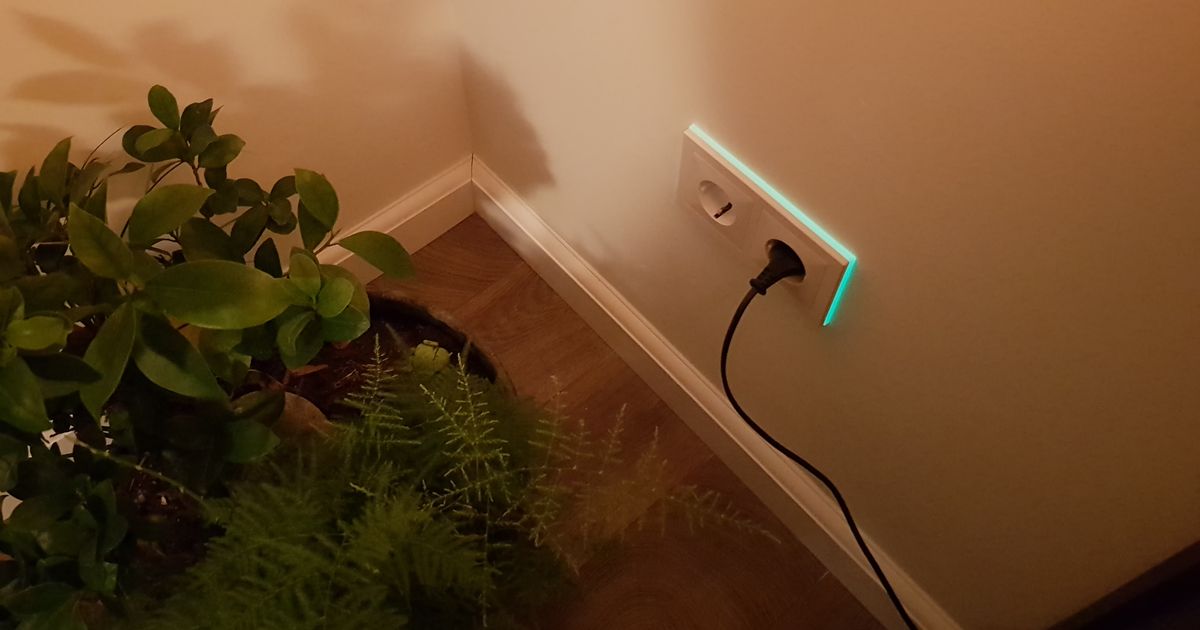
Signage, novelty and cosplay parts that glow after light exposure
PLA with 2–20 wt% phosphorescent additive; both Bambu Lab and Polymaker require a hardened nozzle, and Bambu Lab rules out the AMS lite and 0.2 mm nozzles.
Glow PLA adds phosphorescence: material exposed to light continues emitting visible light afterwards. Its role is therefore passive visual identification and decorative effects, rather than a mechanical improvement. Common uses include signage, novelty objects and cosplay. Because brightness depends on the amount of glowing material, a thin outline and a thick inset can give noticeably different results.
The useful effect fades after charging and depends on the viewing conditions, so ordinary glow filament should not be treated as a qualified emergency-sign material. The additive is abrasive, making nozzle wear a practical cost even for purely decorative printing. The underlying part still has PLA-like heat limits and can remain brittle.
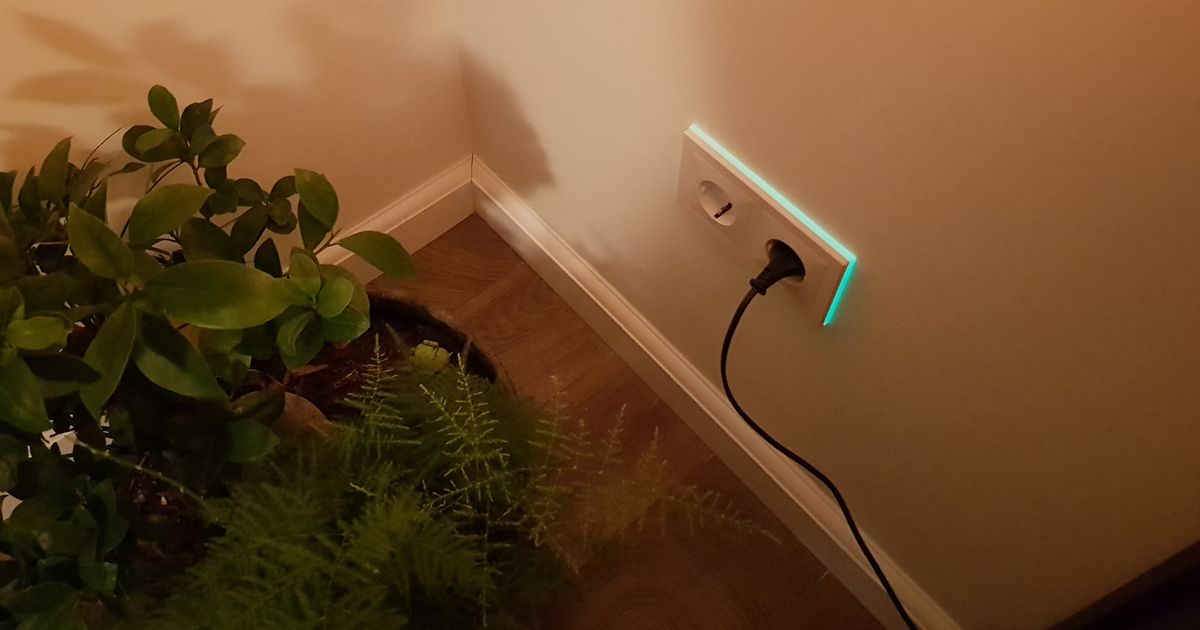
A glow-in-the-dark spacer behind a wall outlet. The uploader identifies ColorFabb glow PLA and 0.2 mm layers; the photograph shows it installed.
Listing note: “ColorFabb Glow in the dark PLA”
Printables listing uploaded by AcE Krystal · CC BY-SA 4.0Original listing · Checked 2026-10-17. This is an uploader report, not an independent material test.Source image · Image bytes unchanged; displayed in full. ShareAlike applies to adaptations.
Representative catalog values. Check the exact grade and its linked conditions before using a setting.
190–230 on the Bambu Lab TDS against 210–240 in its own material table; colorFabb advises 195–220
190–230 on the Bambu Lab TDS against 210–240 in its own material table; colorFabb advises 195–220
35–45 (Bambu Lab); 50–60 (colorFabb)
35–45 (Bambu Lab); 50–60 (colorFabb)
Open frame is fine
Open frame is fine
—
—
—Open a topic to explore the complete data. Each value keeps its original conditions, units and dated sources.
| Property and unit | Published value and conditions | Sources and dates |
|---|---|---|
| Base polymer / chemistry | PLA with a phosphorescent additive at 2–20 wt% (Bambu Lab SDS, filler not named) | 1 source
|
| Density (g/cm³) | 1.24 (colorFabb) to 1.26 (Bambu Lab), ISO 1183 | 2 sources
|
| Typical price (USD/kg) | 1 kg spools cluster near 25 | 2 sources
|
| Price range across brands (USD/kg) | 20–49 across brands; ELEGOO 20, Bambu Lab 25, Polymaker 25, Filament PM 49 on 0.5 kg spools | 4 sources
|
| Market availability (1–5) | Stocked by most mainstream brands | 3 sources
|
| Spool sizes & diameters | 1.75 and 2.85 mm; 0.75 and 1 kg spools | 2 sources
|
| Typical applications | Signage, novelty and cosplay parts that glow after light exposure | 1 source
|
| Property and unit | Published value and conditions | Sources and dates |
|---|---|---|
| Nozzle temperature (°C) | 190–230 on the Bambu Lab TDS against 210–240 in its own material table; colorFabb advises 195–220 | 3 sources
|
| Bed temperature (°C) | 35–45 (Bambu Lab); 50–60 (colorFabb) | 2 sources
|
| Enclosure / chamber requirement (1–5) | Open frame is fine | 1 source
|
| Part cooling fan | Fan on; colorFabb allows 0–100 % | 2 sources
|
| Overall printing difficulty (1–5) | Easy — minor profile tuning; a hardened nozzle is mandatory | 2 sources
|
| Extruder requirement | Bambu Lab: hardened steel and high-flow nozzles only, 0.2 mm excluded, AMS lite not compatible | 1 source
|
| Property and unit | Published value and conditions | Sources and dates |
|---|---|---|
| Nozzle hardness required (1–4) | Hardened steel required | 3 sources
|
| Abrasiveness (1–5) | Highly abrasive — the phosphor is a hard ceramic; Bambu Lab groups glow with carbon fibre as the materials that wear nozzles and grind AMS PTFE, and both Bambu Lab and Polymaker require a hardened nozzle | 2 sources
|
| Nozzle clog risk (1–5) | Moderate — needs dry filament and a clean nozzle | 1 source
|
| Hotend requirement | Hardened steel nozzle; Bambu Lab lists glow-in-the-dark among the filaments its hardened-steel nozzle exists for | 2 sources
|
| Other hardware wear | Bambu Lab reports the filament adds enough feeding resistance to fail prints on the AMS lite; colorFabb warns of brass nozzle wear | 2 sources
|
| Property and unit | Published value and conditions | Sources and dates |
|---|---|---|
| Moisture absorption (hygroscopicity) (1–5) | Moderate — 0.46 % saturated at 25 °C / 55 % RH | 1 source
|
| Equilibrium moisture content at ~50 % RH (%) | 0.46 saturated at 25 °C / 55 % RH (Bambu Lab) | 1 source
|
| Effect of moisture on strength | Polymaker rates PLA low-sensitivity and publishes no dry-versus-conditioned figures for this grade; absorbed water flashes to steam and shows as bubbling and poor layer adhesion | 1 source
|
| Property and unit | Published value and conditions | Sources and dates |
|---|---|---|
| Tensile strength (XY) (MPa) | 32 ± 3 printed XY, ISO 527 (Bambu Lab); colorFabb quotes 61.5 by ISO 527 on its own specimens | 2 sources
|
| Young's modulus (MPa) | 2030 ± 210 printed XY, ISO 527 (Bambu Lab); colorFabb 2960 | 2 sources
|
| Elongation at break (%) | 8.6 ± 1.2 printed XY, ISO 527 (Bambu Lab); colorFabb 10.5 at break | 2 sources
|
| Flexural strength (MPa) | 76 ± 4 printed XY, ISO 178 (Bambu Lab) | 1 source
|
| Flexural modulus (MPa) | 2640 ± 130 printed XY, ISO 178 (Bambu Lab); colorFabb 3295 | 2 sources
|
| Charpy impact, notched (kJ/m²) | 2.8 (colorFabb, ISO 179-1/1eA) and 8.8 ± 1.7 (Bambu Lab, ISO 179) printed XY, notched | 2 sources
|
| Other impact data | Charpy unnotched 27.3 (Bambu Lab) and 30.8 (colorFabb), printed, ISO 179 | 2 sources
|
| Layer adhesion / Z tensile (MPa) | 26 ± 3 printed Z, ISO 527 (Bambu Lab) | 1 source
|
| Brittleness (1–5) | Brittle — snaps with little warning | 1 source
|
| Creep resistance / sustained load (1–5) | Poor — no glow-grade creep test; plain printed PLA sagged from 12 to 16.2–21.8 mm over 5 days at 1.25 kg | 3 sources
|
| Fatigue / repeated-flex resistance (1–5) | Poor — no grade-specific S-N curve; plain printed PLA ran 38 000–49 000 cycles at 30 % of tensile strength and the glow filler leaves a brittle, highly abrasive compound | 2 sources |
| Elasticity / flexibility (1–5) | Rigid | 1 source
|
| Z strength as % of XY (%) | 81 by tensile, 72 by flexural (printed, Bambu Lab) | 1 source
|
| Property and unit | Published value and conditions | Sources and dates |
|---|---|---|
| HDT at 0.45 MPa (°C) | 55 (ISO 75, 0.45 MPa) | 1 source
|
| HDT at 1.8 MPa (°C) | 52 (ISO 75, 1.8 MPa) | 1 source
|
| Glass transition (Tg) (°C) | 55 (DSC) | 1 source
|
| Melting point / Vicat (°C) | 155 peak melt (DSC); colorFabb quotes above 155 by ISO 3146-C | 2 sources
|
| Property and unit | Published value and conditions | Sources and dates |
|---|---|---|
| UV resistance (1–5) | Degrades within weeks outdoors | 1 source
|
| Property and unit | Published value and conditions | Sources and dates |
|---|---|---|
| Fume toxicity (1–5) | Low hazard — minimal VOC and particle emission | |
| Ventilation / filtration requirement (1–5) | None needed in a normal room |
| Property and unit | Published value and conditions | Sources and dates |
|---|---|---|
| Support material pairing | Support for PLA (Bambu Lab) | 1 source
|
| Dimensional accuracy & detail | Glow brightness rises with wall thickness; 0.2 mm nozzles are not usable | 1 source
|
| Property and unit | Published value and conditions | Sources and dates |
|---|---|---|
| Soluble in | Chloroform dissolves the PLA matrix (10 % w/v, 2–4 h at 23 °C) and leaves the filler as loose sludge; laboratory reagent. | 1 source |
| Softened or crazed by | Acetone, ethyl acetate and toluene plasticise the matrix but dissolve <1 % even at 65 °C; acetone submersion crazes parts. | 2 sources
|
| Solvent welding & smoothing agent | Chloroform vapour attacks only the resin fraction, so the filler is left standing proud; no workshop-safe agent exists. | 2 sources |
Values describe representative grades, not every spool. Manufacturer datasheets and independent tests retain their source labels and dates. Printed orientation, test method, conditioning and formulation can change results. Unknown values are —. A listed use is not a certification. Shore A, Shore D and Rockwell hardness are separate scales.
Historical USD/kg snapshots. Read each listing’s sale/from qualifiers, spool mass, source date, shipping and tax notes. Product figures are separate from the material summary.
$19.99 / 1 kg spool, us.elegoo.com product catalogue, Aug 2026
Handle pla-glow. ELEGOO publishes printed X-Y and Z strength figures without naming a test standard, so they are recorded here rather than as specs: tensile 42 ± 2 MPa XY / 30 ± 1 MPa Z, impact 34.9 ± 3.2 kJ/m² XY.
Open product listing ↗| Density (g/cm³) | 1.24 (ELEGOO published spec table) |
|
|---|---|---|
| Nozzle temperature (°C) | 190–230 |
|
| Bed temperature (°C) | 35–65 |
|
| Recommended chamber temperature (°C) | 20–45 |
|
| Nozzle hardness required (1–4) | Hardened steel required, 0.4 mm or larger |
|
| Drying temperature & time | 50 ± 5 °C for 8 h; drying required |
|
| Elongation at break (%) | 7.2 ± 0.6 (printed XY); 5.3 printed Z |
|
| HDT at 0.45 MPa (°C) | 56 (0.45 MPa) |
|
| Melting point / Vicat (°C) | 157 melting; Vicat 57 |
|
$24.99 / 1 kg spool, us.store.bambulab.com, Aug 2026
Hardened steel nozzle required; not compatible with the AMS lite or a 0.2 mm nozzle.
Open product listing ↗| Density (g/cm³) | 1.26 (ISO 1183) |
|
|---|---|---|
| Nozzle temperature (°C) | 190–230 |
|
| Bed temperature (°C) | 35–45 |
|
| Nozzle hardness required (1–4) | Hardened steel required |
|
| Equilibrium moisture content at ~50 % RH (%) | 0.46 saturated at 25 °C / 55 % RH |
|
| Tensile strength (XY) (MPa) | 32 ± 3 (printed XY, ISO 527) |
|
| Young's modulus (MPa) | 2030 ± 210 (printed XY, ISO 527); Z 1750 |
|
| Elongation at break (%) | 8.6 ± 1.2 (printed XY, ISO 527); Z 6.5 |
|
| Flexural strength (MPa) | 76 ± 4 (printed XY, ISO 178); Z 55 |
|
| Flexural modulus (MPa) | 2640 ± 130 (printed XY, ISO 178); Z 2230 |
|
| Charpy impact, notched (kJ/m²) | 8.8 ± 1.7 (printed XY, ISO 179, notched) |
|
| Other impact data | Charpy unnotched 27.3 kJ/m² XY, 19.8 kJ/m² Z (printed, ISO 179) |
|
| Layer adhesion / Z tensile (MPa) | 26 ± 3 (printed Z, ISO 527) |
|
| Z strength as % of XY (%) | 81 (printed Z 26 vs XY 32, ISO 527) |
|
| HDT at 0.45 MPa (°C) | 55 (ISO 75, 0.45 MPa) |
|
| HDT at 1.8 MPa (°C) | 52 (ISO 75, 1.8 MPa) |
|
| Glass transition (Tg) (°C) | 55 (DSC) |
|
| Melting point / Vicat (°C) | 155 melting (DSC); Vicat 56 (ISO 306) |
|
$24.99 / 1 kg spool, shop.polymaker.com, Aug 2026
Product page states the glow additives require a hardened nozzle to prevent excessive wear.
Open product listing ↗| Spool sizes & diameters | 1 kg spool; 1.75 mm |
|
|---|---|---|
| Nozzle temperature (°C) | 190–230 (all Panchroma colour ranges) |
|
| Bed temperature (°C) | 25–60 (all Panchroma colour ranges) |
|
| Nozzle hardness required (1–4) | Hardened steel required |
|
| Drying temperature & time | 55 °C for 6 h (all Panchroma colour ranges) |
|
$24.99 / 1 kg spool, Polymaker product catalogue, Aug 2026
Handle glow-pla. Older packaging listed at $19.99.
Open product listing ↗| Spool sizes & diameters | 1 kg spool; 1.75 mm |
|
|---|---|---|
| Nozzle temperature (°C) | 190–230 (all Panchroma colour ranges) |
|
| Bed temperature (°C) | 25–60 (all Panchroma colour ranges) |
|
| Drying temperature & time | 55 °C for 6 h (all Panchroma colour ranges) |
|
EUR 22.76 incl. 21 % VAT / 0.5 kg spool = EUR 45.52/kg = $49.16/kg at 1.08 USD/EUR, shop.filament-pm.com, Aug 2026
10 % photoluminescent masterbatch in PLA. Diameter tolerance is twice as loose as the maker's unfilled PLA.
Open product listing ↗| Density (g/cm³) | 1.24 (ISO 1183/B) |
|
|---|---|---|
| Diameter tolerance (± mm) | 0.1 |
|
| Nozzle temperature (°C) | 200–220 |
|
| Bed temperature (°C) | 60 |
|
| Flexural modulus (MPa) | 3500 (ISO 178) |
|
| Other impact data | 16 kJ/m² impact strength, ISO 179 (notch type and specimen not stated) |
|
| HDT at 0.45 MPa (°C) | 55 (ISO 75, load not stated) |
|
| Melting point / Vicat (°C) | 55 (Vicat, ISO 306) |
|
PLA with a raised melt index and tuned crystallisation so it can be extruded at roughly 24 mm³/s, about 30 % more flow than…
10 product listingsPLA compounded with a chalk-type mineral filler for a diffuse finish; density rises to 1.31–1.38 g/cm³ and flexural strength…
10 product listings
A familiar starting point for models, prototypes and everyday prints at room temperature.
25 product listings