3D Printing Info
Where it is used
Stiff jigs, drone and RC frames, tool holders — matte black finish, no gain in tensile strength
Sources
- Bambu Filament Technical Data Sheet V4.0 — PLA-CF · 2026-08 · tds
- PolyLite PLA-CF Technical Data Sheet V5.4 · 2024-11 · tds
PLA with 5–10 wt% chopped carbon fibre: stiffness rises by roughly a third and the surface goes matte black, while tensile strength and Z strength fall below unfilled PLA and a hardened…
Open in interactive comparison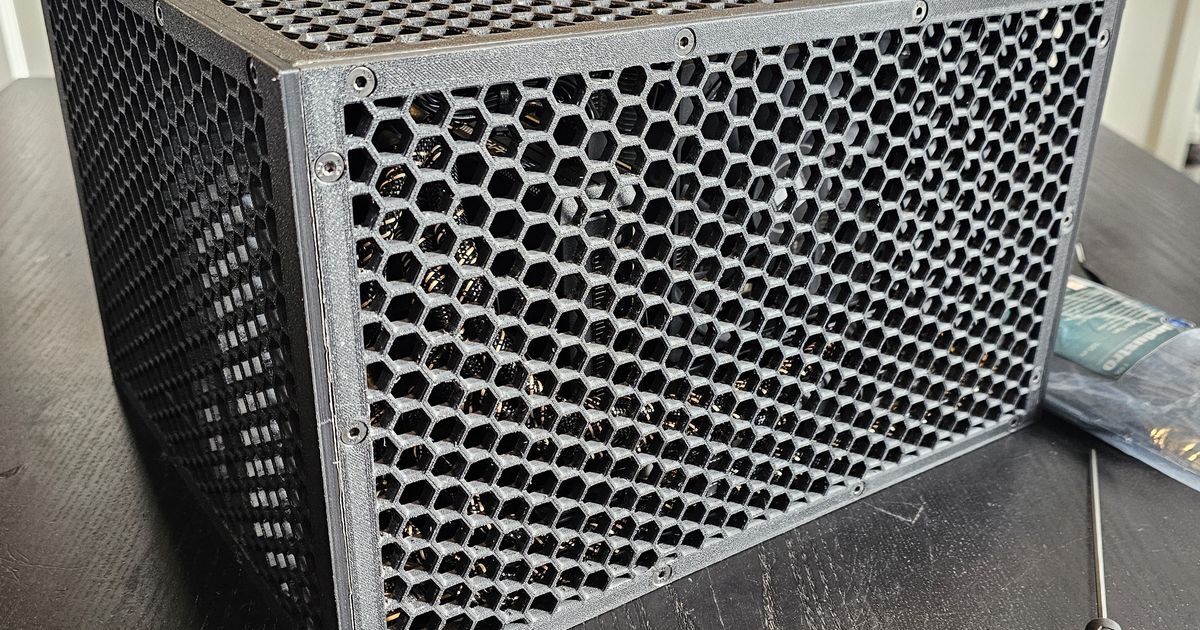
Stiff jigs, drone and RC frames, tool holders — matte black finish, no gain in tensile strength
PLA with 5–10 wt% chopped carbon fibre: stiffness rises by roughly a third and the surface goes matte black, while tensile strength and Z strength fall below unfilled PLA and a hardened nozzle becomes mandatory.
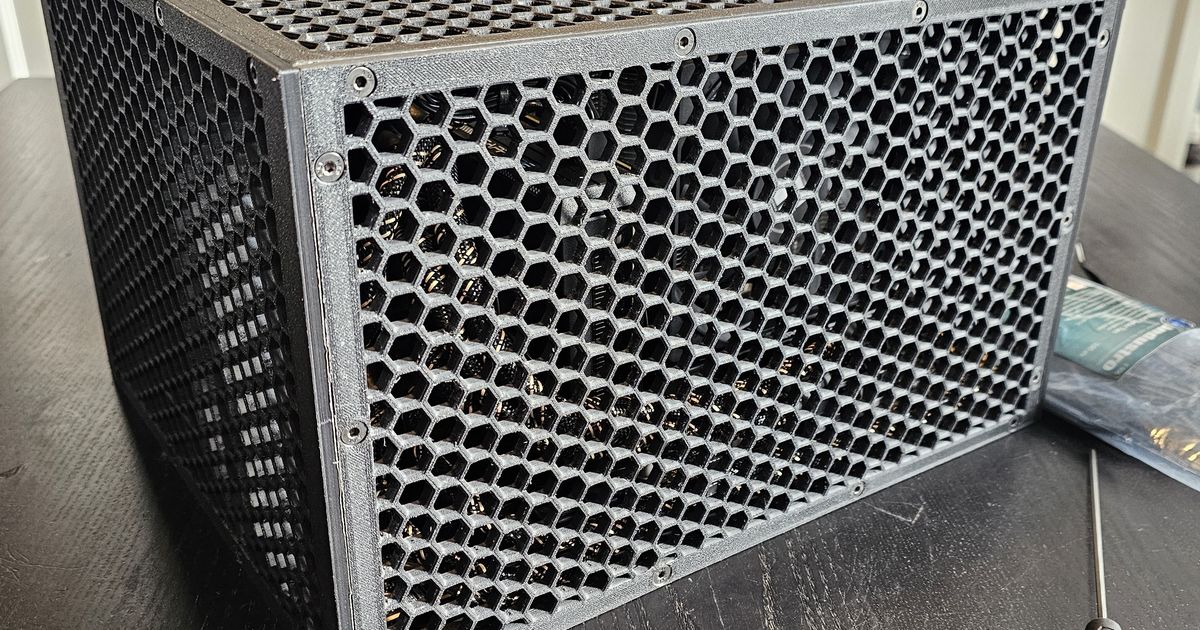
Chopped carbon fibre makes PLA useful where stiffness and a matte surface matter more than toughness. The higher modulus reduces elastic deflection for a given part geometry; the textured finish can also make visible panels look more uniform. The compact ATX case in the gallery was explicitly printed in PLA-CF for its finish, a more defensible interpretation than assuming the fibre was needed for strength.
Tensile strength and strength across layers do not necessarily improve, and brittle failure remains a concern. Fibre-filled PLA also retains the base polymer’s heat and creep limitations. Its engineering role is therefore a stiff, easily produced composite part within those limits, rather than a substitute for continuous-fibre laminates or a high-temperature nylon composite. The abrasive filler additionally requires wear-resistant printing hardware.
An assembled compact ATX computer case. The uploader reports using PLA-CF for the printed panels; the assembly also contains standard PC hardware.
Listing note: “I used PLA-CF for the finish.”
Printables listing uploaded by Fetetert · CC BY 4.0Original listing · Checked 2026-10-17. This is an uploader report, not an independent material test.Source image · Image bytes unchanged; displayed in full.
Representative catalog values. Check the exact grade and its linked conditions before using a setting.
210–240 (Bambu Lab); 190–230 (Polymaker)
210–240 (Bambu Lab); 190–230 (Polymaker)
35–45 (Bambu Lab); 25–60 (Polymaker)
35–45 (Bambu Lab); 25–60 (Polymaker)
Open frame is fine
55 °C for 6–8 h
55 °C for 6–8 h
Open a topic to explore the complete data. Each value keeps its original conditions, units and dated sources.
| Property and unit | Published value and conditions | Sources and dates |
|---|---|---|
| Base polymer / chemistry | PLA filled with chopped carbon fibre — 5–10 wt% (Bambu Lab SDS), 8 wt% (Polymaker) | 2 sources
|
| Density (g/cm³) | 1.22 (Bambu Lab) to 1.29 (Polymaker, 3DXTech), ISO 1183 | 3 sources
|
| Typical price (USD/kg) | 1 kg spools span 19–80; the middle of the market is about 31 | 5 sources
|
| Price range across brands (USD/kg) | 19–80 across brands; IEMAI 19, LANDU 24, SUNLU 27, Polymaker 30, Bambu Lab 32, 3DXTech 47, Proto-pasta 80 | 7 sources
|
| Market availability (1–5) | Stocked by most mainstream brands | 4 sources
|
| Spool sizes & diameters | 1.75 and 2.85 mm; 0.5, 0.75, 1 and 3 kg spools | 3 sources
|
| Typical applications | Stiff jigs, drone and RC frames, tool holders — matte black finish, no gain in tensile strength | 2 sources
|
| Diameter tolerance (± mm) | ±0.03 (Bambu Lab) | 1 source
|
| Property and unit | Published value and conditions | Sources and dates |
|---|---|---|
| Nozzle temperature (°C) | 210–240 (Bambu Lab); 190–230 (Polymaker) | 2 sources
|
| Bed temperature (°C) | 35–45 (Bambu Lab); 25–60 (Polymaker) | 2 sources
|
| Enclosure / chamber requirement (1–5) | Open frame is fine | 1 source
|
| Part cooling fan | Fan on | 2 sources
|
| Maximum volumetric flow (mm³/s; see test conditions) (mm³/s) | 16 at Bambu Lab's 200 mm/s cap and 24 at Polymaker's 300 mm/s, on a 0.4 mm nozzle at 0.2 mm layer; Bambu Lab's own filament guide says 250 mm/s where its TDS says 200 | 4 sources
|
| Warping tendency (1–5) | None | 1 source
|
| Stringing / oozing tendency (1–5) | Slight | 1 source
|
| Overall printing difficulty (1–5) | Easy — minor profile tuning; needs a hardened nozzle and 0.4 mm or larger | 2 sources
|
| Extruder requirement | Nozzles below 0.4 mm are not compatible (Bambu Lab) | 1 source
|
| Property and unit | Published value and conditions | Sources and dates |
|---|---|---|
| Nozzle hardness required (1–4) | Hardened steel required | 2 sources
|
| Abrasiveness (1–5) | Highly abrasive — standard CF composite | 2 sources
|
| Nozzle clog risk (1–5) | Moderate — needs dry filament and a clean nozzle | 1 source
|
| Hotend requirement | Hardened steel nozzle; Bambu Lab lists PLA-CF among the filaments its hardened-steel nozzle exists for | 2 sources
|
| Other hardware wear | Bambu Lab reports AMS wear; Polymaker advises against running PLA-CF through an AMS at all | 2 sources
|
| Property and unit | Published value and conditions | Sources and dates |
|---|---|---|
| Moisture absorption (hygroscopicity) (1–5) | Moderate — 0.42 % saturated at 25 °C / 55 % RH (Bambu Lab); 0.38 % equilibrium (Polymaker) | 2 sources
|
| Equilibrium moisture content at ~50 % RH (%) | 0.42 saturated at 25 °C / 55 % RH (Bambu Lab); 0.38 equilibrium (Polymaker) | 2 sources
|
| Drying temperature & time | 55 °C for 6–8 h | 2 sources
|
| Effect of moisture on strength | Polymaker rates PLA low-sensitivity and publishes no dry-versus-conditioned figures for this grade; absorbed water flashes to steam and shows as bubbling and poor layer adhesion | 1 source
|
| Property and unit | Published value and conditions | Sources and dates |
|---|---|---|
| Tensile strength (XY) (MPa) | 31.2 (Polymaker) to 38 (Bambu Lab) printed XY, ISO 527; 48 at break for 3DXTech | 3 sources
|
| Young's modulus (MPa) | 2790 (Bambu Lab) to 3281 (Polymaker) printed XY, ISO 527; 4950 for 3DXTech | 3 sources
|
| Elongation at break (%) | 8.4 (Bambu Lab) and 13.2 (Polymaker) printed XY, ISO 527; 2 for 3DXTech | 3 sources
|
| Flexural strength (MPa) | 51.7 (Polymaker) to 89 (Bambu Lab) printed XY, ISO 178 | 2 sources
|
| Flexural modulus (MPa) | 3381 (Polymaker) to 3950 (Bambu Lab) printed XY, ISO 178; 6320 for 3DXTech | 3 sources
|
| Charpy impact, notched (kJ/m²) | 5.5 (Polymaker) and 7.6 (Bambu Lab) printed XY, ISO 179, notched | 2 sources
|
| Other impact data | Charpy unnotched 23.2 printed XY (Bambu Lab, ISO 179) | 1 source
|
| Layer adhesion / Z tensile (MPa) | 15.1 (Polymaker) to 26 (Bambu Lab) printed Z, ISO 527 | 2 sources
|
| Brittleness (1–5) | Brittle — snaps with little warning; elongation in Z falls to 0.9 % (Polymaker) | 2 sources
|
| Hardness (scale-specific) (Shore A / Shore D / Rockwell) | 71.5 Shore D measured on printed bars for Sunlu CF PLA (My Tech Fun), against 75.3 for the same maker's unfilled PLA | 1 source |
| Creep resistance / sustained load (1–5) | Poor — 12 mm bars sagged to 15.1, 19.8 and 21.3 mm over 5 days at 1.25 kg across three brands, against 16.2–21.8 mm for their unfilled PLA | 3 sources
|
| Fatigue / repeated-flex resistance (1–5) | Poor — no CF-grade S-N curve; plain printed PLA ran 38 000–49 000 cycles at 30 % of tensile strength and elongation in Z falls to 0.9 % | 2 sources |
| Elasticity / flexibility (1–5) | Rigid | 1 source
|
| Z strength as % of XY (%) | 48 (Polymaker) to 68 (Bambu Lab), printed | 2 sources
|
| Property and unit | Published value and conditions | Sources and dates |
|---|---|---|
| HDT at 0.45 MPa (°C) | 54 (Polymaker) to 55 (Bambu Lab), ISO 75 at 0.45 MPa | 2 sources
|
| HDT at 1.8 MPa (°C) | 50 (Polymaker) to 54 (Bambu Lab), ISO 75 at 1.8 MPa | 2 sources
|
| Glass transition (Tg) (°C) | 62–63 (DSC) | 2 sources
|
| Melting point / Vicat (°C) | 162–165 peak melt (DSC); Vicat 64 °C (Polymaker) | 2 sources
|
| Continuous service temperature (°C) | 50–61 — loaded bars begin to move at this temperature across three brands (Sunlu 50, Bambu Lab and Polymaker 61) | 3 sources
|
| Property and unit | Published value and conditions | Sources and dates |
|---|---|---|
| UV resistance (1–5) | Degrades within weeks outdoors | 1 source
|
| Chemical resistance | Good against weak acids, oils and grease; poor against strong acids and alkalis | 1 source
|
| Property and unit | Published value and conditions | Sources and dates |
|---|---|---|
| Fume toxicity (1–5) | Low hazard — minimal VOC and particle emission | |
| Ventilation / filtration requirement (1–5) | None needed in a normal room | |
| Dust & fibre handling hazard | Carbon fibre is bound in the matrix; sanding dust should not be inhaled | 1 source
|
| Property and unit | Published value and conditions | Sources and dates |
|---|---|---|
| Support material pairing | Support for PLA (Bambu Lab); PolySupport and PolyDissolve S1 (Polymaker) | 2 sources
|
| Dimensional accuracy & detail | Matte finish hides layer lines; stiffness is the gain — tensile strength stays at or below Bambu Lab PLA Basic's 35 MPa and Polymaker PolyLite PLA's 52.3 MPa | 4 sources
|
| Property and unit | Published value and conditions | Sources and dates |
|---|---|---|
| Soluble in | Chloroform dissolves the PLA matrix (10 % w/v, 2–4 h at 23 °C) and leaves the filler as loose sludge; laboratory reagent. | 1 source |
| Softened or crazed by | Acetone, ethyl acetate and toluene plasticise the matrix but dissolve <1 % even at 65 °C; acetone submersion crazes parts. | 2 sources
|
| Solvent welding & smoothing agent | Chloroform vapour attacks only the resin fraction, so the filler is left standing proud; no workshop-safe agent exists. | 2 sources |
Values describe representative grades, not every spool. Manufacturer datasheets and independent tests retain their source labels and dates. Printed orientation, test method, conditioning and formulation can change results. Unknown values are —. A listed use is not a certification. Shore A, Shore D and Rockwell hardness are separate scales.
Historical USD/kg snapshots. Read each listing’s sale/from qualifiers, spool mass, source date, shipping and tax notes. Product figures are separate from the material summary.
$19.00 / 1 kg spool, store.iemai3d.com, Aug 2026 (regular price $22.00)
TDS reports printed XY and Z figures separately.
Open product listing ↗| Density (g/cm³) | 1.22 (ISO 1183) |
|
|---|---|---|
| Tensile strength (XY) (MPa) | 38 +/- 4 (printed XY, ISO 527) |
|
| Young's modulus (MPa) | 2790 +/- 120 (printed XY, ISO 527) |
|
| Elongation at break (%) | 8.4 +/- 3.2 (printed XY, ISO 527) |
|
| Charpy impact, notched (kJ/m²) | 7.6 +/- 2.6 (printed XY, ISO 179, notched) |
|
| Layer adhesion / Z tensile (MPa) | 26 +/- 2 (printed Z, ISO 527) |
|
| HDT at 1.8 MPa (°C) | 54 (ISO 75, 1.8 MPa) |
|
| Glass transition (Tg) (°C) | 63 (DSC) |
|
$23.99 / 1 kg cardboard spool, Amazon US listing, Aug 2026
Amazon-only brand. Vendor specifies a hardened steel nozzle of 0.4 mm or larger.
Open product listing ↗| Spool sizes & diameters | 1 kg spool; 1.75 mm |
|
|---|---|---|
| Diameter tolerance (± mm) | +/-0.02 |
|
| Nozzle temperature (°C) | 210-230 |
|
| Bed temperature (°C) | 50-60 |
|
| Nozzle hardness required (1–4) | Hardened steel required, 0.4 mm or larger |
|
| Storage requirement | Store in a cool dry place or a resealable bag; supplied vacuum-sealed with desiccant |
|
$26.99 / 1 kg spool at the listing's 3 kg minimum order, store.sunlu.com, Aug 2026 (single-roll list price $32.99)
15 % carbon fibre. Minimum order 3 kg.
Open product listing ↗| Base polymer / chemistry | PLA filled with 15 % carbon fibre |
|
|---|---|---|
| Spool sizes & diameters | 1 kg spool; 1.75 mm |
|
| Diameter tolerance (± mm) | +/-0.02 |
|
| Nozzle temperature (°C) | 190-230 |
|
| Bed temperature (°C) | 60-80 |
|
| Drying temperature & time | 50 °C for 6–8 h (recommended) |
$29.99 / 1 kg spool, shop.polymaker.com, Aug 2026
8 wt% carbon fibre. Polymaker advises against running it through an AMS.
Open product listing ↗| Density (g/cm³) | 1.29 (ISO 1183) |
|
|---|---|---|
| Tensile strength (XY) (MPa) | 31.2 ± 0.7 (printed XY, ISO 527) |
|
| Young's modulus (MPa) | 3280.7 ± 79.6 (printed XY, ISO 527) |
|
| Layer adhesion / Z tensile (MPa) | 15.1 ± 0.7 (printed Z, ISO 527) |
|
$31.99 / 1 kg spool, us.store.bambulab.com, Aug 2026
5–10 wt% carbon fibre per the SDS. Hardened steel nozzle required; 0.2 mm not compatible.
Open product listing ↗| Density (g/cm³) | 1.22 (ISO 1183) |
|
|---|---|---|
| Diameter tolerance (± mm) | ±0.03 |
|
| Tensile strength (XY) (MPa) | 38 ± 4 (printed XY, ISO 527) |
|
| Charpy impact, notched (kJ/m²) | 7.6 ± 2.6 (printed XY, ISO 179, notched) |
|
$34.99 / 1 kg spool, proto-pasta.com product catalogue, Aug 2026
Handle carbon-fiber-recycled-pla. Recycled carbon-fibre feedstock.
Open product listing ↗| Spool sizes & diameters | 50 g coil, 1 kg spool and 6x1 kg case; 1.75 mm |
|
|---|---|---|
| Nozzle temperature (°C) | 195–225 | |
| Bed temperature (°C) | 50–60 | |
| Nozzle hardness required (1–4) | Hardened steel required |
|
| Drying temperature & time | Dry below 50 °C; drying usually unnecessary |
$35.00 / 750 g spool = $46.67/kg, 3dxtech.com, Aug 2026
Tensile modulus 4950 MPa and flexural modulus 6320 MPa, the stiffest of the group.
Open product listing ↗| Tensile strength (XY) (MPa) | 48 at break (ISO 527) |
|
|---|---|---|
| Young's modulus (MPa) | 4950 (ISO 527) |
|
| Elongation at break (%) | 2 (ISO 527) |
|
| Flexural modulus (MPa) | 6320 (ISO 178) |
|
$39.99 / 500 g spool = $79.98/kg; 1 kg spool $79.99, proto-pasta.com, Aug 2026
Annealable high-temperature PLA base.
Open product listing ↗| Density (g/cm³) | 1.3 (manufacturer figure) |
|
|---|---|---|
| Nozzle temperature (°C) | 205 (manufacturer profile) |
|
| Bed temperature (°C) | 60 |
|
| Maximum volumetric flow (mm³/s; see test conditions) (mm³/s) | 2–4 (manufacturer profile, 0.65 mm extrusion width) |
|
| Glass transition (Tg) (°C) | 60 onset (heat-treatable HTPLA) |
|
| Melting point / Vicat (°C) | 155 melting onset |
|
Listed $29.99/1 kg; regular price unknown. Micro Center (Tustin, CA), 2026-10-17; excludes tax/shipping.
Carbon-fiber-filled PLA according to retailer designation. Fiber percentage and mechanical measurements are not documented here.
Open product listing ↗| Spool sizes & diameters | 1 kg spool; 1.75 mm diameter (retailer listing) |
|---|
PLA with a raised melt index and tuned crystallisation so it can be extruded at roughly 24 mm³/s, about 30 % more flow than…
10 product listingsPLA compounded with a chalk-type mineral filler for a diffuse finish; density rises to 1.31–1.38 g/cm³ and flexural strength…
10 product listings
A familiar starting point for models, prototypes and everyday prints at room temperature.
25 product listings