3D Printing Info
Where it is used
Functional parts, enclosures and outdoor fittings that need more toughness and heat tolerance than PLA
Sources
- Prusament PETG Technical Datasheet v1.1 · 2022-02 · tds
- PolyLite PETG Technical Data Sheet · 2026-08 · tds
A practical step up from PLA for tougher functional parts. Expect a little more tuning.
Open in interactive comparison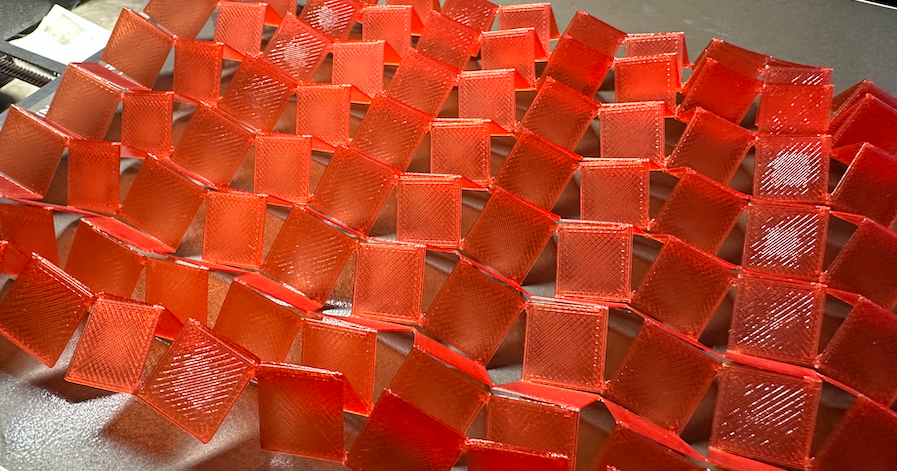
Functional parts, enclosures and outdoor fittings that need more toughness and heat tolerance than PLA
The default step up from PLA: tougher, tolerant to about 70 °C, and printable on an open frame, at the cost of stringing and a tendency to weld itself to bare PEI.
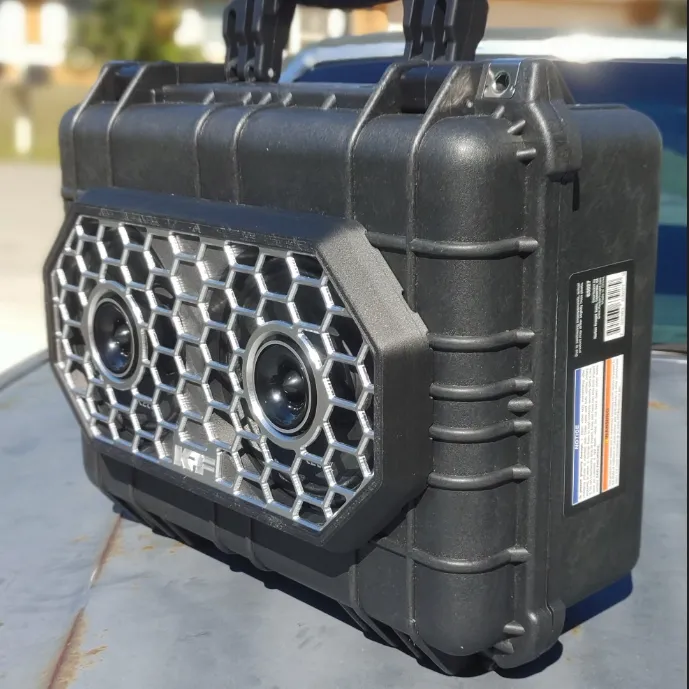
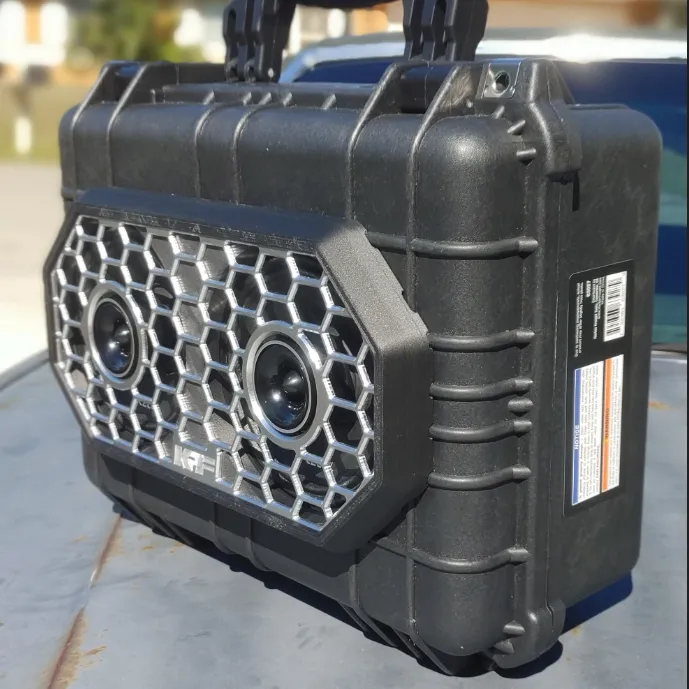
PETG is a useful general-purpose engineering filament for housings, holders, clamps and machine accessories that need some toughness without demanding an enclosed printer. Its relatively low printing shrinkage helps mating parts retain their shape, and its ductility allows modest deformation before fracture. Prusa uses PETG for plastic components on the Original Prusa i3 MK3, providing a real production example rather than just a suggested use.
The same compliance that helps during handling makes PETG a weaker choice for permanently loaded precision fixtures: it creeps, especially as temperature rises. It also strings and bonds aggressively to some build surfaces. Use the actual grade’s heat-deflection data rather than treating all PETG parts as suitable for a hot enclosure.
FDM · Unfilled PETG; Original Prusa i3 MK3 · Documented case
Prusa states that the machine’s plastic parts are made from PETG, using its toughness and low-warp printing for functional printer hardware. This identifies the polymer; it does not establish recycled PETG or carbon-filled PETG use.
FDM · Prusament PETG · Manufacturer-listed applications
Prusa specifically lists holders and clamps as PETG applications. Moderate ductility and low printing warp suit fitted mechanical accessories, while sustained clamping still needs allowance for creep.
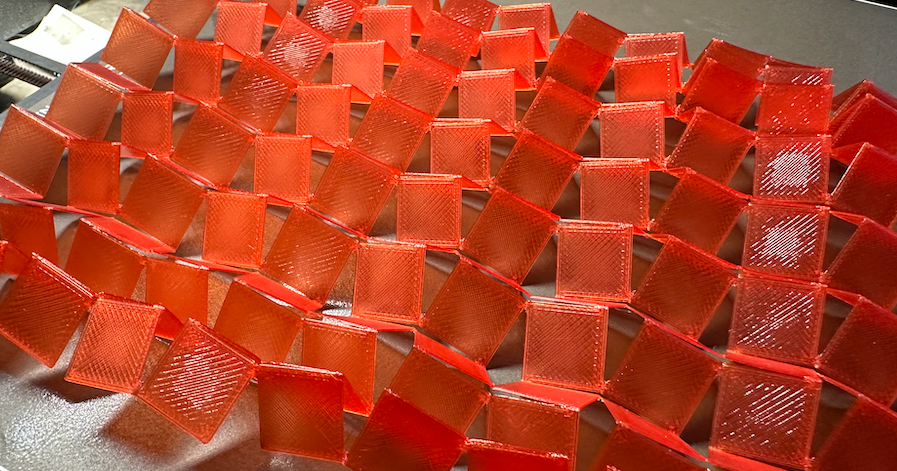
A two-layer PETG sheet folds into a three-dimensional structure. The uploader describes this as their MK4 print.
Listing note: “Print .2mm layers with a .4mm nozzle in PETG.”
Printables listing uploaded by geektoybox · CC BY 4.0Original listing · Checked 2026-10-17. This is an uploader report, not an independent material test.Source image · Image bytes unchanged; displayed in full.
Representative catalog values. Check the exact grade and its linked conditions before using a setting.
230–260 across brands; Prusament 250 ± 10, Polymaker 240–260
230–260 across brands; Prusament 250 ± 10, Polymaker 240–260
60–90; Prusament 80 ± 10, Polymaker 60–70
60–90; Prusament 80 ± 10, Polymaker 60–70
Open frame is fine
60–65 °C for 6–8 h
60–65 °C for 6–8 h
Open a topic to explore the complete data. Each value keeps its original conditions, units and dated sources.
| Property and unit | Published value and conditions | Sources and dates |
|---|---|---|
| Base polymer / chemistry | Polyethylene terephthalate glycol copolymer — PET with a glycol comonomer that suppresses crystallisation | 2 sources
|
| Density (g/cm³) | 1.24–1.30 (ISO 1183) | 4 sources
|
| Typical price (USD/kg) | 1 kg spools cluster near 20 | 3 sources
|
| Price range across brands (USD/kg) | 12–70 across brands; IEMAI 12, ELEGOO 14, CHCKX 14, Bambu Lab 18–20, Hatchbox 26, Prusament 38, Prusament PETG V0 70 | 6 sources
|
| Market availability (1–5) | Ubiquitous, every brand and retailer | 4 sources
|
| Spool sizes & diameters | 1.75 and 2.85 mm; 0.75, 0.8 and 1 kg spools plus spool-less refills | 2 sources
|
| Typical applications | Functional parts, enclosures and outdoor fittings that need more toughness and heat tolerance than PLA | 2 sources
|
| Diameter tolerance (± mm) | ±0.02 (Prusament) | 1 source
|
| Property and unit | Published value and conditions | Sources and dates |
|---|---|---|
| Nozzle temperature (°C) | 230–260 across brands; Prusament 250 ± 10, Polymaker 240–260 | 3 sources
|
| Bed temperature (°C) | 60–90; Prusament 80 ± 10, Polymaker 60–70 | 2 sources
|
| Enclosure / chamber requirement (1–5) | Open frame is fine | 1 source
|
| Part cooling fan | Around 50 %; Polymaker specifies 20–60 %, less than PLA to protect layer bonding | 2 sources
|
| Bed surface & adhesion aid | Textured PEI, satin or powder-coated sheets. On smooth PEI a glue stick is used as a release agent, not an adhesive — PETG bonds to bare PEI hard enough to tear the sheet | 2 sources
|
| Maximum volumetric flow (mm³/s; see test conditions) (mm³/s) | 8–15 (PrusaSlicer guidance); My Tech Fun ran Bambu Lab PETG Basic at 13 mm³/s | 2 sources
|
| Warping tendency (1–5) | Slight — corner lift on large flat parts | 2 sources
|
| Bed-adhesion difficulty (1–5) | Needs the right surface or a thin adhesive — the problem is releasing the part, not sticking it | 1 source
|
| Stringing / oozing tendency (1–5) | Moderate — retraction tuning needed | 2 sources
|
| Overall printing difficulty (1–5) | Easy — minor profile tuning | 1 source
|
| Property and unit | Published value and conditions | Sources and dates |
|---|---|---|
| Nozzle hardness required (1–4) | Brass fine indefinitely | 1 source
|
| Abrasiveness (1–5) | Non-abrasive | 1 source
|
| Nozzle clog risk (1–5) | Low — no special hot-end required and clogging is not among the listed drawbacks; Prusa lists no drybox and no hardened nozzle | 2 sources
|
| Heat-creep / jam sensitivity (1–5) | Slightly sensitive | 1 source
|
| Hotend requirement | No special hot-end required | 1 source
|
| Property and unit | Published value and conditions | Sources and dates |
|---|---|---|
| Moisture absorption (hygroscopicity) (1–5) | Moderate (0.3–0.8 %) — Bambu Lab reports 0.40 % saturated at 25 °C / 55 % RH; Prusa measures only 0.07 % in 24 h and 0.10 % in 7 days at the drier 22 % RH | 2 sources
|
| Equilibrium moisture content at ~50 % RH (%) | 0.10 after 7 days at 24 °C / 22 % RH (Prusa Polymers); 0.40 saturated at 25 °C / 55 % RH (Bambu Lab) | 2 sources
|
| Drying temperature & time | 60–65 °C for 6–8 h | 2 sources
|
| Symptoms when wet | Bubbling and popping at the nozzle, stringing and a rough surface | 1 source
|
| Effect of moisture on strength | Polymaker groups PETG with nylon, PVA and TPU as highly hygroscopic and shows a before-and-after-drying comparison; the loss appears as poor layer adhesion and weak, brittle layers rather than a published dry-versus-conditioned figure | 1 source
|
| Storage requirement | Sealed with desiccant; Polymaker groups PETG with the highly hygroscopic materials | 2 sources
|
| Property and unit | Published value and conditions | Sources and dates |
|---|---|---|
| Tensile strength (XY) (MPa) | 38–51 (printed XY, ISO 527); Prusament 47 ± 2 at yield; 62 on My Tech Fun 4×4 mm bars | 4 sources
|
| Young's modulus (MPa) | 1500–2311 (printed XY, ISO 527) | 4 sources
|
| Elongation at break (%) | 5.2–9.3 at break (printed XY, ISO 527); Prusament 5.1 at yield | 4 sources
|
| Flexural strength (MPa) | 58–80 (printed XY, ISO 178); Prusament 66 ± 2 | 4 sources
|
| Flexural modulus (MPa) | 1068–2277 (printed XY, ISO 178) | 4 sources
|
| Charpy impact, notched (kJ/m²) | 2.6 (PolyLite) to 11.6 (PolyMax) printed XY, ISO 179, notched; Prusament 6 ± 1 | 3 sources
|
| Other impact data | Charpy unnotched does not break on Prusa's 4 J pendulum (ISO 179-1); Izod 3.37 kJ/m² on My Tech Fun printed bars | 2 sources
|
| Layer adhesion / Z tensile (MPa) | 18 ± 4 (Prusa interlayer adhesion test); 42.8 printed Z for PolyLite PETG; 33 on My Tech Fun bars | 3 sources
|
| Brittleness (1–5) | Moderate | 2 sources
|
| Hardness (scale-specific) (Shore A / Shore D / Rockwell) | 74 Shore D (Prusa Polymers method); measured on printed bars at 68.2 for Extrudr PETG, 72 for Fiberlogy PETG and 72.8 for Prusament PETG | 4 sources
|
| Creep resistance / sustained load (1–5) | Below average — a 12 mm bar sagged to 18.2 mm (Fiberlogy) and 19.4 mm (Bambu Lab Basic) over 5 days at 1.25 kg | 2 sources
|
| Fatigue / repeated-flex resistance (1–5) | Moderate — 79 000–193 000 cycles at 30 % of tensile strength, about three times printed PLA (R = 0.2, 7 Hz) | |
| Elasticity / flexibility (1–5) | Slightly flexible in thin sections | 1 source
|
| Z strength as % of XY (%) | 84 (PolyLite, printed Z against XY tensile) | 1 source
|
| Property and unit | Published value and conditions | Sources and dates |
|---|---|---|
| HDT at 0.45 MPa (°C) | 68 (Prusament) to 78 (PolyLite), ISO 75 at 0.45 MPa | 3 sources
|
| HDT at 1.8 MPa (°C) | 65 (Polymaker) to 75 (PolyLite), ISO 75 at 1.8 MPa; Prusament 68 | 3 sources
|
| Glass transition (Tg) (°C) | 71–81 (DSC) | 3 sources
|
| Melting point / Vicat (°C) | Amorphous — no melting point; Vicat 75–84 (ISO 306) | 3 sources
|
| Continuous service temperature (°C) | 61–66 — loaded bars begin to move at this temperature across six grades from four brands; Prusa publishes 68 for Prusament PETG | 5 sources
|
| Thermal expansion (CTE) (µm/m·K) | 65 at 30 °C (neat PETG, large-format printed bead, TMA) | |
| Flammability / UL 94 | Flammable; no UL 94 rating published for standard PETG, though flame-retardant V0 grades exist | 2 sources
|
| Property and unit | Published value and conditions | Sources and dates |
|---|---|---|
| UV resistance (1–5) | Moderate — a season or two | 1 source
|
| Chemical resistance | Withstands acids, alkalis, oils and UV exposure — Polymaker names outdoor use as a result | 1 source
|
| Water / humidity resistance in service (1–5) | Good — minor absorption | 1 source
|
| Food contact | PET is the polymer of drinks bottles, but printed layer grooves harbour bacteria and no filament here carries a food-contact certification | 1 source
|
| Biodegradability / compostability | Not biodegradable | 1 source
|
| Recyclability | PET is widely recycled as bottle stock, but printed PETG waste is not accepted in household collection | 1 source
|
| Property and unit | Published value and conditions | Sources and dates |
|---|---|---|
| Fume toxicity (1–5) | Moderate — measurable VOCs and UFPs, ventilation advised | |
| Ultrafine-particle emission rate (particles/min) | ≈5 × 10⁹ median for the PET-based T-Glase filament in the same chamber study, against ≈1 × 10⁸ for PLA | |
| Ventilation / filtration requirement (1–5) | Open a window / occasional ventilation |
| Property and unit | Published value and conditions | Sources and dates |
|---|---|---|
| Sanding & machining | Sands poorly — the material is tough and gums rather than powders | 1 source
|
| Painting & finishing | Paint adheres poorly without abrasion and a primer | 1 source
|
| Gluing & solvent welding | Cyanoacrylate; no common solvent welds PETG cleanly | 1 source
|
| Vapour / chemical smoothing | No practical vapour smoothing | 1 source
|
| Support material pairing | Prints its own supports; Polymaker rates PolyDissolve S1 for PETG | 1 source
|
| Dimensional accuracy & detail | Stringing and blobbing are the usual accuracy limits, not shrinkage | 2 sources
|
| Property and unit | Published value and conditions | Sources and dates |
|---|---|---|
| Soluble in | No common workshop solvent; 1,2-dichloroethane destroys it inside a week and dichloromethane — a carcinogen — dissolves the surface. | 2 sources |
| Softened or crazed by | Acetone (+16 % weight over 1 year at 23 °C), ethyl acetate, toluene and DMF swell and soften it; methanol crazes it. | 1 source |
| Solvent welding & smoothing agent | Dichloromethane brushed on is the only agent that smooths PETG — a controlled carcinogen, not workshop stock. | 1 source
|
Values describe representative grades, not every spool. Manufacturer datasheets and independent tests retain their source labels and dates. Printed orientation, test method, conditioning and formulation can change results. Unknown values are —. A listed use is not a certification. Shore A, Shore D and Rockwell hardness are separate scales.
Historical USD/kg snapshots. Read each listing’s sale/from qualifiers, spool mass, source date, shipping and tax notes. Product figures are separate from the material summary.
$12.00 / 1 kg spool, store.iemai3d.com, Aug 2026 (regular price $13.00)
White, 1.75 mm.
Open product listing ↗| Density (g/cm³) | 1.29 (ASTM D792) |
|
|---|---|---|
| Tensile strength (XY) (MPa) | 53 at yield (ISO 527-2; specimen type not stated, resin-level data) |
|
| Young's modulus (MPa) | 3000 (ISO 527-2; specimen type not stated) |
|
| Elongation at break (%) | 31 nominal at break (ISO 527-2; specimen type not stated) |
|
| Flexural modulus (MPa) | 2040 (ISO 178; specimen type not stated) |
|
| Other impact data | Notched Izod 4.5 kJ/m² at 23 °C, 50 % RH (ISO 180) |
|
| Hardness (scale-specific) (Shore A / Shore D / Rockwell) | 70 Shore D (ASTM D2240) |
|
| HDT at 0.45 MPa (°C) | 68 (ISO 75-2, 0.45 MPa) |
|
| HDT at 1.8 MPa (°C) | 62 (ISO 75-2, 1.8 MPa) |
|
| Glass transition (Tg) (°C) | 80 (ASTM D3418) |
|
| Melting point / Vicat (°C) | Vicat 78 (ISO 306) |
|
| Water / humidity resistance in service (1–5) | Absorbs water, properties shift — 0.12 % water absorption (ASTM D570) |
|
$13.99 / 1 kg spool, us.elegoo.com product catalogue, Aug 2026
Handle petg-translucent. ELEGOO publishes printed X-Y and Z strength figures without naming a test standard, so they are recorded here rather than as specs: tensile 53 ± 2 MPa XY / 46 ± 4 MPa Z, bending 80 ± 2 MPa XY, impact 76.4 ± 3.2 kJ/m² XY.
Open product listing ↗| Density (g/cm³) | 1.24 (ELEGOO published spec table) |
|
|---|---|---|
| Nozzle temperature (°C) | 230–260 |
|
| Bed temperature (°C) | 65–75 |
|
| Recommended chamber temperature (°C) | 25–50 |
|
| Drying temperature & time | 60 ± 5 °C for 8 h; drying required |
|
| Elongation at break (%) | 8.2 ± 1.3 (printed XY); 6.2 printed Z |
|
| HDT at 0.45 MPa (°C) | 73 (0.45 MPa) |
|
| Melting point / Vicat (°C) | 219 melting; Vicat 78 |
|
$13.99 / 1 kg spool, Amazon US listing, Aug 2026
Amazon-only brand; no manufacturer website found.
Open product listing ↗| Diameter tolerance (± mm) | +/-0.02 |
|
|---|---|---|
| Nozzle temperature (°C) | 240-260 |
|
| Bed temperature (°C) | 70-80 |
|
$17.99 / 1 kg spool, us.store.bambulab.com, Aug 2026 (an earlier promotional price has ended)
My Tech Fun measured 37.4 MPa tensile and 19.0 MPa layer adhesion on 4×4 mm printed bars at 13 mm³/s. Bambu gives impact 34.2 ± 4.1 kJ/m² XY and 10.5 ± 1.8 kJ/m² Z to ISO 179 without stating notched or unnotched.
Open product listing ↗| Density (g/cm³) | 1.25 (ISO 1183) |
|
|---|---|---|
| Spool sizes & diameters | 1 kg net on a 200 mm ABS spool; 1.75 mm |
|
| Nozzle temperature (°C) | 230–260 |
|
| Bed temperature (°C) | 65–75 |
|
| Recommended chamber temperature (°C) | 35–50 |
|
| Part cooling fan | 0–60 % |
|
| Maximum volumetric flow (mm³/s; see test conditions) (mm³/s) | 13 (My Tech Fun test profile) |
|
| Equilibrium moisture content at ~50 % RH (%) | 0.45 saturated at 25 °C, 55 % RH |
|
| Drying temperature & time | Blast drying oven 65 °C for 8 h, or printer heatbed 80 °C for 12 h |
|
| Tensile strength (XY) (MPa) | 37.4 (My Tech Fun 4×4 mm printed bars) |
|
| Young's modulus (MPa) | 2780 ± 65 (printed XY, ISO 527) |
|
| Elongation at break (%) | 9.5 ± 0.7 (printed XY, ISO 527); 5.2 printed Z |
|
| Flexural strength (MPa) | 75 ± 3 (printed XY, ISO 178) |
|
| Flexural modulus (MPa) | 1950 ± 50 (printed XY, ISO 178) |
|
| Layer adhesion / Z tensile (MPa) | 19.0 (My Tech Fun layer-adhesion bars) |
|
| HDT at 0.45 MPa (°C) | 71 (ISO 75, 0.45 MPa) |
|
| HDT at 1.8 MPa (°C) | 68 (ISO 75, 1.8 MPa) |
|
| Glass transition (Tg) (°C) | 69 (DSC) |
|
| Melting point / Vicat (°C) | Vicat 69 (ISO 306) |
|
$13.49 / 750 g spool = $17.99/kg, 3dxtech.com product catalogue, Aug 2026
Handle economy-petg. 3DXTech publishes no temperatures, density or mechanical data for Economy PETG; it directs users to its GitHub slicer-profile library, which has no Economy PETG profile.
Open product listing ↗| Spool sizes & diameters | 750 g reel; 1.75 mm |
|
|---|
$18.99 / 1 kg spool, Polymaker product catalogue, Aug 2026
Handle petg, new formula. Density 1.30 g/cm³, rated up to 300 mm/s.
Open product listing ↗| Density (g/cm³) | 1.30 (ISO 1183) |
|
|---|---|---|
| Nozzle temperature (°C) | 240–260 |
|
| Bed temperature (°C) | 60–70 |
|
| Equilibrium moisture content at ~50 % RH (%) | 0.51 max water absorption at 70 % RH, 23 °C |
|
| Tensile strength (XY) (MPa) | 47.96 (printed XY, ISO 527) |
|
| Young's modulus (MPa) | 2311 ± 92 (printed XY, ISO 527); Z 2203 |
|
| Elongation at break (%) | 9.33 ± 6.57 (printed XY, ISO 527); Z 3.54 |
|
| Flexural strength (MPa) | 80.08 ± 3.53 (printed XY, ISO 178); Z 57.65 |
|
| Flexural modulus (MPa) | 2277 ± 198 (printed XY, ISO 178); Z 1959 |
|
| Charpy impact, notched (kJ/m²) | 4.95 ± 0.55 (printed XY, ISO 179, notched) |
|
| Other impact data | Charpy unnotched 20.24 kJ/m² XY, 15.74 kJ/m² Z (printed, ISO 179) |
|
| Layer adhesion / Z tensile (MPa) | 45.71 (printed Z, ISO 527) |
|
| Z strength as % of XY (%) | 95 (printed Z 45.71 vs XY 47.96, ISO 527) |
|
| HDT at 0.45 MPa (°C) | 69 (ISO 75, 0.45 MPa) |
|
| HDT at 1.8 MPa (°C) | 65 (ISO 75, 1.8 MPa) |
|
| Glass transition (Tg) (°C) | 71.24 (DSC) |
|
| Melting point / Vicat (°C) | Vicat 75 (ISO 306) |
|
$19.99 / 1 kg spool, us.store.bambulab.com, Aug 2026 (an earlier promotional price has ended)
Rated to 300 mm/s against 200 for standard PETG; melt index 28.2 g/10 min.
Open product listing ↗| Density (g/cm³) | 1.28 (ISO 1183) |
|
|---|---|---|
| Nozzle temperature (°C) | 230–260 |
|
| Bed temperature (°C) | 65–75 |
|
| Equilibrium moisture content at ~50 % RH (%) | 0.40 saturated at 25 °C / 55 % RH |
|
| Tensile strength (XY) (MPa) | 34 ± 4 (printed XY, ISO 527) |
|
| Young's modulus (MPa) | 1810 ± 190 (printed XY, ISO 527); Z 1540 |
|
| Elongation at break (%) | 8.6 ± 1.2 (printed XY, ISO 527); Z 5.1 |
|
| Flexural strength (MPa) | 64 ± 3 (printed XY, ISO 178); Z 48 |
|
| Flexural modulus (MPa) | 2050 ± 120 (printed XY, ISO 178); Z 1810 |
|
| Charpy impact, notched (kJ/m²) | 6.2 ± 1.8 (printed XY, ISO 179, notched) |
|
| Other impact data | Charpy unnotched 31.5 kJ/m² XY, 10.6 kJ/m² Z (printed, ISO 179) |
|
| Layer adhesion / Z tensile (MPa) | 23 ± 4 (printed Z, ISO 527) |
|
| Z strength as % of XY (%) | 68 (printed Z 23 vs XY 34, ISO 527) |
|
| HDT at 0.45 MPa (°C) | 69 (ISO 75, 0.45 MPa) |
|
| HDT at 1.8 MPa (°C) | 62 (ISO 75, 1.8 MPa) |
|
| Glass transition (Tg) (°C) | 66 (DSC) |
|
| Melting point / Vicat (°C) | 214 melting (DSC); Vicat 70 (ISO 306) |
|
$19.99 / 1 kg spool, us.store.bambulab.com, Aug 2026 (an earlier promotional price has ended)
Broke at 52.5 MPa on My Tech Fun bars, the strongest of the three Bambu Lab PETG grades tested.
Open product listing ↗| Density (g/cm³) | 1.25 (ISO 1183) |
|
|---|---|---|
| Spool sizes & diameters | 1 kg net on a 200 mm ABS spool; 1.75 mm |
|
| Nozzle temperature (°C) | 230–270 |
|
| Bed temperature (°C) | 65–75 |
|
| Recommended chamber temperature (°C) | 35–50 |
|
| Part cooling fan | 0–60 % |
|
| Equilibrium moisture content at ~50 % RH (%) | 0.30 saturated at 25 °C, 55 % RH |
|
| Drying temperature & time | Blast drying oven 65 °C for 8 h, or X1-series heatbed 75–85 °C for 12 h |
|
| Tensile strength (XY) (MPa) | 52.5 (My Tech Fun 4×4 mm printed bars) |
|
| Young's modulus (MPa) | 1420 ± 160 (printed XY, ISO 527) |
|
| Elongation at break (%) | 8.2 ± 1.3 (printed XY, ISO 527); 5.2 printed Z |
|
| Flexural strength (MPa) | 68 ± 3 (printed XY, ISO 178) |
|
| Flexural modulus (MPa) | 1610 ± 130 (printed XY, ISO 178) |
|
| Charpy impact, notched (kJ/m²) | 8.6 ± 2.1 (printed XY, notched, ISO 179) |
|
| Layer adhesion / Z tensile (MPa) | 23.9 (My Tech Fun layer-adhesion bars) |
|
| HDT at 0.45 MPa (°C) | 74 (ISO 75, 0.45 MPa) |
|
| HDT at 1.8 MPa (°C) | 68 (ISO 75, 1.8 MPa) |
|
| Glass transition (Tg) (°C) | 70 (DSC) |
|
| Melting point / Vicat (°C) | 228 melting (DSC); Vicat 79 |
|
EUR 19.15 incl. 21 % VAT / 1 kg spool = $20.68/kg at 1.08 USD/EUR, shop.filament-pm.com, Aug 2026
Also sold in 0.3 kg, 2 kg and 5 kg spools.
Open product listing ↗| Density (g/cm³) | 1.27 (ISO 1183/B) |
|
|---|---|---|
| Diameter tolerance (± mm) | 0.05 |
|
| Nozzle temperature (°C) | 230–270 (1.75 mm); 230–260 (2.85 mm) |
|
| Bed temperature (°C) | 80–90 |
|
| Flexural modulus (MPa) | 1800 (ISO 178) |
|
| Other impact data | 11 kJ/m² impact strength, ISO 179 (notch type and specimen not stated) |
|
| HDT at 0.45 MPa (°C) | 70 (ISO 75, load not stated) |
|
| Melting point / Vicat (°C) | 85 (Vicat, ISO 306) |
|
EUR 21.00 incl. 19 % VAT / 1 kg spool = $22.68/kg at 1.08 USD/EUR, dasfilament.de, Aug 2026
States maximum moisture uptake 0.3 %.
Open product listing ↗| Density (g/cm³) | 1.29 |
|
|---|---|---|
| Diameter tolerance (± mm) | 0.04 |
|
| Nozzle temperature (°C) | 210–240 |
|
| Bed temperature (°C) | 80–85 |
|
| Tensile strength (XY) (MPa) | 51 (ISO 527-2, specimen type not stated) |
|
| Young's modulus (MPa) | 2980 |
|
| Glass transition (Tg) (°C) | 80 (stated as softening temperature) |
|
EUR 23.60 incl. tax / 1 kg spool = $25.49/kg at 1.08 USD/EUR, sakata3d.com, Aug 2026
All mechanical and thermal figures are injection-moulded bars, as stated on the sheet.
Open product listing ↗| Density (g/cm³) | 1.27 (ASTM D792) |
|
|---|---|---|
| Diameter tolerance (± mm) | 0.03 |
|
| Nozzle temperature (°C) | 235–250 classic, 235–260 high-speed |
|
| Bed temperature (°C) | 70 and above |
|
| Maximum volumetric flow (mm³/s; see test conditions) (mm³/s) | 16 (0.4 mm nozzle at 260 °C) |
|
| Tensile strength (XY) (MPa) | 50 at yield, 28 at break (injection-moulded, ASTM D638) |
|
| Elongation at break (%) | 140 (injection-moulded, ASTM D638) |
|
| Flexural strength (MPa) | 73 (injection-moulded, ASTM D790) |
|
| Flexural modulus (MPa) | 2110 (injection-moulded, ASTM D790) |
|
| Other impact data | 100 J/m notched Izod, ASTM D256 (injection-moulded) |
|
| Hardness (scale-specific) (Shore A / Shore D / Rockwell) | R110 Rockwell (ASTM D785) |
|
| HDT at 0.45 MPa (°C) | 64–70 (injection-moulded, ASTM D648) |
|
| Melting point / Vicat (°C) | 85 (Vicat, ASTM D1525) |
|
EUR 23.90 incl. VAT / 1 kg spool = $25.81/kg at 1.08 USD/EUR, primacreator.com, Aug 2026
Roundness stated as >= 95 %.
Open product listing ↗| Diameter tolerance (± mm) | 0.05 |
|
|---|---|---|
| Nozzle temperature (°C) | 195–235 |
|
| Tensile strength (XY) (MPa) | 50 at yield (ASTM D638, specimen type not stated) |
|
| Elongation at break (%) | 120 (ASTM D638) |
|
| Flexural modulus (MPa) | 2150 (ASTM D790) |
|
| Other impact data | 85 J/m notched Izod, ASTM D256 (specimen type not stated) |
|
$26.00 / 1 kg spool, hatchbox3d.com, Aug 2026
Open product listing ↗| Spool sizes & diameters | 1 kg spool; 1.75 mm |
|
|---|---|---|
| Diameter tolerance (± mm) | 0.03 |
|
| Nozzle temperature (°C) | 230–260 |
|
| Bed surface & adhesion aid | Adheres easily to a range of surfaces; Hatchbox states no heated bed is required |
|
$33.00 regular / 1 kg spool (listed at $29.00 on promotion), coex3d.com, Aug 2026
Eastman Eastar copolyester. Figures are printed XY bars, 100 % infill, unannealed.
Open product listing ↗| Density (g/cm³) | 1.27 (ASTM D792) |
|
|---|---|---|
| Diameter tolerance (± mm) | 0.03 |
|
| Tensile strength (XY) (MPa) | 50 at yield (printed XY, 100 % infill, unannealed, ASTM D638) |
|
| Young's modulus (MPa) | 2100 (printed XY, ASTM D638) |
|
| Elongation at break (%) | 130 (printed XY, ASTM D638) |
|
| Flexural strength (MPa) | 68 (printed XY, ISO 178) |
|
| Other impact data | 100 J/m notched Izod, ASTM D256 (printed XY, unannealed) |
|
| HDT at 0.45 MPa (°C) | 70 (printed XY, ASTM D648) |
|
| Glass transition (Tg) (°C) | 80 (DSC) |
|
| Flammability / UL 94 | UL 94 HB at 1.14 mm (yellow card E118289) |
|
$37.99 / 1 kg spool with NFC, printedsolid.com product catalogue, Aug 2026; 1 kg refill $27.19
Diameter guaranteed to ±0.02 mm; interlayer adhesion 18 ± 4 MPa; Charpy unnotched does not break.
Open product listing ↗| Density (g/cm³) | 1.27 (ISO 1183) |
|
|---|---|---|
| Diameter tolerance (± mm) | ±0.02 |
|
| Nozzle temperature (°C) | 250 ± 10 |
|
| Bed temperature (°C) | 80 ± 10 |
|
| Equilibrium moisture content at ~50 % RH (%) | 0.10 after 7 days at 24 °C / 22 % RH |
|
| Tensile strength (XY) (MPa) | 47 ± 2 at yield (printed horizontal, ISO 527-1); vertical xz 50 |
|
| Young's modulus (MPa) | 1500 ± 100 (printed horizontal, ISO 527-1); vertical xz 1600 |
|
| Elongation at break (%) | 5.1 ± 0.1 at yield (printed horizontal, ISO 527-1) |
|
| Flexural strength (MPa) | 66 ± 2 (printed horizontal, ISO 178); vertical xz 70 |
|
| Flexural modulus (MPa) | 1700 ± 100 (printed horizontal, ISO 178) |
|
| Charpy impact, notched (kJ/m²) | 6 ± 1 (printed horizontal, ISO 179-1, notched); vertical xz 3 |
|
| Other impact data | Charpy unnotched: no break in either direction, 4 J pendulum (ISO 179-1) |
|
| Layer adhesion / Z tensile (MPa) | 18 ± 4 (Prusa Polymers interlayer adhesion test) |
|
| Hardness (scale-specific) (Shore A / Shore D / Rockwell) | 74 Shore D |
|
| Z strength as % of XY (%) | 38 (interlayer adhesion 18 vs printed horizontal tensile 47) |
|
| HDT at 0.45 MPa (°C) | 68 (ISO 75, 0.45 MPa) |
|
| HDT at 1.8 MPa (°C) | 68 (ISO 75, 1.8 MPa) |
|
$29.99 / 0.75 kg spool = $39.99/kg, Polymaker product catalogue, Aug 2026
Handle polymax-petg. Notched Charpy 11.6 kJ/m², four times PolyLite PETG's 2.6.
Open product listing ↗| Density (g/cm³) | 1.24 (ISO 1183) |
|
|---|---|---|
| Nozzle temperature (°C) | 230–260 |
|
| Bed temperature (°C) | 70–80 |
|
| Tensile strength (XY) (MPa) | 37.9 ± 1.4 (printed XY, ISO 527) |
|
| Young's modulus (MPa) | 1684 ± 135 (printed XY, ISO 527); Z 1603 |
|
| Elongation at break (%) | 5.22 ± 1.5 (printed XY, ISO 527); Z 3.10 |
|
| Flexural strength (MPa) | 58.3 ± 0.38 (printed XY, ISO 178); Z 55.1 |
|
| Flexural modulus (MPa) | 1068 ± 94 (printed XY, ISO 178) |
|
| Charpy impact, notched (kJ/m²) | 11.6 ± 0.8 (printed XY, ISO 179, notched) |
|
| Layer adhesion / Z tensile (MPa) | 29.4 ± 1.0 (printed Z, ISO 527) |
|
| Z strength as % of XY (%) | 78 (printed Z 29.4 vs XY 37.9, ISO 527) |
|
| HDT at 0.45 MPa (°C) | 76 (ISO 75, 0.45 MPa) |
|
| HDT at 1.8 MPa (°C) | 72 (ISO 75, 1.8 MPa) |
|
| Glass transition (Tg) (°C) | 79 (DSC) |
|
| Melting point / Vicat (°C) | Vicat 82 (ISO 306) |
|
$69.99 / 1 kg spool with NFC, printedsolid.com product catalogue, Aug 2026
Handle prusament-petg-v0-natural-1kg-nfc. Flame-retardant PETG: the added retardant drops flexural modulus to 1.0 GPa against 1.7 for standard Prusament PETG.
Open product listing ↗| Tensile strength (XY) (MPa) | 39 ± 2 (printed horizontal, ISO 527-1, yield) |
|
|---|---|---|
| Flexural modulus (MPa) | 1000 printed horizontal (ISO 178), against 1700 for standard Prusament PETG |
|
| Layer adhesion / Z tensile (MPa) | 16.4 ± 1.3 (Prusa Polymers interlayer adhesion test) |
|
| Hardness (scale-specific) (Shore A / Shore D / Rockwell) | 79 Shore D |
|
Sale $8.99/1 kg; retailer original $12.99. Micro Center (Tustin, CA), 2026-10-17; excludes tax/shipping.
Cardboard spool. Diameter tolerance omitted because this page gives conflicting ±0.03 mm and ±0.05 mm values. Do not treat generic application examples as food-contact certification.
Open product listing ↗| Spool sizes & diameters | 1 kg spool; 1.75 mm diameter (retailer listing) | |
|---|---|---|
| Nozzle temperature (°C) | 230–250 °C (retailer / package recommendation) |
Sale $15.99/1 kg; retailer original $22.99. Micro Center (Tustin, CA), 2026-10-17; excludes tax/shipping.
PETG+ is the retailer’s grade name. Product-specific mechanical properties and recommended settings are unfilled.
Open product listing ↗| Spool sizes & diameters | 1 kg spool; 1.75 mm diameter (retailer listing) |
|---|
Listed $29.99/1 kg; regular price unknown. Micro Center (Madison Heights, MI), 2026-10-17; excludes tax/shipping.
Shimmer-finish PETG. Retail listing provides material and spool identity; no product-specific mechanical test results are recorded.
Open product listing ↗| Spool sizes & diameters | 1 kg spool; 1.75 mm diameter (retailer listing) |
|---|
Listed $11.99/1 kg; regular price unknown. Best Buy (Sterling), 2026-10-17; excludes tax/shipping.
Package label recommends up to 300 mm/s linear speed. This is not a published maximum volumetric-flow measurement.
Open product listing ↗| Spool sizes & diameters | 1 kg spool; 1.75 mm diameter (retailer listing) | |
|---|---|---|
| Diameter tolerance (± mm) | ±0.02 mm (retailer / package claim) | |
| Nozzle temperature (°C) | 240–260 °C (retailer / package recommendation) | |
| Bed temperature (°C) | 60–70 °C (retailer / package recommendation) |
Compare specific grades and connect test results to part design.
Semi-crystalline PET with carbon fibre — a genuinely different material from PETG-CF, reaching 182–205 °C heat deflection but…
4 product listings
PETG with chopped carbon fibre: stiffness and heat deflection rise — Prusament reaches 96 °C at 0.45 MPa — while impact…
11 product listingsPETG with a conductive filler for static-dissipative parts; Polymaker's data shows surface resistivity moving three orders of…
2 product listings