 3D Printing Info
Where it is used
Load-bearing parts that must survive above PETG's 70 °C ceiling without moving to PA or PC
Sources
- Bambu Filament Technical Data Sheet — PET-CF · 2026-08 · tds
- Fiberon PET-CF17 Technical Data Sheet V1.0 · 2026-08 · tds
Semi-crystalline PET with carbon fibre — a genuinely different material from PETG-CF, reaching 182–205 °C heat deflection but needing an 80 °C dry, a heated chamber and speeds halved to 100…
Open in interactive comparison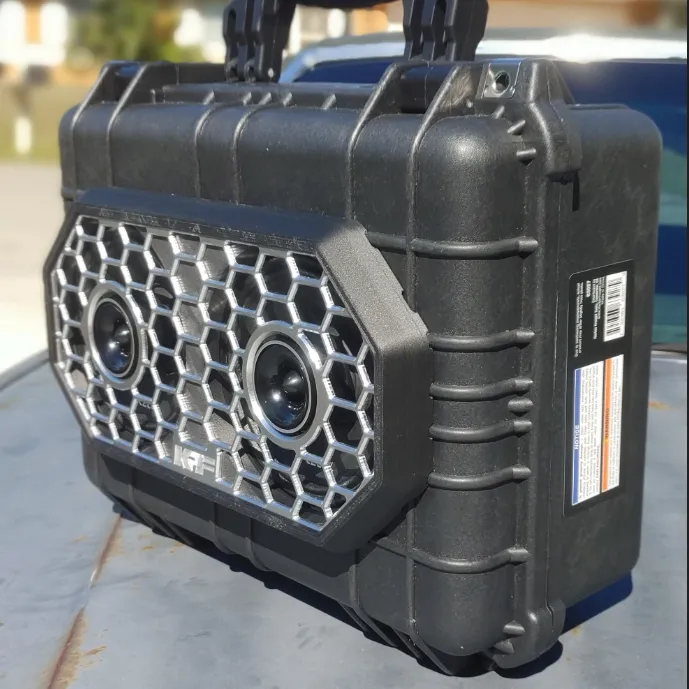
Load-bearing parts that must survive above PETG's 70 °C ceiling without moving to PA or PC
Semi-crystalline PET with carbon fibre — a genuinely different material from PETG-CF, reaching 182–205 °C heat deflection but needing an 80 °C dry, a heated chamber and speeds halved to 100 mm/s.
PET-CF occupies a higher-temperature engineering niche than PETG-CF because the PET matrix can crystallize. Polymaker positions PET-CF17 for automotive, robotics and industrial components where stiffness and thermal stability matter. That makes the category relevant to rigid end-use parts and tooling, provided the material has received the processing needed to obtain the quoted properties.
Annealing is central to that distinction. Polymaker states that it improves heat resistance and stiffness but does not improve impact resistance or layer adhesion; thin features can also deform during the heat treatment. PET-CF remains brittle and direction-dependent, so high in-plane strength should not be read as equivalent strength across layers or reliable flexural-fatigue performance.
FDM · Fiberon PET-CF17; annealed thermal properties require annealing · Manufacturer-listed applications
Polymaker lists these engineering sectors for PET-CF17 and ties the grade to stiffness and dimensional stability. The page describes an intended application class rather than a named qualified component.
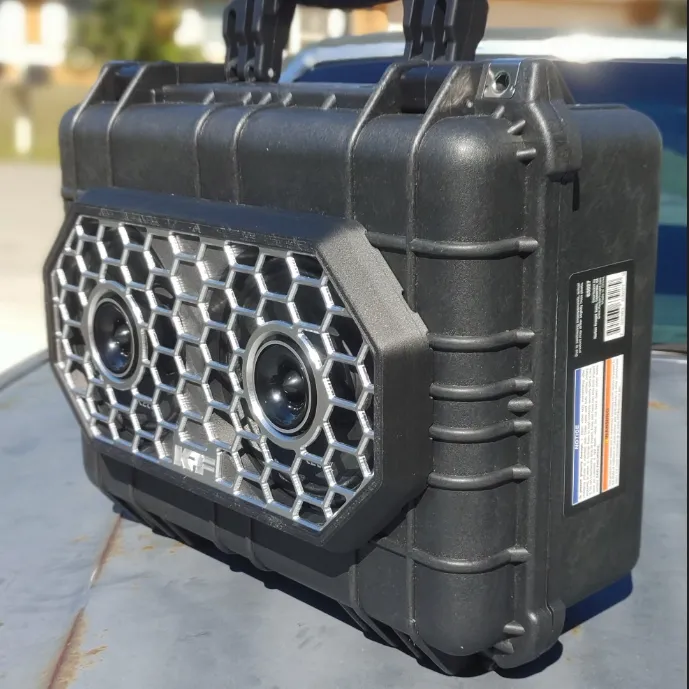
A printed speaker grille and trim installed on an Apache case. In a reply on the model’s comments page, the uploader reports PET-CF on a Qidi Plus 4.
Listing note: “i used pet-cf at .2 layer height”
Printables listing uploaded by Dylan Kirby · CC BY-NC 4.0Original listing · Checked 2026-10-17. This is an uploader report, not an independent material test.Source image · Image bytes unchanged; displayed in full. Noncommercial reuse only.
Representative catalog values. Check the exact grade and its linked conditions before using a setting.
260–290 (Bambu Lab)
80–100 (Bambu Lab)
Enclosure recommended
Enclosure recommended — Bambu Lab specifies a 45–60 °C chamber
80 °C for 8–12 h (Bambu Lab)
80 °C for 8–12 h (Bambu Lab) — the longest and hottest dry in the polyester family; Fiberon specifies 100 °C for 10 h
Open a topic to explore the complete data. Each value keeps its original conditions, units and dated sources.
| Property and unit | Published value and conditions | Sources and dates |
|---|---|---|
| Base polymer / chemistry | Semi-crystalline PET reinforced with carbon fibre — a different polymer from PETG-CF, with the glycol modifier removed so the matrix can crystallise | 2 sources
|
| Density (g/cm³) | 1.29 (Bambu Lab) and 1.34 (Fiberon PET-CF17), ISO 1183 | 2 sources
|
| Typical price (USD/kg) | 1 kg spools cluster near 45 | 2 sources
|
| Price range across brands (USD/kg) | 26–50 across brands; ELEGOO 26 in a 5 kg pack, Bambu Lab 45, Fiberon 50 | 3 sources
|
| Market availability (1–5) | Available from several mainstream brands | 3 sources
|
| Spool sizes & diameters | 1.75 mm; 0.5 and 1 kg spools | 2 sources
|
| Typical applications | Load-bearing parts that must survive above PETG's 70 °C ceiling without moving to PA or PC | 2 sources
|
| Property and unit | Published value and conditions | Sources and dates |
|---|---|---|
| Nozzle temperature (°C) | 260–290 (Bambu Lab) | 1 source
|
| Bed temperature (°C) | 80–100 (Bambu Lab) | 1 source
|
| Enclosure / chamber requirement (1–5) | Enclosure recommended — Bambu Lab specifies a 45–60 °C chamber | 1 source
|
| Recommended chamber temperature (°C) | 45–60 (Bambu Lab) | 1 source
|
| Part cooling fan | 0–60 % (Bambu Lab) | 1 source
|
| Bed surface & adhesion aid | Textured PEI, satin or powder-coated sheets; on smooth PEI a glue stick acts as a release agent | 2 sources
|
| Maximum volumetric flow (mm³/s; see test conditions) (mm³/s) | 8 at Bambu Lab's 100 mm/s cap on a 0.4 mm nozzle at 0.2 mm layer — half the speed it allows for PETG-CF | 2 sources
|
| Bed-adhesion difficulty (1–5) | Needs the right surface or a thin adhesive — the problem is releasing the part, not sticking it | 2 sources
|
| Stringing / oozing tendency (1–5) | Moderate — retraction tuning needed; Polymaker names stringing as PETG's common quirk | 1 source
|
| Overall printing difficulty (1–5) | Advanced — enclosure, hardware upgrades, tuning | 1 source
|
| Property and unit | Published value and conditions | Sources and dates |
|---|---|---|
| Nozzle hardness required (1–4) | Hardened steel required | 1 source
|
| Abrasiveness (1–5) | Highly abrasive — standard CF composite | 1 source
|
| Nozzle clog risk (1–5) | Moderate — needs dry filament and a clean nozzle; Prusa lists higher risk of nozzle clogging for carbon-filled composites | 1 source
|
| Heat-creep / jam sensitivity (1–5) | Slightly sensitive | 1 source
|
| Hotend requirement | No special hot-end required | 1 source
|
| Property and unit | Published value and conditions | Sources and dates |
|---|---|---|
| Moisture absorption (hygroscopicity) (1–5) | Moderate — 0.37 % saturated at 25 °C / 55 % RH (Bambu Lab); 0.53 % equilibrium (Fiberon) | 2 sources
|
| Equilibrium moisture content at ~50 % RH (%) | 0.37 saturated at 25 °C / 55 % RH (Bambu Lab); 0.53 equilibrium (Fiberon PET-CF17) | 2 sources
|
| Drying temperature & time | 80 °C for 8–12 h (Bambu Lab) — the longest and hottest dry in the polyester family; Fiberon specifies 100 °C for 10 h | 2 sources
|
| Symptoms when wet | Bubbling and popping at the nozzle, stringing and a rough surface | 1 source
|
| Effect of moisture on strength | Bambu Lab publishes its whole mechanical table under the heading "Mechanical Properties (Dry state)" — the quoted figures apply only to dried filament | 1 source
|
| Storage requirement | Sealed with desiccant; Polymaker groups PETG with the highly hygroscopic materials | 2 sources
|
| Hydrolysis at melt temperature | The 80–100 °C dry both suppliers mandate is far above the 55–65 °C used for PETG, consistent with a melt-hydrolysis risk in the semi-crystalline PET matrix; neither publishes a molecular-weight loss figure | 2 sources
|
| Property and unit | Published value and conditions | Sources and dates |
|---|---|---|
| Tensile strength (XY) (MPa) | 65.9 (Fiberon) to 74 (Bambu Lab) printed XY, ISO 527 | 2 sources
|
| Young's modulus (MPa) | 4730 ± 260 (Bambu Lab) and 5481 ± 224 (Fiberon) printed XY, ISO 527 | 2 sources
|
| Elongation at break (%) | 2.4 ± 0.5 printed XY, ISO 527 (Fiberon PET-CF17) | 1 source
|
| Flexural strength (MPa) | 109.3 ± 2.0 printed XY, ISO 178 (Fiberon PET-CF17) | 1 source
|
| Flexural modulus (MPa) | 4744 ± 136 printed XY, ISO 178 (Fiberon PET-CF17) | 1 source
|
| Charpy impact, notched (kJ/m²) | 5.1 ± 0.2 printed XY, ISO 179 notched (Fiberon PET-CF17); unnotched 25.1 ± 2.8 | 1 source
|
| Layer adhesion / Z tensile (MPa) | 27.9 (Fiberon) and 35 ± 5 (Bambu Lab) printed Z, ISO 527 | 2 sources
|
| Brittleness (1–5) | Very brittle — elongation at break 2.4 % in XY and 0.8 % in Z | 1 source
|
| Creep resistance / sustained load (1–5) | Good — no creep test found; annealed PET-CF holds a 105 °C HDT at 1.8 MPa and a 4730–5481 MPa modulus against 1500–2311 for PETG | 2 sources
|
| Fatigue / repeated-flex resistance (1–5) | Below average — no S-N curve; elongation at break is 2.4 % in XY and 0.8 % in Z, against 5.2–9.3 % for unfilled PETG | 1 source
|
| Elasticity / flexibility (1–5) | Rigid | 1 source
|
| Z strength as % of XY (%) | 42 (Fiberon) to 47 (Bambu Lab), printed | 2 sources
|
| Property and unit | Published value and conditions | Sources and dates |
|---|---|---|
| HDT at 0.45 MPa (°C) | 147.5 (Fiberon) and 205 (Bambu Lab), ISO 75 at 0.45 MPa | 2 sources
|
| HDT at 1.8 MPa (°C) | 105 (Fiberon) and 182 (Bambu Lab), ISO 75 at 1.8 MPa | 2 sources
|
| Glass transition (Tg) (°C) | 75 (Bambu Lab) and 79.3 (Fiberon), DSC | 2 sources
|
| Melting point / Vicat (°C) | 241.3 (Fiberon) and 250 (Bambu Lab) melting, DSC; Vicat 226–238 | 2 sources
|
| Annealing response | The PET matrix crystallises on annealing, which is what separates this grade from PETG-CF | 2 sources
|
| Flammability / UL 94 | Flammable; no UL 94 rating published for standard grades | 1 source
|
| Property and unit | Published value and conditions | Sources and dates |
|---|---|---|
| Chemical resistance | Withstands acids, alkalis, oils and UV exposure | 1 source
|
| Food contact | Not certified for food contact as filament | 1 source
|
| Biodegradability / compostability | Not biodegradable | 1 source
|
| Recyclability | Not accepted in household plastic collection | 1 source
|
| Electrical & ESD properties | Surface resistivity above 10¹² ohm — insulating (Fiberon PET-CF17, ANSI/ESD S11.11) | 1 source
|
| Property and unit | Published value and conditions | Sources and dates |
|---|---|---|
| Fume toxicity (1–5) | Moderate — measurable VOCs and UFPs, ventilation advised | |
| Ventilation / filtration requirement (1–5) | Ventilated room or enclosure recommended | |
| Dust & fibre handling hazard | Carbon fibre is bound in the matrix; sanding dust should not be inhaled | 1 source
|
| Property and unit | Published value and conditions | Sources and dates |
|---|---|---|
| Sanding & machining | Sands poorly — the material is tough and gums rather than powders | 1 source
|
| Gluing & solvent welding | Cyanoacrylate; no common solvent welds PETG cleanly | 1 source
|
| Vapour / chemical smoothing | No practical vapour smoothing | 1 source
|
| Support material pairing | Prints its own supports; Polymaker rates PolyDissolve S1 for PETG | 1 source
|
| Dimensional accuracy & detail | Bambu Lab markets it on low warping and shrinkage relative to other high-temperature composites | 1 source
|
| Property and unit | Published value and conditions | Sources and dates |
|---|---|---|
| Soluble in | None common; fluorinated solvents such as hexafluoroisopropanol dissolve linear polyester at 23 °C. Laboratory only. | 2 sources |
| Softened or crazed by | Ensinger rates polyester not resistant to chloroform or dichloromethane and only conditionally resistant to acetone and MEK. | 1 source |
| Solvent welding & smoothing agent | Dichloromethane attacks polyester and can be brushed on, but the carbon fibre blocks any useful surface flow. | 2 sources |
Values describe representative grades, not every spool. Manufacturer datasheets and independent tests retain their source labels and dates. Printed orientation, test method, conditioning and formulation can change results. Unknown values are —. A listed use is not a certification. Shore A, Shore D and Rockwell hardness are separate scales.
Historical USD/kg snapshots. Read each listing’s sale/from qualifiers, spool mass, source date, shipping and tax notes. Product figures are separate from the material summary.
$129.99 / 5 kg = $26.00/kg, us.elegoo.com product catalogue, Aug 2026
Handle pet-cf-filament-5-kg; the 1 kg listing is $29.99. ELEGOO publishes printed X-Y and Z strength figures without naming a test standard, so they are recorded here rather than as specs: tensile 84 ± 3 MPa XY / 40 ± 2 MPa Z, bending 136 ± 2 MPa XY, impact 40.2 ± 2.5 kJ/m² XY.
Open product listing ↗| Density (g/cm³) | 1.32 (ELEGOO published spec table) |
|
|---|---|---|
| Nozzle temperature (°C) | 260–290 |
|
| Bed temperature (°C) | 90–110 |
|
| Recommended chamber temperature (°C) | 45–60 |
|
| Nozzle hardness required (1–4) | Hardened steel required, 0.4 mm or larger |
|
| Drying temperature & time | 80 ± 5 °C for 8 h; drying required |
|
| Elongation at break (%) | 6.3 ± 1.2 (printed XY); 4.1 printed Z |
|
| HDT at 0.45 MPa (°C) | 194 (0.45 MPa) after annealing 8 h at 100 °C |
|
| Melting point / Vicat (°C) | 255 melting; Vicat 112 after annealing |
|
| Annealing response | Annealing 8 h at 100 °C raises HDT at 0.45 MPa to 194 °C and Vicat to 112 °C |
|
$34.99 / 1 kg spool, siraya.tech US store, Aug 2026 (list $49.99); 2.5 kg spool $74.99
15 % carbon fibre. TDS gives annealed and unannealed figures; the annealed HDT rises to 118 °C at 1.8 MPa.
Open product listing ↗| Tensile strength (XY) (MPa) | 74 unannealed, 73 annealed (printed XY, ASTM D638) |
|
|---|---|---|
| Young's modulus (MPa) | 5950 unannealed, 6700 annealed (printed XY, ASTM D638) |
|
| Elongation at break (%) | 2.5 unannealed, 1.5 annealed (printed XY, ASTM D638) |
|
| Charpy impact, notched (kJ/m²) | 9 unannealed, 4.8 annealed (printed, ISO 179) |
|
| Layer adhesion / Z tensile (MPa) | 35 (printed Z, ASTM D638) |
|
| HDT at 0.45 MPa (°C) | 86.7 unannealed, 176 annealed (ISO 75 method B, 0.45 MPa) |
|
| HDT at 1.8 MPa (°C) | 76.6 unannealed, 118 annealed (ISO 75 method A, 1.8 MPa) |
|
| Glass transition (Tg) (°C) | 80 (ASTM D3418) |
|
$44.99 / 1 kg spool, us.store.bambulab.com, Aug 2026
HDT 205 °C at 0.45 MPa and 182 °C at 1.8 MPa. Needs an 80 °C dry and a 45–60 °C chamber.
Open product listing ↗| Density (g/cm³) | 1.29 (ISO 1183) |
|
|---|---|---|
| Tensile strength (XY) (MPa) | 74 ± 6 (printed XY, ISO 527) |
|
| HDT at 0.45 MPa (°C) | 205 (ISO 75, 0.45 MPa) |
|
| HDT at 1.8 MPa (°C) | 182 (ISO 75, 1.8 MPa) |
|
$24.99 / 0.5 kg spool = $49.98/kg, Polymaker product catalogue, Aug 2026
Handle fiberon-pet-cf17. 17 wt% carbon fibre; Young's modulus 5481 MPa printed XY.
Open product listing ↗| Density (g/cm³) | 1.34 (ISO 1183) |
|
|---|---|---|
| Nozzle temperature (°C) | 270–300 |
|
| Bed temperature (°C) | 70–80 |
|
| Equilibrium moisture content at ~50 % RH (%) | 0.53 equilibrium water absorption at 70 % RH, 23 °C |
|
| Tensile strength (XY) (MPa) | 65.9 ± 1.0 (printed XY, ISO 527); Z 27.9 |
|
| Young's modulus (MPa) | 5481.0 ± 223.7 (printed XY, ISO 527) |
|
| Elongation at break (%) | 2.4 ± 0.5 (printed XY, ISO 527); Z 0.8 |
|
| Flexural strength (MPa) | 109.3 ± 2.0 (printed XY, ISO 178); Z 43.4 |
|
| Flexural modulus (MPa) | 4744.4 ± 136.3 (printed XY, ISO 178); Z 2768.2 |
|
| Charpy impact, notched (kJ/m²) | 5.1 ± 0.2 (printed XY, ISO 179, notched) |
|
| Other impact data | Charpy unnotched 25.1 kJ/m² XY, 3.1 kJ/m² Z (printed, ISO 179) |
|
| Layer adhesion / Z tensile (MPa) | 27.9 ± 1.3 (printed Z, ISO 527) |
|
| Z strength as % of XY (%) | 42 (printed Z 27.9 vs XY 65.9, ISO 527) |
|
| HDT at 0.45 MPa (°C) | 147.5 (ISO 75, 0.45 MPa) |
|
| HDT at 1.8 MPa (°C) | 105 (ISO 75, 1.8 MPa) |
|
| Glass transition (Tg) (°C) | 79.3 (DSC) |
|
| Melting point / Vicat (°C) | 241.3 melting (DSC); Vicat 238.4 (ISO 306) |
|
| Flammability / UL 94 | UL 94 HB at 1.5 mm |
|
| Electrical & ESD properties | Surface resistivity >10^12 Ω (ANSI/ESD S11.11) |
|
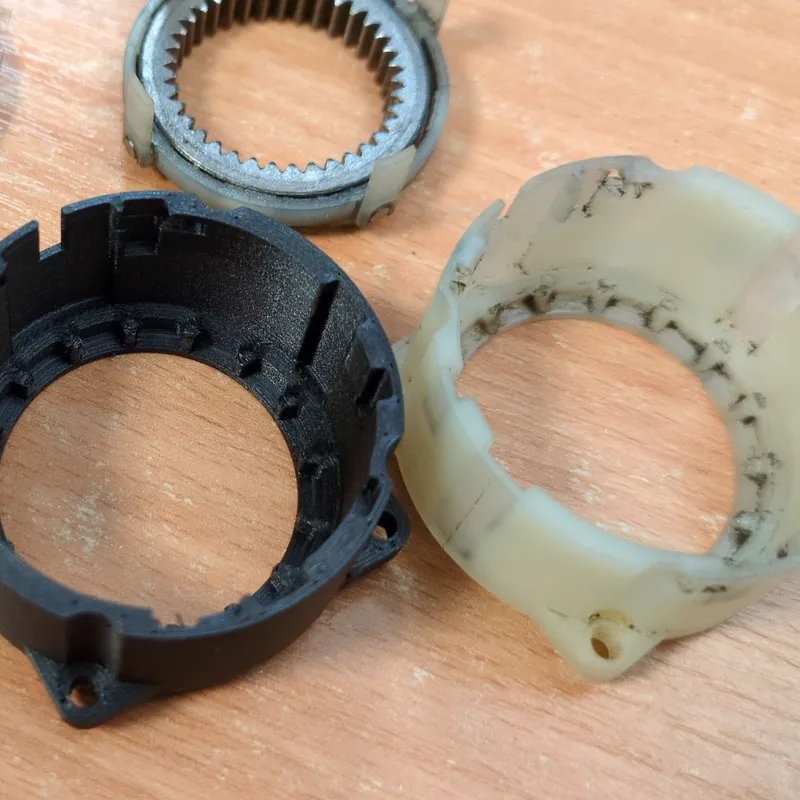
PETG with chopped carbon fibre: stiffness and heat deflection rise — Prusament reaches 96 °C at 0.45 MPa — while impact…
11 product listingsPETG with a conductive filler for static-dissipative parts; Polymaker's data shows surface resistivity moving three orders of…
2 product listingsGlass-fibre reinforced polyester. The best-documented grade, Polymaker's Fiberon PET-GF15, uses a PET matrix with 15 wt% glass…
3 product listings