3D Printing Info
Where it is used
Stiff, dimensionally stable fixtures; the Fiberon grade is designed to be annealed for heat resistance
Sources
- Fiberon PET-GF15 Technical Data Sheet V1.0 · 2026-08 · tds
Glass-fibre reinforced polyester. The best-documented grade, Polymaker's Fiberon PET-GF15, uses a PET matrix with 15 wt% glass and reaches 133.7 °C HDT at 0.45 MPa after annealing.
Open in interactive comparisonStiff, dimensionally stable fixtures; the Fiberon grade is designed to be annealed for heat resistance
Glass-fibre reinforced polyester. The best-documented grade, Polymaker's Fiberon PET-GF15, uses a PET matrix with 15 wt% glass and reaches 133.7 °C HDT at 0.45 MPa after annealing.
This category groups glass-reinforced polyesters, but the best-documented example, Fiberon PET-GF15, is PET rather than PETG. Polymaker lists jigs, fixtures, brackets, enclosures and automotive parts. The glass reinforcement provides stiffness for locating and mounting geometry, while the PET matrix allows heat resistance to be increased by annealing.
The as-printed and annealed material should not be treated interchangeably. Polymaker reports a substantial heat-deflection increase after annealing, accompanied by the practical need to control deformation during that operation. Glass-filled material remains abrasive and less tolerant of large strains than unfilled PETG. Molded-resin data from another polyester grade cannot establish the strength of a particular FDM bracket.
FDM · Fiberon PET-GF15; PET matrix with 15% glass fibre · Manufacturer-listed applications
Polymaker lists these uses for PET-GF15. Stiffness supports locating and mounting duties, and annealing is required where the application depends on the grade’s higher thermal performance.
FDM · Fiberon PET-GF15 · Manufacturer-listed applications
These are manufacturer-listed uses for PET-GF15 rather than verified case studies. The source does not identify a specific vehicle component or transfer an injection-molded qualification to printed parts.
Check the model’s material and process notes before choosing a filament.
Representative catalog values. Check the exact grade and its linked conditions before using a setting.
—
—
——
—
——
—
——
—
—Open a topic to explore the complete data. Each value keeps its original conditions, units and dated sources.
| Property and unit | Published value and conditions | Sources and dates |
|---|---|---|
| Base polymer / chemistry | Glass-fibre reinforced polyester. Polymaker's Fiberon PET-GF15 uses a PET rather than a PETG matrix and carries 15 wt% glass fibre | 1 source
|
| Density (g/cm³) | 1.43 (Fiberon PET-GF15, ISO 1183) | 1 source
|
| Typical price (USD/kg) | 1 kg spools cluster near 25 | 2 sources
|
| Price range across brands (USD/kg) | 19–30 across brands; ELEGOO 19, Polymaker Fiberon 30 | 2 sources
|
| Market availability (1–5) | Niche, a handful of specialist brands | 2 sources
|
| Spool sizes & diameters | 1.75 mm; 0.5 and 1 kg spools | 1 source
|
| Typical applications | Stiff, dimensionally stable fixtures; the Fiberon grade is designed to be annealed for heat resistance | 1 source
|
| Property and unit | Published value and conditions | Sources and dates |
|---|---|---|
| Bed surface & adhesion aid | Textured PEI, satin or powder-coated sheets; on smooth PEI a glue stick acts as a release agent | 2 sources
|
| Bed-adhesion difficulty (1–5) | Needs the right surface or a thin adhesive — the problem is releasing the part, not sticking it | 2 sources
|
| Stringing / oozing tendency (1–5) | Moderate — retraction tuning needed; Polymaker names stringing as PETG's common quirk | 1 source
|
| Property and unit | Published value and conditions | Sources and dates |
|---|---|---|
| Nozzle hardness required (1–4) | Hardened steel required | 1 source
|
| Abrasiveness (1–5) | Highly abrasive — standard GF composite | 1 source
|
| Nozzle clog risk (1–5) | Moderate — needs dry filament and a clean nozzle; Prusa lists higher risk of nozzle clogging for glass-filled composites | 1 source
|
| Heat-creep / jam sensitivity (1–5) | Slightly sensitive | 1 source
|
| Hotend requirement | No special hot-end required | 1 source
|
| Property and unit | Published value and conditions | Sources and dates |
|---|---|---|
| Moisture absorption (hygroscopicity) (1–5) | Moderate (0.3–0.8 %) — the PETG matrix reaches 0.40 % saturated at 25 °C / 55 % RH; no glass-filled grade publishes its own figure | 1 source
|
| Symptoms when wet | Bubbling and popping at the nozzle, stringing and a rough surface | 1 source
|
| Effect of moisture on strength | Polymaker groups PETG with nylon, PVA and TPU as highly hygroscopic; no dry-versus-conditioned strength figures are published for this grade and the loss shows as bubbling and poor layer adhesion | 1 source
|
| Storage requirement | Sealed with desiccant; Polymaker groups PETG with the highly hygroscopic materials | 2 sources
|
| Property and unit | Published value and conditions | Sources and dates |
|---|---|---|
| Tensile strength (XY) (MPa) | 59.9 ± 0.8 printed XY, ISO 527 (Fiberon PET-GF15) | 1 source
|
| Young's modulus (MPa) | 4144 ± 133 printed XY, ISO 527 (Fiberon PET-GF15) | 1 source
|
| Elongation at break (%) | 4.0 ± 0.5 printed XY, ISO 527 (Fiberon PET-GF15) | 1 source
|
| Flexural strength (MPa) | 104.2 ± 2.4 printed XY, ISO 178 (Fiberon PET-GF15) | 1 source
|
| Flexural modulus (MPa) | 3705 ± 85 printed XY, ISO 178 (Fiberon PET-GF15) | 1 source
|
| Charpy impact, notched (kJ/m²) | 8.7 ± 0.6 printed XY, ISO 179, notched (Fiberon PET-GF15) | 1 source
|
| Other impact data | Charpy unnotched 27.2 ± 2.0 printed XY (Fiberon PET-GF15, ISO 179) | 1 source
|
| Layer adhesion / Z tensile (MPa) | 48.2 ± 0.3 printed Z, ISO 527 (Fiberon PET-GF15) | 1 source
|
| Brittleness (1–5) | Brittle — snaps with little warning; elongation 4.0 % in XY and 2.6 % in Z | 1 source
|
| Creep resistance / sustained load (1–5) | Below average — no GF-grade creep test; the CF grades sagged to 14.8–16.7 mm over 5 days at 1.25 kg against 17.1–20.4 mm unfilled | 3 sources
|
| Fatigue / repeated-flex resistance (1–5) | Below average — no GF-grade S-N curve; elongation at break falls to 4.0 % in XY against 5.2–9.3 % unfilled | 2 sources |
| Elasticity / flexibility (1–5) | Rigid | 1 source
|
| Z strength as % of XY (%) | 80 (Fiberon PET-GF15, printed Z against XY tensile) | 1 source
|
| Property and unit | Published value and conditions | Sources and dates |
|---|---|---|
| HDT at 0.45 MPa (°C) | 81.6 as printed, 133.7 after annealing (ISO 75, 0.45 MPa) | 1 source
|
| HDT at 1.8 MPa (°C) | 71.8 as printed, 87.3 after annealing (ISO 75, 1.8 MPa) | 1 source
|
| Glass transition (Tg) (°C) | 59.5 (DSC) | 1 source
|
| Melting point / Vicat (°C) | 231.6 melting (DSC); Vicat 232.6 (ISO 306) | 1 source
|
| Annealing response | Annealing lifts HDT at 0.45 MPa from 81.6 to 133.7 °C | 1 source
|
| Thermal expansion (CTE) (µm/m·K) | 20 along the print bead and 63–74 in the build direction at 30 °C (30 wt% GF, large-format printed, TMA) | |
| Flammability / UL 94 | UL 94 HB at 1.5 mm (Fiberon PET-GF15) | 1 source
|
| Property and unit | Published value and conditions | Sources and dates |
|---|---|---|
| Chemical resistance | Withstands acids, alkalis, oils and UV exposure | 1 source
|
| Food contact | Not certified for food contact as filament | 1 source
|
| Biodegradability / compostability | Not biodegradable | 1 source
|
| Recyclability | Not accepted in household plastic collection | 1 source
|
| Electrical & ESD properties | Surface resistivity above 10¹² ohm — insulating (Fiberon PET-GF15, ANSI/ESD S11.11) | 1 source
|
| Property and unit | Published value and conditions | Sources and dates |
|---|---|---|
| Fume toxicity (1–5) | Moderate — measurable VOCs and UFPs, ventilation advised | |
| Ventilation / filtration requirement (1–5) | Open a window / occasional ventilation | |
| Dust & fibre handling hazard | Glass fibre is bound in the matrix; avoid inhaling sanding dust | 1 source
|
| Property and unit | Published value and conditions | Sources and dates |
|---|---|---|
| Sanding & machining | Sands poorly — the material is tough and gums rather than powders | 1 source
|
| Gluing & solvent welding | Cyanoacrylate; no common solvent welds PETG cleanly | 1 source
|
| Vapour / chemical smoothing | No practical vapour smoothing | 1 source
|
| Support material pairing | Prints its own supports; Polymaker rates PolyDissolve S1 for PETG | 1 source
|
| Property and unit | Published value and conditions | Sources and dates |
|---|---|---|
| Soluble in | No common workshop solvent; dichloromethane — a carcinogen — dissolves the matrix surface, 1,2-dichloroethane destroys it in a week. | 2 sources |
| Softened or crazed by | Acetone (+16 % weight over 1 year at 23 °C), ethyl acetate, toluene and DMF swell and soften it; methanol crazes it. | 1 source |
| Solvent welding & smoothing agent | Dichloromethane reaches only the resin, so the fibre is left standing proud of the surface. Controlled carcinogen. | 1 source
|
Values describe representative grades, not every spool. Manufacturer datasheets and independent tests retain their source labels and dates. Printed orientation, test method, conditioning and formulation can change results. Unknown values are —. A listed use is not a certification. Shore A, Shore D and Rockwell hardness are separate scales.
Historical USD/kg snapshots. Read each listing’s sale/from qualifiers, spool mass, source date, shipping and tax notes. Product figures are separate from the material summary.
$18.99 / 1 kg spool, us.elegoo.com, Aug 2026
Handle petg-gf. ELEGOO publishes printed X-Y and Z strength figures without naming a test standard, so they are recorded here rather than as specs: tensile 50 ± 3 MPa XY / 42 ± 2 MPa Z, bending 83 ± 3 MPa XY, impact 51.9 ± 5.2 kJ/m² XY.
Open product listing ↗| Density (g/cm³) | 1.30 (ELEGOO published spec table) |
|
|---|---|---|
| Nozzle temperature (°C) | 240–270 |
|
| Bed temperature (°C) | 65–75 |
|
| Recommended chamber temperature (°C) | 25–50 |
|
| Nozzle hardness required (1–4) | Hardened steel required, 0.4 mm or larger |
|
| Drying temperature & time | 60 ± 5 °C for 8 h; drying required |
|
| Elongation at break (%) | 7.9 ± 1.0 (printed XY); 8.5 printed Z |
|
| HDT at 0.45 MPa (°C) | 74 (0.45 MPa) |
|
| Melting point / Vicat (°C) | 226 melting; Vicat 83 |
|
$27.38 / 1 kg spool in black, siraya.tech US store, Aug 2026 (list $32.99)
15 % glass fibre in unmodified PET rather than glycol-modified PETG: the TDS gives Tg 135 °C and a 250 °C melting point, and the vendor prints it at 300 °C. Listed here as the nearest glass-filled polyester grade; its figures are not comparable with PETG-GF and are left out of the table.
Open product listing ↗| Base polymer / chemistry | PET with 15 % glass fibre |
|
|---|---|---|
| Nozzle temperature (°C) | 300 |
|
| Bed temperature (°C) | 80 |
|
| Part cooling fan | Off |
|
| Maximum volumetric flow (mm³/s; see test conditions) (mm³/s) | 20 at 320 °C |
|
| Nozzle hardness required (1–4) | Hardened steel required |
|
| Hotend requirement | Enclosed printer required; hardened steel or harder nozzle, 0.4–1.0 mm |
|
$29.99 / 1 kg spool, Polymaker product catalogue, Aug 2026
Handle fiberon-pet-gf15. 15 wt% glass fibre on a PET matrix; annealed HDT 133.7 °C at 0.45 MPa.
Open product listing ↗| Density (g/cm³) | 1.43 (ISO 1183) |
|
|---|---|---|
| Nozzle temperature (°C) | 280–310 |
|
| Bed temperature (°C) | 70–80 |
|
| Shrinkage (%) | 0.38 XY, 0.45 Z (TDS 40 mm print test, as printed) |
|
| Equilibrium moisture content at ~50 % RH (%) | 0.32 equilibrium water absorption at 70 % RH, 23 °C |
|
| Tensile strength (XY) (MPa) | 59.9 ± 0.8 (printed XY, ISO 527) |
|
| Young's modulus (MPa) | 4144.2 ± 133.3 (printed XY, ISO 527); Z 3428.9 |
|
| Elongation at break (%) | 4.0 ± 0.5 (printed XY, ISO 527); Z 2.6 |
|
| Flexural strength (MPa) | 104.2 ± 2.4 (printed XY, ISO 178); Z 80.3 |
|
| Flexural modulus (MPa) | 3705.4 ± 84.5 (printed XY, ISO 178); Z 2998.4 |
|
| Charpy impact, notched (kJ/m²) | 8.7 ± 0.6 (printed XY, ISO 179, notched) |
|
| Other impact data | Charpy unnotched 27.2 kJ/m² XY, 13.9 kJ/m² Z (printed, ISO 179) |
|
| Layer adhesion / Z tensile (MPa) | 48.2 ± 0.3 (printed Z, ISO 527) |
|
| Z strength as % of XY (%) | 80 (printed Z 48.2 vs XY 59.9, ISO 527) |
|
| HDT at 0.45 MPa (°C) | 133.7 annealed, 81.6 as printed (ISO 75, 0.45 MPa) |
|
| HDT at 1.8 MPa (°C) | 87.3 annealed, 71.8 as printed (ISO 75, 1.8 MPa) |
|
| Glass transition (Tg) (°C) | 59.5 (DSC) |
|
| Melting point / Vicat (°C) | 231.6 melting (DSC); Vicat 232.6 (ISO 306) |
|
| Flammability / UL 94 | UL 94 HB at 1.5 mm |
|
| Electrical & ESD properties | Surface resistivity >10^12 Ω (ANSI/ESD S11.11) |
|
Semi-crystalline PET with carbon fibre — a genuinely different material from PETG-CF, reaching 182–205 °C heat deflection but…
4 product listings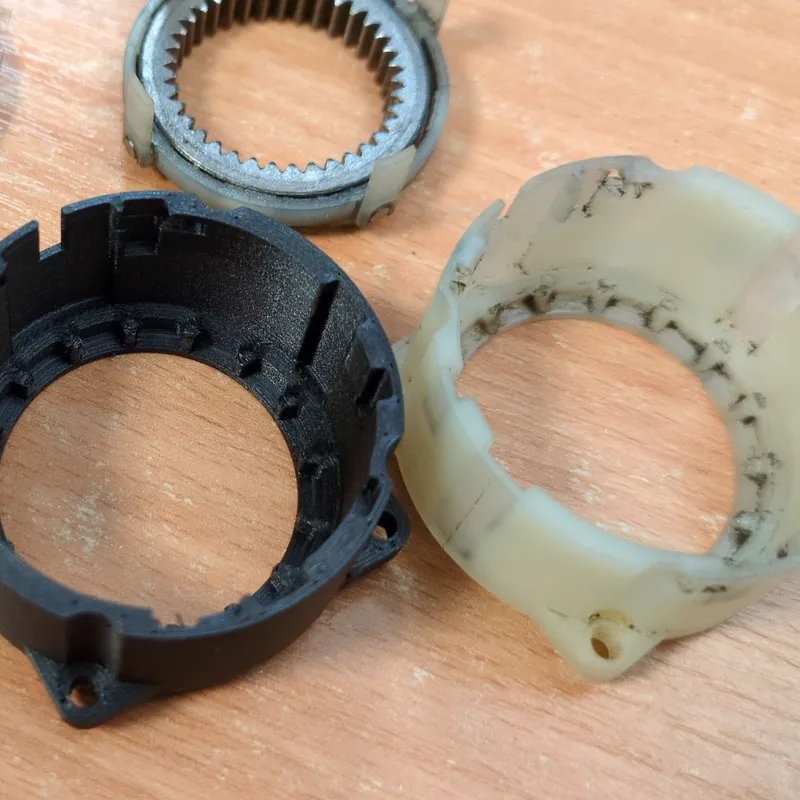
PETG with chopped carbon fibre: stiffness and heat deflection rise — Prusament reaches 96 °C at 0.45 MPa — while impact…
11 product listingsPETG with a conductive filler for static-dissipative parts; Polymaker's data shows surface resistivity moving three orders of…
2 product listingsCompare Glass-fibre polyester (PETG-GF / PET-GF) with another filament