3D Printing Info
Where it is used
Break-away and d-limonene-soluble support for ABS and ASA, and a light model material in its own right
Sources
- 3DXMAX HIPS — product page · 2026-08 · vendor
Rubber-toughened polystyrene, used mainly as a break-away or d-limonene-soluble support for ABS and ASA; as a model material it is light and ductile but the softest of the styrenics.
Open in interactive comparison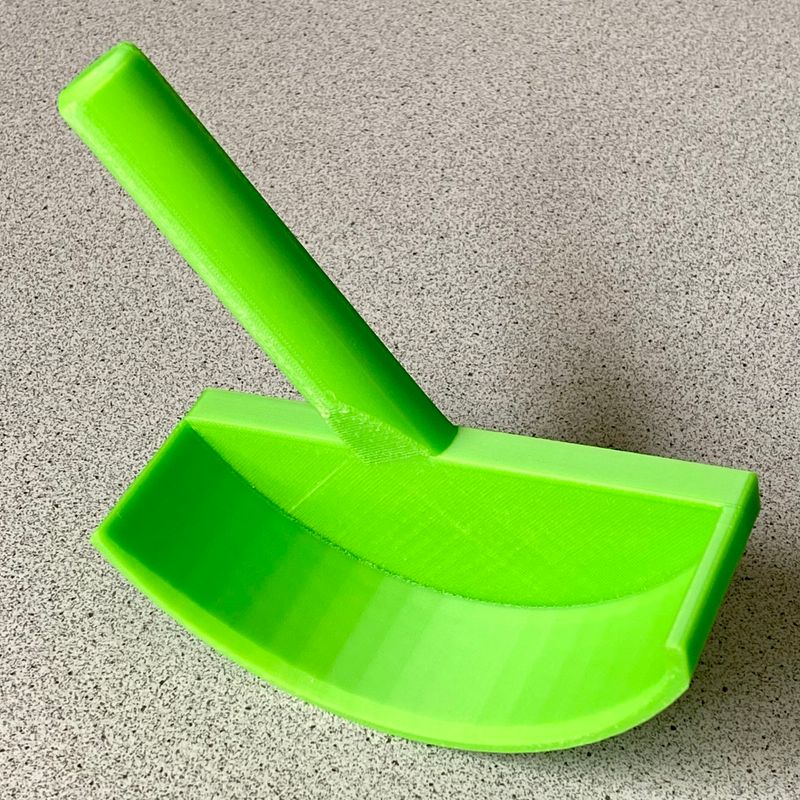
Break-away and d-limonene-soluble support for ABS and ASA, and a light model material in its own right
Rubber-toughened polystyrene, used mainly as a break-away or d-limonene-soluble support for ABS and ASA; as a model material it is light and ductile but the softest of the styrenics.
HIPS has two distinct jobs in printing: a light, finishable model material and a sacrificial support for ABS or ASA. As support, its value is removability rather than strength: inaccessible material can be dissolved in d-limonene instead of mechanically pulled through a narrow opening. 3DXTech specifically formulates its natural support grade for greater solvent sensitivity than its colored model-material grades.
For finished models, rubber toughening gives useful ductility, and HIPS sands and paints readily, but it is relatively compliant and has poor long-term UV resistance. Support compatibility is also formulation-dependent: verify that the solvent removes HIPS without damaging the actual main-part grade. A successful model-material print does not establish suitability for a highly stressed rotating or outdoor component.
FDM · 3DXTech 3DXMAX HIPS natural support formulation · Manufacturer-listed applications
3DXTech specifically lists these pairings and notes that its natural HIPS support formulation is made more sensitive to d-limonene than colored model grades. Solvent compatibility still needs checking for the actual supported material.
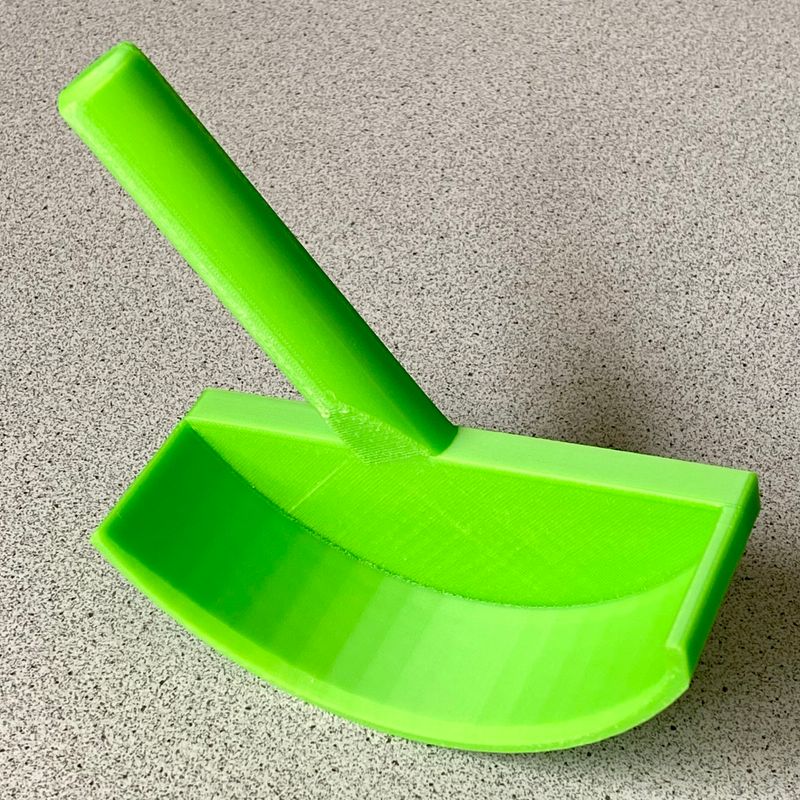
A scoop shaped to fit a 150 mm rain gutter. The uploader reports printing it on an X1C using Euroharry HIPS.
Listing note: “Designed in TinkerCad, printed on X1C with Hips filament from Euroharry.”
Printables listing uploaded by Tritschi · CC BY-NC-SA 4.0Original listing · Checked 2026-10-17. This is an uploader report, not an independent material test.Source image · Image bytes unchanged; displayed in full. Noncommercial reuse only. ShareAlike applies to adaptations.
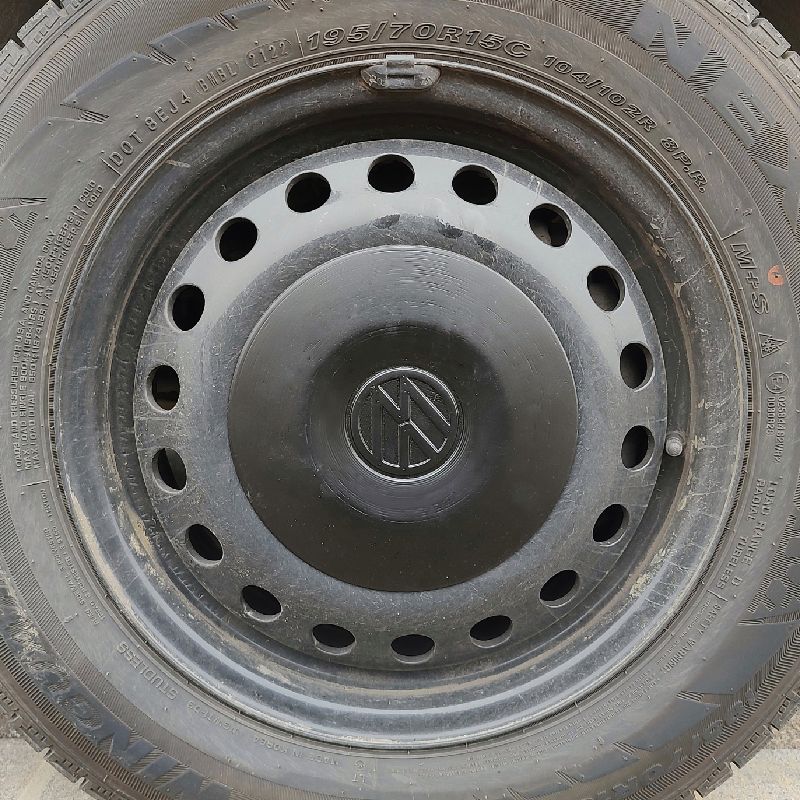
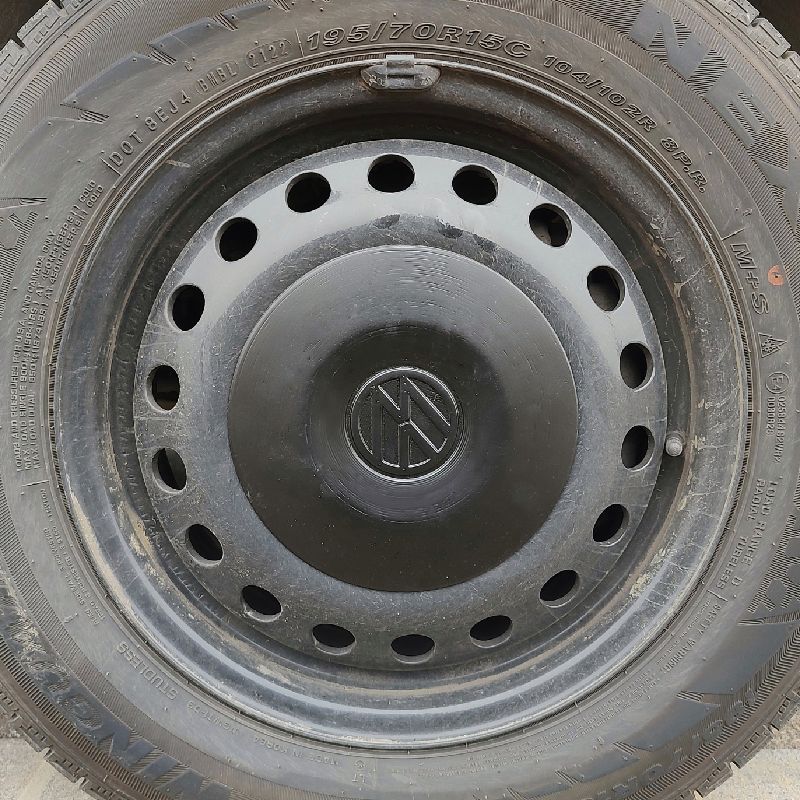
A replacement wheel-center cap photographed installed on a Volkswagen T4. The uploader reports printing and using this part in HIPS.
Listing note: “I have it printed in HIPS and use it with no problems.”
Printables listing uploaded by RH3D · CC BY-NC-SA 4.0Original listing · Checked 2026-10-17. This is an uploader report, not an independent material test.Source image · Image bytes unchanged; displayed in full. Noncommercial reuse only. ShareAlike applies to adaptations.
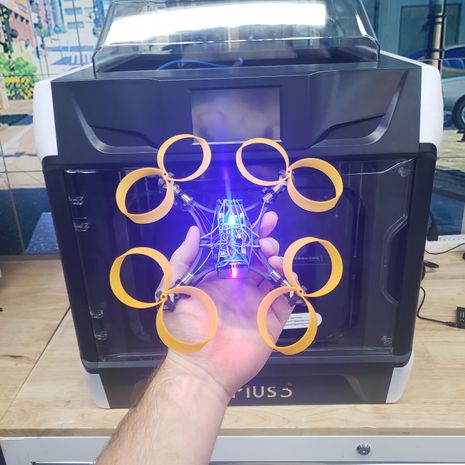
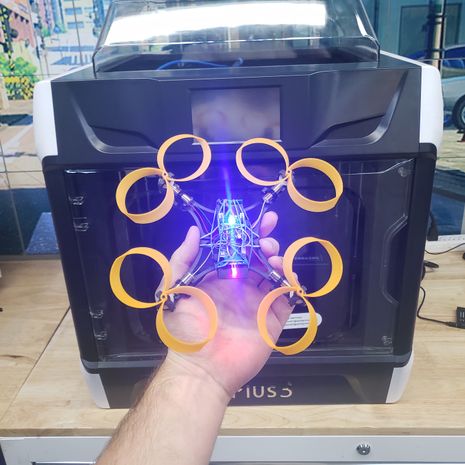
The uploader reports printing the ring-shaped propellers in HIPS. The frame and motor housings use PAHT-CF, so this example applies only to the propellers.
Listing note: “I printed my propellers in HIPS (high impact polystyrene)”
Printables listing uploaded by blake3dcake · CC BY-SA 4.0Original listing · Checked 2026-10-17. This is an uploader report, not an independent material test.Source image · Image bytes unchanged; displayed in full. ShareAlike applies to adaptations.
Representative catalog values. Check the exact grade and its linked conditions before using a setting.
230–245 (Simplify3D)
100–115 (Simplify3D)
Enclosure recommended
—
—
—Open a topic to explore the complete data. Each value keeps its original conditions, units and dated sources.
| Property and unit | Published value and conditions | Sources and dates |
|---|---|---|
| Base polymer / chemistry | High-impact polystyrene — polystyrene toughened with a butadiene rubber phase | 2 sources
|
| Density (g/cm³) | 1.04 (ISO 1183) | 1 source
|
| Typical price (USD/kg) | 1 kg spools cluster near 31 | 2 sources
|
| Price range across brands (USD/kg) | 28–32 across brands; YXPOLYER 28, Push Plastic 30, 3DXTech 32 | 3 sources
|
| Market availability (1–5) | Available from several mainstream brands | 2 sources
|
| Spool sizes & diameters | 1.75 and 2.85 mm; 1 and 3 kg spools | 2 sources
|
| Typical applications | Break-away and d-limonene-soluble support for ABS and ASA, and a light model material in its own right | 1 source
|
| Property and unit | Published value and conditions | Sources and dates |
|---|---|---|
| Nozzle temperature (°C) | 230–245 (Simplify3D) | 1 source
|
| Bed temperature (°C) | 100–115 (Simplify3D) | 1 source
|
| Enclosure / chamber requirement (1–5) | Enclosure recommended | 1 source
|
| Part cooling fan | Part cooling fan not required | 1 source
|
| Bed surface & adhesion aid | Glue stick, glass plate, Kapton tape or PET sheets | 1 source
|
| Warping tendency (1–5) | Moderate — needs adhesion aid or draught shield | 1 source
|
| Bed-adhesion difficulty (1–5) | Needs a specific surface plus adhesive | 1 source
|
| Stringing / oozing tendency (1–5) | Slight — HIPS oozes less than ABS | 2 sources
|
| Overall printing difficulty (1–5) | Intermediate — dry filament and a tuned profile | 1 source
|
| Property and unit | Published value and conditions | Sources and dates |
|---|---|---|
| Nozzle hardness required (1–4) | Brass fine indefinitely | 1 source
|
| Abrasiveness (1–5) | Non-abrasive | 1 source
|
| Nozzle clog risk (1–5) | Low — no special hot-end required, no drybox and no hardened nozzle, and 3DXTech states drying is not needed | 3 sources
|
| Heat-creep / jam sensitivity (1–5) | Slightly sensitive | 1 source
|
| Hotend requirement | No special hot-end required | 1 source
|
| Property and unit | Published value and conditions | Sources and dates |
|---|---|---|
| Moisture absorption (hygroscopicity) (1–5) | Low (0.1–0.3 %) — Simplify3D lists water resistance as a headline property | 1 source
|
| Symptoms when wet | Bubbling and popping at the nozzle, stringing and a rough surface | 1 source
|
| Effect of moisture on strength | Polymaker rates ABS moderate-sensitivity and publishes no dry-versus-conditioned figures; absorbed water flashes to steam in the hotend and shows as bubbling and poor layer adhesion | 1 source
|
| Storage requirement | Sealed with desiccant; less critical than for the polyamides | 1 source
|
| Property and unit | Published value and conditions | Sources and dates |
|---|---|---|
| Tensile strength (XY) (MPa) | 40 at break (printed XY, ISO 527) | 1 source
|
| Young's modulus (MPa) | 1350 (printed XY, ISO 527) — the lowest modulus of the styrenics here | 1 source
|
| Elongation at break (%) | 18 at break (printed XY, ISO 527) | 1 source
|
| Flexural strength (MPa) | 70 (printed XY, ISO 178) | 1 source
|
| Flexural modulus (MPa) | 1600 (printed XY, ISO 178) | 1 source
|
| Brittleness (1–5) | Tough — absorbs impact, yields before breaking | 1 source
|
| Creep resistance / sustained load (1–5) | Moderate — no printed-HIPS creep test found; Tg of 100 °C keeps room-temperature service far below softening | 2 sources
|
| Fatigue / repeated-flex resistance (1–5) | Moderate | 1 source
|
| Elasticity / flexibility (1–5) | Rigid | 1 source
|
| Property and unit | Published value and conditions | Sources and dates |
|---|---|---|
| Glass transition (Tg) (°C) | 100 (DSC) | 1 source
|
| Melting point / Vicat (°C) | Amorphous — no melting point | 1 source
|
| Continuous service temperature (°C) | Bounded by a glass transition of 100 °C; no loaded-bar service figure is published for HIPS | 1 source
|
| Flammability / UL 94 | Flammable; no UL 94 rating published | 1 source
|
| Property and unit | Published value and conditions | Sources and dates |
|---|---|---|
| UV resistance (1–5) | Months outdoors before embrittlement — polystyrene yellows and chalks under UV | 1 source
|
| Chemical resistance | Dissolves completely in d-limonene — the basis of its use as a soluble support | 1 source
|
| Food contact | Not food safe | 1 source
|
| Biodegradability / compostability | Not biodegradable | 1 source
|
| Recyclability | Not accepted in household plastic collection | 1 source
|
| Electrical & ESD properties | Surface resistance above 10¹³ ohm/sq — insulating (ASTM D257) | 1 source
|
| Property and unit | Published value and conditions | Sources and dates |
|---|---|---|
| Fume toxicity (1–5) | High — hazardous VOC such as styrene; enclosure and filtration needed | |
| VOC emission rate (µg/min) | 12–113 styrene, the range measured across ABS and the one HIPS filament tested | |
| Ultrafine-particle emission rate (particles/min) | ≈4 × 10⁹ median for the HIPS filament tested, an order of magnitude below ABS but forty times PLA | |
| Hazardous species emitted | Styrene was the only dominant VOC identified for the HIPS filament tested | |
| Ventilation / filtration requirement (1–5) | Enclosure with carbon and HEPA filtration |
| Property and unit | Published value and conditions | Sources and dates |
|---|---|---|
| Sanding & machining | Sands and paints readily, like ABS | 1 source
|
| Gluing & solvent welding | Solvent-welds with d-limonene, and with acetone via its polystyrene backbone | 2 sources
|
| Vapour / chemical smoothing | d-limonene attacks the surface; acetone smoothing is far less effective than on ABS | 2 sources
|
| Support material pairing | Used as the support material itself — dissolves in d-limonene, or breaks away from ABS and ASA | 1 source
|
| Property and unit | Published value and conditions | Sources and dates |
|---|---|---|
| Soluble in | d-limonene, 12–24 h submerged with occasional agitation; acetone also dissolves it, and xylene does so at 23 °C. | 3 sources |
| Softened or crazed by | Limonene also disrupts layer adhesion in some ABS and ASA grades, so an ABS model can flake apart in the same bath. | 1 source
|
| Solvent welding & smoothing agent | Limonene welds and lightly etches it; acetone welds through the polystyrene backbone but smooths less well than ABS. | 2 sources
|
Values describe representative grades, not every spool. Manufacturer datasheets and independent tests retain their source labels and dates. Printed orientation, test method, conditioning and formulation can change results. Unknown values are —. A listed use is not a certification. Shore A, Shore D and Rockwell hardness are separate scales.
Historical USD/kg snapshots. Read each listing’s sale/from qualifiers, spool mass, source date, shipping and tax notes. Product figures are separate from the material summary.
$27.99 / 1 kg spool, yxpolyer.com, Aug 2026; showed out of stock
Sold as a limonene-soluble support material for ABS. YXPOLYER quotes tensile 20 MPa, flexural 51 MPa, flexural modulus 2100 MPa and impact 21 kJ/m² without naming a test standard or specimen type.
Open product listing ↗| Density (g/cm³) | 1.04 (YXPOLYER published spec table) |
|
|---|---|---|
| Nozzle temperature (°C) | 220–260 |
|
| HDT at 0.45 MPa (°C) | 80 (heat deflection temperature; load not stated) |
|
| Soluble in | Dissolves in d-limonene |
|
$29.99 / 1 kg spool, pushplastic.com product catalogue, Aug 2026
Handle hips-production-filament-1-75mm-1kg; 3 kg spool $79.99.
Open product listing ↗| Tensile strength (XY) (MPa) | 25.5 at yield (ASTM D638, 3.0 mm specimen; specimen type not stated) |
|
|---|---|---|
| Flexural strength (MPa) | 35.3 at yield (ASTM D790, 6.0 mm specimen; specimen type not stated) |
|
| Flexural modulus (MPa) | 1862 (ASTM D790; specimen type not stated) |
|
| Other impact data | Notched Izod 2.8 ft-lb/in ≈ 149 J/m at 23 °C (ASTM D256) |
|
| Hardness (scale-specific) (Shore A / Shore D / Rockwell) | 50 Rockwell L (ASTM D785) |
|
| HDT at 1.8 MPa (°C) | 81 (ASTM D648, 1.82 MPa) |
|
| Flammability / UL 94 | UL 94 HB at 1.5 mm |
|
$32.00 / 1 kg spool, 3dxtech.com, Aug 2026
Formulated to be more sensitive to d-limonene attack for faster support dissolution.
Open product listing ↗| Density (g/cm³) | 1.04 (ISO 1183) |
|
|---|---|---|
| Nozzle temperature (°C) | 225 (TDS printed-specimen condition) |
|
| Bed temperature (°C) | 100 (TDS printed-specimen condition) |
|
| Tensile strength (XY) (MPa) | 40 at break (ISO 527) |
|
| Young's modulus (MPa) | 1350 (printed XY, ISO 527) |
|
| Elongation at break (%) | 18 at break (ISO 527) |
|
| Flexural strength (MPa) | 70 (printed XY, ISO 178) |
|
| Flexural modulus (MPa) | 1600 (printed XY, ISO 178) |
|
| HDT at 0.45 MPa (°C) | 80 (ISO 75, 0.45 MPa) |
|
| Glass transition (Tg) (°C) | 100 (DSC) |
|
| Electrical & ESD properties | Surface resistance >10^13 Ω/sq (ASTM D257) |
|
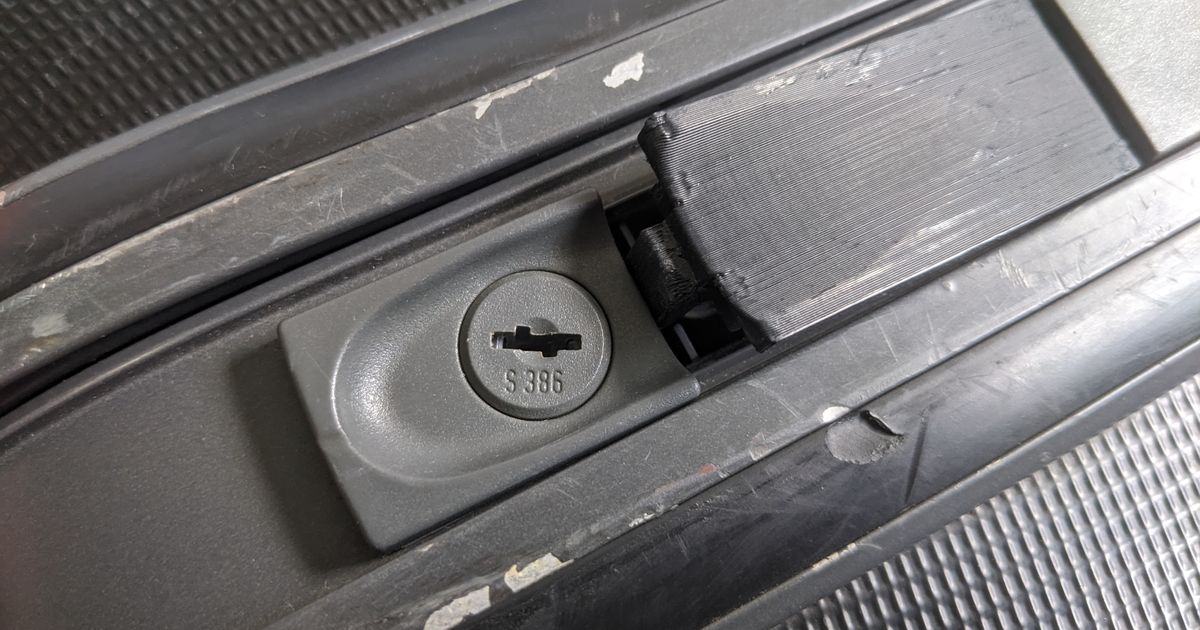
A familiar engineering plastic for functional parts, with more demanding printing conditions.
16 product listingsABS reformulated for lower warping and higher heat: Polymaker's ABS Max reaches Tg 126 °C and 118 °C HDT at 0.45 MPa, against…
4 product listingsABS with chopped carbon fibre: tensile modulus more than doubles to 5210 MPa and warping drops, at the cost of elongation…
7 product listings