3D Printing Info
CoreXYFlashForge

FlashForge AD5M

140 catalog fields124 catalog sources

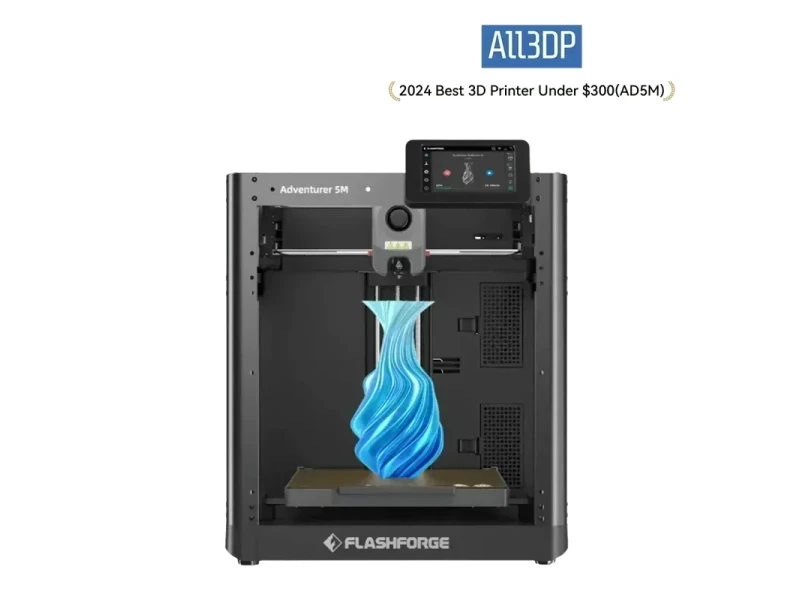
Model referenceFlashforge Adventurer 5M: High-Speed 3D Printer with 280°C Extruder; product image published by Top 3D Shop. Pictured accessories and sample prints may be optional.
Publisher product image · Top 3D Shop · Image source · Top 3D Shop content permission · Proportionally resized and encoded as WebP. No crop or retouch.
Start here

At a glance

Explore this printer

Build volume

Advertised 220 × 220 × 220 mm; measured usable 217 × 217 mm X/Y; firmware travel envelope X/Y −125 → +125 and Z −10 → 230

Advertised dimensions; check usable space and variants.

Sources & dates
  • manual §1.2; TechGearLab "217mm × 217mm (approximately 2.71% less than advertised)"; printer-hub "~217 x 217 mm actual"; stock printer.base.cfg L19-20/34-35 position_max: · 2026-08 · local

Nozzle temperature

Claimed 280 °C; firmware [extruder] max_temp: 350; [verify_heater extruder] max_error: 290; the printer's own settings file records extruderType: "0.4-300"

Published limits; hardware and firmware limits may differ.

Sources & dates
  • FlashForge product page & manual §1.2; stock printer.base.cfg L73 max_temp: 350, L94; firmware/flashforge-ad5m-5mpro-research/software/Adventurer5M.json "extruderType" : · 2026-08 · local

Price snapshot

Official store $299.00 (was $399.00, plus "Save an extra $50, discount auto-applied in cart" ⇒ ~$249 effective); US B2B reseller (CDW) $419.99; discount channel floor $127–$157 (AliExpress $127.12 w/ code; DealNews $139 w/ code AFFUS20, expires 2026-08-26; Slickdeals $157); mid-tier resellers $220–$239 (Slickdeals $220.15, STEMfinity $239.00)

Dated listing, not a live offer. Read the configuration and region.

Sources & dates
A closer look

Hardware, software & ownership

Full specifications inside each chapter

Understand the hardware, explore compatible changes and find a diagnostic starting point when something goes wrong. Expand the specification sections for every recorded value, condition and original reference.

Machine & motion

Dimensions, construction and the hardware that moves the print.

Model, variants & pricing6 fields
FlashForge AD5M — Identity & Market
Property and unitPublished value and conditionsSources and dates
Manufacturer & exact marketed model name (verify the exact product identity first)Zhejiang FlashForge 3D Technology — Adventurer 5M (AD5M), single-extruder open-frame CoreXY
3 sources
Release date (announcement and actual shipping)Announced/launched 2023-09-01; shipping units reviewed by 2023-10-18
2 sources
Launch MSRP (USD)$399
1 source
  • 3DPrintBeginner (5M $399 / 5M Pro $599); TechGearLab "$399 list" · 2026-08 · local
Street price (USD; dated snapshot per entry)Official store $299.00 (was $399.00, plus "Save an extra $50, discount auto-applied in cart" ⇒ ~$249 effective); US B2B reseller (CDW) $419.99; discount channel floor $127–$157 (AliExpress $127.12 w/ code; DealNews $139 w/ code AFFUS20, expires 2026-08-26; Slickdeals $157); mid-tier resellers $220–$239 (Slickdeals $220.15, STEMfinity $239.00)
1 source
Variants & sibling models — and how to tell them apart (spec-contamination risk)5M (this report): open frame, no camera, no filtration, no aux fan, unpopulated TVOC/servo/power-button headers on the mainboard. 5M Pro: enclosure + door/lid, built-in camera, HEPA+carbon dual-circulation filtration, auxiliary chamber fan, TVOC sensor, filtration servo, larger footprint (3Dnatives lists 380×400×453 mm). AD5X: 4-colour, different model. Robo E4: rebadged 5M.
1 source
  • firmware/flashforge-ad5m-5mpro-research/photo/readme.md (PCB comparison: TVOC connector, servo connector, power-on section "(*) Not soldered on the base version"); stock · 2026-08 · local
Market position: superseded? successor announced?Not superseded, and not actually abandoned. Still sold and listed 2026-08-19 in FlashForge's own nav as "Adventurer 5M — The Best Value Entry-Level 3D Printer", alongside AD5M Pro, AD5X (best seller) and the newer Creator 5 / Creator 5 Pro 4-toolhead flagships. No successor to the 5M has been announced (fresh search 2026-08-19: no "Adventurer 6", no replacement). Genuine counter-signal: 3DJake (major EU retailer) shows "Sold out — Our shop no longer sells this product", and deep discounting to ~$139 (A4) is end-of-life channel behaviour.
2 sources
Printable modification

FlashForge AD5M enclosure files

FlashForge supplies the printable enclosure parts, STEP geometry and assembly instructions for enclosing the open AD5M.

Applies to: AD5M enclosure design; panels and other nonprinted hardware are also required.

Creator listing Sources & dates
Hardware & upgrades

AD5M enclosure hardware kit

The manufacturer’s enclosure kit supplies the nonprinted components used with the downloadable enclosure design.

Applies to: Adventurer 5M; match the kit and printed enclosure revision.

Manufacturer documentation Sources & dates
Size, frame & enclosure6 fields
FlashForge AD5M — Physical & Frame
Property and unitPublished value and conditionsSources and dates
Build volume X×Y×Z (mm) — advertised vs actually usableAdvertised 220 × 220 × 220 mm; measured usable 217 × 217 mm X/Y; firmware travel envelope X/Y −125 → +125 and Z −10 → 230
1 source
  • manual §1.2; TechGearLab "217mm × 217mm (approximately 2.71% less than advertised)"; printer-hub "~217 x 217 mm actual"; stock printer.base.cfg L19-20/34-35 position_max: · 2026-08 · local
Machine footprint (mm) & clearance needed (cable/spool overhang)363 × 376 × 413 mm (excl. screen & spool holder); 363 × 402 × 448 mm (incl. screen, excl. spool holder). Manual requires ≥ 20 cm clearance front, back, left and right.
1 source
  • manual §1.2 L300-311; docs/manual.txt:202; FlashForge product page; 3DJake "363 × 402 × 448 mm (without spool holder)" · 2026-08 · local
Net weight (kg)10.8 kg
1 source
  • manual §1.2 (Net Weight 10.8kg) · 2026-08 · local
Frame construction & materialSheet-metal / all-metal chassis with sheet-metal top cover; "CoreXY all metal structure" in retail copy
1 source
  • FlashForge wiki linear-guide page (references "sheet metal top cover"); TechGearLab; printer-hub · 2026-08 · local
Enclosure: open / enclosed; panel material; door/lidOpen frame as shipped. Official Adventurer 5M Enclosure Kit, $39.99 — modular kit where "Some parts require self-printing"; claims odour containment and ABS/ASA/PC support.
1 source
Passive chamber temperature reached (if enclosed; measured values preferred)Not published
1 source
  • — · 2026-08 · local
Motion system8 fields
FlashForge AD5M — Kinematics & Motion Hardware
Property and unitPublished value and conditionsSources and dates
Kinematics (bedslinger i3 / CoreXY / other)CoreXY with moving bed on Z (not a bedslinger)
1 source
  • stock printer.base.cfg L174 kinematics: corexy; FlashForge wiki "CoreXY mechanism … two motors working in unison" · 2026-08 · local
X-axis guide type (rods / linear rails / V-wheels; size)Smooth linear shaft(s) with upper + lower sleeve (plain) bearings — not MGN linear rails
1 source
  • FlashForge wiki, Linear Guide Maintenance for AD5M Series (fetched 2026-08-19): "Clean the X, Y, and Z-axis linear shafts…"; "clean both sides of the upper and lower slee · 2026-08 · local
Y-axis guide typeSame family: linear shafts (wiki instructs cleaning "X, Y, and Z-axis linear shafts"); Y motion is CoreXY-coupled
1 source
Z-axis: leadscrew count & type, sync mechanism, anti-backlashThree lead screws driven by one belted Z stepper; rotation_distance: 8 ⇒ 8 mm lead/rev. Single Z stepper ⇒ no motorised tilt.
1 source
Belts (type, width, e.g. Gates?)XY "synchronous belt" (toothed), tensioned by a belt-tension adjusting screw on the printer back; CoreXY belts cross for "bi-directional tension balance"
1 source
Stepper motors (frame size, step angle, brand if known)XY/Z frame size and part numbers (not published). Observed: the two CoreXY motors are not identical units ("two different-looking motors", Igor's Lab, base 5M). Firmware run currents: X 0.9 A, Y 0.9 A, Z 0.6 A (hold 0.6), E 0.8 A (hold 0.8), sense_resistor: 0.10. Extruder motor per aftermarket listing: 36 mm pancake, 2-phase, 1.8°, 2.3 V / 1 A, 10-tooth drive gear
1 source
Stepper drivers (exact model e.g. TMC2209; UART/SPI; sensorless homing?)TMC2209 on X, Y, Z, E via UART (uart_pin per driver), interpolate: True. Physical endstops (X eboard:PA15, Y eboard:PB11, Z PB15) ⇒ no sensorless homing; stealthchop_threshold present but commented out ⇒ SpreadCycle by default
1 source
  • stock printer.base.cfg L183-213 ([tmc2209 stepper_x] uart_pin: PC2 … run_current: 0.9), L17/32/48 · 2026-08 · local
Microstepping / interpolation settings (firmware evidence)Microsteps: 16 on all four steppers, interpolate: True (TMC 256-step interpolation)
1 source
  • stock printer.base.cfg L15, L30, L46, L61, L185/193/201/209 · 2026-08 · local
Speed & acceleration10 fields
FlashForge AD5M — Speed & Acceleration
Property and unitPublished value and conditionsSources and dates
Max print speed (claimed, mm/s)600 mm/s (product page "Max Printing Speed") vs 10–300 mm/s ("Printing Speed", manual §1.2, with 600 mm/s assigned to *travel*) vs 200 mm/s ("Max Print Speed: 200 mm/s (but optimal quality at 60-100 mm/s)", FlashForge UK blog FAQ)
1 source
Recommended/typical print speedManual 10–300 mm/s; reviewers' working range 200–300 mm/s, quality profiles 250–400 mm/s; FlashForge UK FAQ suggests 60–100 mm/s for "optimal quality"
1 source
  • manual §1.2; printer-hub ("quality mode 250-400 mm/s; working speed 200-300 mm/s"); 3DTechValley ("PLA clean at 0.2mm layer, 250 mm/s"); FlashForge UK FAQ · 2026-08 · local
Max travel speed600 mm/s claimed and firmware-limited
1 source
  • manual §1.2 Max Travel Speed 600mm/s; stock printer.base.cfg L175 max_velocity: 600; Orca machine_max_speed_x/y = 600 · 2026-08 · local
Max acceleration (claimed, mm/s²)20 000 mm/s²
1 source
  • FlashForge product page; manual §1.2; stock printer.base.cfg L176 · 2026-08 · local
Firmware velocity limit (`max_velocity` or Marlin equivalent — exact value)Max_velocity: 600 (plus max_z_velocity: 25)
1 source
  • stock printer.base.cfg L175, L178 · 2026-08 · local
Firmware acceleration limit (`max_accel` / `DEFAULT_MAX_ACCELERATION` — exact value)Max_accel: 20000 (plus max_z_accel: 500, max_accel_to_decel: 5000)
1 source
  • stock printer.base.cfg L176-179; Orca machine_max_acceleration_x/y = 20000, _z = 500, _e = 5000 · 2026-08 · local
Jerk / square-corner-velocity setting (exact value)Firmware default square_corner_velocity: 25; but FlashForge's own slicer profile emits jerk 9 (machine_max_jerk_x/y = 9, with emit_machine_limits_to_gcode = 1), and both community mods force SCV = 9 because stock SCV is broken
1 source
  • stock printer.base.cfg L180; firmware/orca_flashforge_profiles/fdm_adventurer5m_common.json L28-29; firmware/ff5m/tuning.cfg ([printer] square_corner_velocity: 9); firmwa · 2026-08 · local
Max volumetric flow claimed (mm³/s)32 mm³/s ("32mm³/s High Flow Nozzle") vs FlashForge's own slicer profiles capping PLA 25 mm³/s / PETG 12 mm³/s
2 sources
Max volumetric flow independently measured (mm³/s, method)Not published
1 source
  • — · 2026-08 · local
Real-world speed benchmarks (e.g. Benchy time from third-party tests)3DBenchy on the base 5M, same reviewer, three profiles — the only apples-to-apples set that exists: 14 min 09 s (modified/speed G-code), 26 min 09 s ("speedboat rules"), 33 min 28 s (normal 0.20 mm profile). Others: 26.8 min (TechGearLab, base); 31 min speed / 52 min quality (printer-hub, base); ~14 min (owner, base). Non-Benchy: Clearance Spinner 1 h 05 m, Z-wobble test 45 m 43 s (Igor's Lab, base); large model 6 h 52 min (Tom's, Pro); full-volume 220³ ASA array 24 h 44 min (3DPrint.com, Pro)
2 sources

Printing system

Extrusion, heating, leveling and material handling.

Vibration compensation5 fields
FlashForge AD5M — Vibration Compensation / Input Shaping
Property and unitPublished value and conditionsSources and dates
Input shaping supported? Implementation (Klipper IS / Marlin ZV / proprietary)Yes — genuine Klipper input shaping, with [input_shaper] and [resonance_tester] in the stock config
1 source
  • stock printer.cfg L2-6; stock printer.base.cfg L160-165 [resonance_tester] accel_chip:adxl345, min_freq: 5, max_freq: 100, probe_points: 0,0,100 · 2026-08 · local
Accelerometer: present? model (ADXL345 / LIS2DW12 / …), location(s), countADXL345, one unit, permanently mounted on the toolhead board (eboard), software SPI, rate: 800, axes_map: x, y, z
1 source
  • stock printer.base.cfg L150-158 ([adxl345] cs_pin: eboard:PA4, spi_speed: 1000000, spi_software_sclk_pin: eboard:PA5 …) · 2026-08 · local
Calibration mode: automatic per-print / user-run routine / factory-fixed valuesUser-run routine from the touchscreen — not per-print, not factory-fixed. Results written back to printer.cfg by Klipper SAVE_CONFIG.
1 source
  • manual §5.1 "Choose [Leveling] or [Vibration test], click [Start]"; "When to perform vibration compensation: When there is noticeable ghosting and ringing…; After adjusti · 2026-08 · local
Shaper type & default frequencies (firmware evidence preferred)Shipped (commented) defaults: 2hump_ei @ 47.4 Hz X, mzv @ 46.2 Hz Y. Measured on a real unit: mzv @ 52.4 Hz X, zv @ 47.0 Hz Y. xblax's own AD5M calibration: mzv @ 52.5 Hz X, zv @ 50 Hz Y.
1 source
  • stock printer.cfg L2-6 and L30-34; firmware/flashforge_ad5m_klipper_mod/printer_configs/printer.cfg (shaper_type_x = mzv, shaper_freq_x = 52.5, shaper_type_y = zv, shaper · 2026-08 · local
Effectiveness evidence (ringing/VFA tests from reviews)Clean PLA at 0.2 mm / 250 mm/s; at full 600 mm/s "some minor surface artifacts are visible on close inspection"; 3DPrint.com (Pro) "virtually no skew", consistent/accurate/square; TechGearLab Print Quality 6.7/10
1 source
  • 3DTechValley; 3DPrint.com; TechGearLab · 2026-08 · local
Extrusion pressure control5 fields
FlashForge AD5M — Extrusion Pressure Control
Property and unitPublished value and conditionsSources and dates
Pressure advance (Klipper) / linear advance (Marlin) supported?Yes (Klipper pressure advance)
1 source
  • stock printer.base.cfg L74 · 2026-08 · local
Enabled by default? Factory value? (firmware evidence)Yes, on by default: pressure_advance: 0.035
1 source
  • stock printer.base.cfg L74 pressure_advance:0.035 · 2026-08 · local
Auto-calibration for PA/LA? How does it work?No. Stock calibration menu offers leveling, vibration test and PID only.
1 source
  • manual §5.1; FlashForge wiki release notes 2.6.5 "Add PID calibration" (no PA entry in any release note) · 2026-08 · local
Any physical nozzle pressure / load-cell extrusion sensing?No. A load cell exists but is a bed-probe sensor, not an extrusion-force sensor.
1 source
  • stock printer.base.cfg L216-239 (level_h1/h2/h3, [temperature_sensor weightValue] sensor_type: MAX31856 … gcode_id: W), L317-321 [probe] pin: !PB4 · 2026-08 · local
Related settings (PA smooth time etc., firmware values)Pressure_advance_smooth_time: 0.040; max_extrude_only_distance: 1500.00; max_extrude_cross_section: 80; [firmware_retraction] absent from stock; Marlin shim M900 K… → SET_PRESSURE_ADVANCE
1 source
  • stock printer.base.cfg L75-77, L287-295 · 2026-08 · local
Extruder6 fields
FlashForge AD5M — Extruder
Property and unitPublished value and conditionsSources and dates
Type (direct drive / bowden) & design nameDirect drive, single extruder, proprietary FlashForge "Extruder Unit (Filament Feeder)" with clip-in nozzle assembly
1 source
  • FlashForge product page ("Extruder: Direct drive; Qty: 1"); manual §1.2; stock printer.base.cfg L57-60 (extruder stepper on eboard) · 2026-08 · local
Gear ratio & drive gear material(not published). Inference only: rotation_distance: 4.7 with a 10-tooth motor pinion implies roughly a ~5:1 reduction; material not stated anywhere.
1 source
  • stock printer.base.cfg L62 rotation_distance: 4.7; Amazon replacement-motor listing (10-tooth gear) · 2026-08 · local
Filament diameter1.75 mm
1 source
  • stock printer.base.cfg L64 filament_diameter: 1.750 · 2026-08 · local
Filament path (PTFE-lined? all-metal? reverse bowden?)External PTFE filament guide tube from the rear-mounted spool into the extruder (reverse-bowden feed to a direct-drive head); hotend assembly includes a "throat tube"
1 source
  • manual §2.3 "Installing the Spool Holder and Filament Guide Tube"; manual §1.1 component 6 "Filament Detection Sensor"; nozzle-assembly kit descriptions · 2026-08 · local
Claimed extrusion force / grip (if published)Not published
1 source
  • — · 2026-08 · local
Auto load/unload routineYes, UI-driven; timing changed in firmware 2.7.8 ("Change the filament loading/unloading time")
1 source
  • FlashForge wiki firmware release notes (2.7.8-2.2.3-20241213); manual (keep ≥50 mm nozzle-plate distance during loading) · 2026-08 · local
Problems & troubleshooting

Clogging and leveling after nozzle changes

The official FAQ provides clog-clearing checks and calls for automatic leveling after nozzle replacement before evaluating the next first layer.

Applies to: Adventurer 5M; follow the nozzle-specific replacement procedure.

Official troubleshooting Sources & dates
Hotend & nozzle10 fields
FlashForge AD5M — Hotend & Nozzle
Property and unitPublished value and conditionsSources and dates
Hotend design (proprietary/standard; quick-swap mechanism?)Proprietary integrated "Nozzle Assembly": nozzle + heater + thermistor + throat + heat block + heatsink as one replaceable unit, tool-free, released by pressing two red plastic clips/buckles. FlashForge claims "detached in just 3 seconds without any tools" / "patent-designed".
2 sources
Max nozzle temp claimed AND firmware max temp limit (both values)Claimed 280 °C; firmware [extruder] max_temp: 350; [verify_heater extruder] max_error: 290; the printer's own settings file records extruderType: "0.4-300"
1 source
  • FlashForge product page & manual §1.2; stock printer.base.cfg L73 max_temp: 350, L94; firmware/flashforge-ad5m-5mpro-research/software/Adventurer5M.json "extruderType" : · 2026-08 · local
Heater cartridge power (W)50 W claimed. Heat-up performance measured: 200 °C in 46 s vs FlashForge's claimed 35 s
2 sources
Temperature sensor type (thermistor model / thermocouple) & ratingNTC thermistor, Klipper sensor_type: Generic 3950 (100 kΩ B3950-class), read on eboard:PA0
1 source
  • stock printer.base.cfg L66-67 · 2026-08 · local
Stock nozzle size & sizes included in box0.4 mm installed; no spare nozzle — packing list is printer, filament, power cable, screen, spool holder + 2 screws, grease, glue, diagonal pliers, unclogging pin tool, screwdriver, Allen wrenches 2.0/2.5/3.0
1 source
  • manual §1.2; manual §2.2 Packing List (docs/manual.txt:380-415); stock printer.base.cfg L63 nozzle_diameter: 0.400 · 2026-08 · local
Stock nozzle material (brass / hardened steel / plated copper / composite tip)0.25 mm and 0.4 mm = stainless steel; 0.6 mm and 0.8 mm = "high-strength steel"
1 source
  • FlashForge wiki intro: "0.25mm and 0.4mm Nozzle are made of stainless steel; 0.6mm and 0.6mm Nozzle are high-strength steel" [sic — second "0.6" is FlashForge's typo for · 2026-08 · local
Nozzle mount standard (V6 / MK8 / Unicorn / proprietary) & swap procedureProprietary clip-in cartridge — not V6, not MK8, not Unicorn. Swap = squeeze both clips, pull, click new one in, then re-level
1 source
  • FlashForge wiki intro; manual §6.2 item 5 ("After replacing the nozzle, please perform leveling again"); Tom's Hardware · 2026-08 · local
Available nozzle sizes/materials (official + third-party compatibility)Official 0.25 / 0.4 / 0.6 / 0.8 mm, $35 each. Third-party: ceramic-heater hardened-steel and copper-heatsink clones (Amazon, Innocube3D), plus a Bambu X1 hotend adapter mod
1 source
All-metal hotend? PTFE near melt zone?Not published
1 source
  • — · 2026-08 · local
Melt-zone / high-flow design details (CHT-style, length)Marketed as a "32mm³/s High Flow Nozzle"; no geometry disclosed (no CHT/bi-metal/length figures)
1 source
  • FlashForge nozzle-assembly page · 2026-08 · local
Build plate & heating6 fields
FlashForge AD5M — Heated Bed & Surface
Property and unitPublished value and conditionsSources and dates
Max bed temp claimed AND firmware limit110 °C (manual §1.2 + FlashForge wiki + 3DJake) vs 100 °C (FlashForge.com product page and FlashForge UK buying FAQ). Firmware [heater_bed] max_temp: 130; [verify_heater heater_bed] max_error: 120
3 sources
Bed heater type (DC/AC mains) & wattageDC (24 V rail) heater, driven on mainboard pin PB9; published wattage still — but bounded by measurement at roughly 240–260 W: measured whole-machine peak 320 W while heating nozzle and bed together, minus the 50 W hotend and ~11–26 W base load
1 source
Heat-up time to 60°C (measured preferred)2 min 27 s (measured, base 5M)
1 source
Bed surface (material, texture, coating), single/double-sidedPowder-coated PEI flexible spring-steel plate, textured, single-sided — and it requires glue for PLA/PETG per FlashForge's own manual. Optional plates: PEI film plate (PLA/TPU glue-free) and PC sticker plate (PC/ABS/ASA)
1 source
  • manual §6.1 (docs/manual.txt:891-896): "1. Powder coated PEI plate requires glue and is suitable for printing PLA/PETG/PLA-CF/PETG-CF/ABS/ASA. TPU printing does not requi · 2026-08 · local
Magnetic removable plate? Spare plate availability & costYes — flexible removable steel plate on a magnetic bed. Official accessory line includes "PEI Textured Build Plate" for AD5M; Partsbuilt stocks build-plate parts. Exact spare-plate price
1 source
Bed thermal uniformity (third-party thermal imaging if available)Measured bed temperature gradient: 2.6 °C
1 source
Leveling & Z-offset6 fields
FlashForge AD5M — Leveling & Z-Offset
Property and unitPublished value and conditionsSources and dates
Auto bed leveling: probe technology (inductive / strain gauge / load cell / touch probe)Load cell / strain gauge under the bed — nozzle-touch probing. Stock implementation: three channel-select pins level_h1/h2/h3 (PG2/PG3/PG4), a level_clear reset pin (PD10), the gauge value read through a MAX31856 SPI ADC exposed as [temperature_sensor weightValue] … gcode_id: W, trigger consumed by [probe] pin: !PB4
1 source
  • stock printer.base.cfg L216-257 and L317-321; FlashForge wiki intro ("The heated bed has a pressure sensor at its base"; "measuring the relative height between the nozzle · 2026-08 · local
Mesh grid size (probe point count — firmware evidence)5 × 5 = 25 probe points, mesh_pps: 3, 3, algorithm: bicubic, bicubic_tension: 0.2, over mesh_min: -105,-105 → mesh_max: 105,105
1 source
  • stock printer.base.cfg L302-312; corroborated by the SAVE_CONFIG mesh in stock printer.cfg L11-28 (x_count = 5, y_count = 5, mesh_x_pps = 3, algo = bicubic) · 2026-08 · local
Auto Z-offset (nozzle-touch etc.) or manual (paper method)?Automatic, nozzle-touch (same load cell). Stock [probe] z_offset: -0.25. Live Z trim during print in 0.025 mm steps since firmware 2.4.2.
1 source
  • stock printer.base.cfg L319 z_offset: -0.25; FlashForge wiki release notes 2.4.2 ("Change the single adjustment unit for Z-offset to 0.025mm"); wiki intro ("No need for l · 2026-08 · local
Manual leveling screws/knobs present?Four screws under the bed exist (mods expose them as screws_tilt_adjust at ±94 mm, screw_thread: CW-M4), but stock firmware provides no screw-tilt routine
1 source
  • Stock printer.base.cfg has no [screws_tilt_adjust]; firmware/flashforge_ad5m_klipper_mod/printer_configs/printer.base.cfg L313-324 adds it (4× M4, ±94) · 2026-08 · local
Gantry-leveling / Z-tilt routine?No. One Z stepper belted to three lead screws ⇒ tilt is mechanical, not motorised; no z_tilt/quad_gantry_level in stock or mod configs
1 source
  • stock printer.base.cfg (single [stepper_z], no z_tilt); FlashForge wiki intro · 2026-08 · local
Leveling workflow (forced per print? saved mesh? adaptive mesh?)Mesh is saved (profile MESH_DATA) and re-used. Manual states "The equipment defaults to the leveling operation before each print", but firmware 2.3.6 "Cancel[led] the default checking of leveling in the print preview interface" and the manual elsewhere says PLA-only users need not level every print. Mods add adaptive/KAMP meshing.
1 source
  • manual §5.1 (docs/manual.txt:848-858) + evidence/flashforge_ad5m_user_manual_extracts.md; FlashForge wiki release notes 2.3.6 and 2.4.5 ("Add bed preheating before leveli · 2026-08 · local
Filament handling6 fields
FlashForge AD5M — Filament Handling & Detection
Property and unitPublished value and conditionsSources and dates
Filament runout sensor (type, location)Mechanical switch at the rear filament inlet (manual lists "Filament Detection Sensor" as external component #6). Firmware: [filament_switch_sensor e0_sensor] switch_pin: !PB14, pause_on_runout: False, event_delay: 1.0. A second, unused e1_sensor on PE1 is declared (leftover dual-extruder/AD5X provision).
1 source
  • stock printer.base.cfg L259-274; manual §1.1 (docs/manual.txt:241); manual §5.2 ("When [Filament detect] is enabled, the printer will stop printing if filament runs out m · 2026-08 · local
Tangle/snag detection (exact mechanism, if any — do not accept marketing wording at face value)None. There is no tangle detection on the AD5M. FlashForge's only claim is a "Filament run-out reminder".
1 source
  • Grep of the full official manual text for `tangl\ · 2026-08 · local
Clog detection (mechanism, if any)None in stock.
1 source
  • Stock config has no filament_motion_sensor, no extrusion encoder, no clog macro · 2026-08 · local
Filament change support (M600 / UI-driven)UI-driven load/unload/change; M25 pause recognised since firmware 2.3.6; change-pause position adjusted in 2.4.2. Stock config has no M600; mods add it.
1 source
  • FlashForge wiki release notes 2.3.6 ("Add M25 pause command", "Recognize M106 P2") and 2.4.2; stock printer.base.cfg (only M900 custom macro); firmware/flashforge_ad5m_kl · 2026-08 · local
Spool holder location & max spool size; drybox compatibilityExternal, screw-mounted on the rear panel (2 screws), feeding through a PTFE guide tube. Max spool diameter/width
1 source
  • manual §1.1 component 5 "Screw Holes for Spool Holder"; manual §2.3; FlashForge wiki intro ("Spool holder mounting hole") · 2026-08 · local
Multi-material/multi-color capability or official upgrade pathNone, and no official upgrade path for the 5M. FlashForge's multi-colour answer is the AD5X; FlashForge states the AD5M "cannot be converted into an AD5X". Third-party: Co Print KCM set (documented for the 5M Pro).
1 source
Cooling & filtration6 fields
FlashForge AD5M — Cooling & Air Handling
Property and unitPublished value and conditionsSources and dates
Part-cooling fan(s): count, size, ducting designOne toolhead part-cooling fan ([fan] pin: eboard:PB5), ducted to both sides of the nozzle
1 source
  • stock printer.base.cfg L117-118; FlashForge wiki intro ("a model cooling fan, and the air ducts at both sides ensure comprehensive model cooling") · 2026-08 · local
Auxiliary part-cooling fan?No — Pro only
1 source
  • FlashForge wiki intro: "Adventurer 5M Pro is additionally equipped with an auxiliary cooling fan"; base PCB lacks the populated Pro fan headers (g992 photo/readme.md) · 2026-08 · local
Heatbreak/hotend fanYes, one — a 3010 — [heater_fan heat_fan] pin: eboard:PB4, max_power: 1.0, heater: extruder, heater_temp: 50.0
1 source
Chamber/exhaust fan & filtration (activated carbon / HEPA)No filtration and no chamber fan assembly on the base 5M. Config declares Pro hardware (chamber_fan PC6 with enable_pin: PC7, hardware_pwm: True; internal_fan PB8; external_fan PB6). Pro adds HEPA + activated carbon, dual internal/external circulation, with a servo flap to switch modes. Whether the two air-path fan *headers* are populated on the base mainboard is — see note.
1 source
  • stock printer.base.cfg L120-132, L276-282; g992 photo/readme.md items 2, 3, 6, 7 carry "(*) Not soldered on the base version"; FlashForge wiki intro (Pro-only filtration, · 2026-08 · local
Electronics bay coolingYes — [fan_generic pcb_fan] pin: PB7, physically a 4010 blower cooling the stepper drivers; firmware 2.3.6 "Turn off the PCB fan when idle". Separately, the PSU has its own always-on fan.
1 source
Fan control (PWM? RPM feedback? firmware evidence)PWM software control on all fans; hardware_pwm: True only on the Pro chamber_fan. No tach/RPM feedback anywhere in the config.
1 source
  • stock printer.base.cfg L117-132 · 2026-08 · local
Supported materials6 fields
FlashForge AD5M — Materials Support
Property and unitPublished value and conditionsSources and dates
Officially supported filament listManual §1.2: \*PLA / \*PETG with 0.4 mm; \*TPU / PLA-CF / PETG-CF with 0.6/0.8 mm (\* = recommended). FlashForge product page: "PLA/PETG series recommended" and explicitly "ABS series Filaments is not compatible with the AD5M".
1 source
  • manual §1.2 Supported Filament; FlashForge product page; FlashForge wiki intro ("Print PLA, PETG with 0.4mm or 0.25mm nozzle; print TPU, PLA-CF and PETG-CF with 0.6mm or · 2026-08 · local
PLA/PETG/TPU results & constraints (min TPU shore hardness)PLA: clean at 0.2 mm / 250 mm/s. PETG: needed 240 °C (+5 °C) and 40 % fan; FlashForge's own profile runs PETG at 255 °C / bed 70 °C, 12 mm³/s. TPU: works but 30–40 mm/s required; Tom's Hardware had TPU jam under the drive gear, requiring full extruder disassembly. Min TPU shore hardness: — never published.
1 source
  • 3DTechValley; firmware/orca_flashforge_profiles/Flashforge Generic PETG.json (nozzle_temperature: 255, hot_plate_temp: 70, filament_max_volumetric_speed: 12); 3DPrint.com · 2026-08 · local
ABS/ASA feasibility (enclosure/chamber constraints, warping reports)Officially not supported on the open 5M. Practically: the official $39.99 enclosure kit claims ABS/ASA/PC support, and an owner ran ABS at bed 110 / nozzle 270 on stock firmware (while hitting E0011 MCU errors). 3DTechValley: ABS "frustrating" without an enclosure. Manual Q7 warns ABS releases toxic gases.
1 source
PC / Nylon / CF-filled feasibility (nozzle & extruder wear constraints)CF-filled: officially supported with the 0.6/0.8 mm "high-strength steel" nozzles (PLA-CF, PETG-CF); 3Dnatives printed PA-CF on the Pro. PC: only with enclosure + the separately-sold PC sticker plate. Nylon: no official support, and the 110 °C bed / no heated chamber make it impractical.
1 source
  • manual §1.2; FlashForge wiki intro; manual §6.1 item 3 ("PC sticker platform plate is suitable for printing PC/ABS/ASA"); 3Dnatives (PLA, PETG, ABS, PA-CF tested on the P · 2026-08 · local
Effective material ceiling given hotend+bed+chamber limits (reasoned, cite limits)PLA, PETG, TPU, PLA-CF, PETG-CF comfortably. ABS/ASA only with the enclosure kit and ventilation, and even then marginal (no active chamber heater, bed caps at 110 °C, no filtration on base). PC and PA: not realistically viable. Reasoning from hard limits: nozzle 280 °C rated (firmware would allow 350, but the thermistor is a Generic 3950 NTC and the assembly is rated 280), bed 110 °C max (100 °C per storefront), no chamber heater, open frame, no filtration.
1 source
  • stock printer.base.cfg L73 (max_temp: 350), L66 (Generic 3950), L91 (bed max_temp: 130); manual §1.2 (280 °C / 110 °C); FlashForge product page · 2026-08 · local
Filament profile ecosystem in the recommended slicerOfficial and reasonably complete. FlashForge maintains FlashForge/Orca-Flashforge (pushed 2026-07-18) with machine profiles for all four nozzle sizes of both 5M and 5M Pro, plus FlashForge filament profiles (Generic PLA, HS PLA, PETG…). Recommended slicers: Orca-Flashforge, OrcaSlicer, FlashPrint 5.
1 source

Software & workflow

Firmware, controls, connections and calibration.

Electronics & power6 fields
FlashForge AD5M — Electronics & Power
Property and unitPublished value and conditionsSources and dates
Mainboard model & MCU (exact chip markings if teardowns exist)Two microcontrollers, both Nations Technology N32G455 series (Cortex-M4-class, STM32F1-pin-compatible Chinese parts) running at 144 MHz off a 12 MHz reference: mainboard = N32G455xE (/dev/ttyS5), toolhead "eboard" = N32G455xC (/dev/ttyS1), both UART @ 230400 baud, restart_method: command. Shipped MCU blobs: Mainboard-20230831.bin, Eboard-20231012.hex; vendor MCU firmware version 2.2.3 (2.1.9 on the first three releases).
1 source
  • stock printer.base.cfg L1-9; firmware/flashforge_ad5m_klipper_mod/build_scripts/components/mcu_configs/ffad5m/mainboard → CONFIG_MACH_N32G455xE=y, CONFIG_MACH_N32G45x=y, · 2026-08 · local
Host computer (SoC, RAM, storage) if firmware runs on embedded LinuxAllwinner T113-S3, dual-core ARM Cortex-A7, 128 MB RAM, 8 GB eMMC, Linux 5.4-era kernel headers, armhf
1 source
  • firmware/flashforge_ad5m_klipper_mod/README.md L38: "All features of the mod run directly on the printer built-in system (Allwinner T113-S3 with 128MB RAM)"; firmware/ff5 · 2026-08 · local
PSU (brand, wattage, rail voltage)350 W (manual, vendor) internal supply with an always-on fan; 24 V rail inferred from the drop-in Mean Well LRS-350-24 swap ("same seating locations"). A component in a base 5M is marked A-350FGF-24 — but the source attributes that marking to the mainboard, not the PSU, so "the PSU part number is A-350FGF-24" is the report's inference, not an observation ⇒ for that specific attribution.
1 source
Input voltage (110/220 V, switch or auto)AC 100–120 V / 200–240 V, 50/60 Hz — no voltage-selector switch documented
1 source
  • manual §1.2 line 302 (Input: AC 100~120V/200~240V,50/60Hz,350W); FlashForge product page · 2026-08 · local
Total rated power draw350 W rated; measured: 130 W steady-state PLA printing, 320 W peak during simultaneous nozzle+bed heat-up
1 source
Expansion headers / spare ports (fans, steppers, GPIO, USB host)Two unused USB headers on the mainboard; unpopulated TVOC, servo, power-button and one unknown header on the base board; one USB-A host port on the printer front; Ethernet
1 source
  • g992 photo/readme.md ("1. USB connector, not used in the basic version"; "8. 1 more free USB! Yay!"); photo/USB_HUB_Connection.png, photo/PDIC_Connection.png; manual §1.1 · 2026-08 · local
Firmware & software

Community Klipper replacement stack

The beta project runs Klipper, Moonraker and browser interfaces on the printer’s built-in host; installation and uninstall/recovery are documented by its maintainer.

Applies to: Adventurer 5M only; observe the project’s hardware and stock-firmware requirements, including limited host memory.

Maintainer documentation Sources & dates
Firmware & openness12 fields
FlashForge AD5M — Firmware & Openness
Property and unitPublished value and conditionsSources and dates
Firmware base & current version (Klipper fork / Marlin fork / proprietary)Klipper-derived, proprietary vendor UI/app on top. Host klippy is a Klipper ~0.11-era fork; MCU firmware is a Klipper-11 build labelled 2.2.3, unchanged since Jan 2024. Latest version on FlashForge's own release-notes page: 3.1.9-2.2.3-20250807. Actual shipping firmware is far newer: Z-Mod's native-firmware index lists AD5M stock builds up to 5.1.1 (2026-04-17), and Forge-X byte-analysed series images up to 5.1.7 (2026-06-05) pulled from FlashForge's own OTA source. Linux kernel: 5.4.61, byte-identical across stock firmware 2.6.5 → 5.1.x.
1 source
Source code availability (repos, GPL compliance status, last update date)Partial compliance. FlashForge published one GPL repo for this printer: FlashForge/AD5M_Series_Klipper (GPL-3.0, Klipper 0.11.0-era, last push 2024-05-09, 81★). Its entire GitHub org is 3 repos (that one + OrcaSlicer + Orca-Flashforge). No Linux kernel, U-Boot, Buildroot or rootfs sources are published despite shipping a GPL/GPLv2 Linux 5.4.61 system — the community has to pull the matching kernel source from a third-party mirror of the Allwinner T113 vendor BSP (github.com/iLotusK9/linux_kernel_aw_t113, branch 5.4.61) to build anything against it. The published Klipper also appears not to correspond to shipped binaries.
1 source
Root/SSH access: possible? official or community methodPossible, community-only. Two documented routes: (a) flash Z-Mod's Adventurer5M-root.tgz via USB → SSH root/root; (b) g992's method: edit flashforge_init.sh inside a firmware update archive to add a user + overwrite /etc/passwd with uid 0, then connect by telnet on port 23.
1 source
Moonraker / Mainsail / Fluidd or other open API available (stock vs after mods)?Stock: none. No Moonraker, no web UI, no documented open HTTP API. All three mods add Moonraker (7125) + Mainsail + Fluidd.
1 source
  • g992 software/readme.md: "we have not moonraker :("; printer-hub ("ships with Klipper-based firmware without web interface"); firmware/flashforge_ad5m_klipper_mod/README. · 2026-08 · local
Notable community firmware/mods (names, repos, what they add)Xblax/flashforge_ad5m_klipper_mod (433★, GPL-3.0, Buildroot rootfs + upstream Klipper 0.13 + MCU reflash, full init hijack); ghzserg/zmod "Z-Mod" (418★, Apache-2.0, keeps stock Klipper, adds KAMP/PID/IS/belt spectrogram/Telegram/plugins/GuppyScreen/HelixScreen, zmod.link remote access); DrA1ex/ff5m "Forge-X" v1.4.1 (396★, GPL-3.0, extends the Z-Mod lineage, resurrection.py power-loss plugin, Feather UI, ZRAM swap, real-time Klipper scheduling)
1 source
  • GitHub API repo stats (fetched 2026-08-19); evidence/zmod_readme.md; firmware/ff5m/README.md, version.txt, docs/MOD_COMPARISON.md; firmware/flashforge_ad5m_klipper_mod/RE · 2026-08 · local
Firmware update mechanism (OTA/USB) & update cadence historyOTA over WiFi (Settings → Firmware update) and USB stick (FAT32, vendor.tgz, no signature check). FlashForge's public changelog lists exactly 17 releases, re-extracted verbatim by curl + regex on 2026-08-19: 2.3.6-2.1.9-20231101, 2.3.7-2.1.9-20231110, 2.4.2-2.1.9-20231201, 2.4.5-2.2.3-20240118, 2.6.5-2.2.3-20240411, 2.6.6-2.2.3-20240428, 2.7.1-2.2.3-20240606, 2.7.2-2.2.3-20240705, 2.7.3-2.2.3-20240829, 2.7.5-2.2.3-20240911, 2.7.6-2.2.3-20241028, 2.7.7-2.2.3-20241122, 2.7.8-2.2.3-20241213, 2.7.9-2.2.3-20241228, 3.1.3-2.2.3-20250107, 3.1.5-2.2.3-20250212, 3.1.9-2.2.3-20250807. At least 6 further AD5M releases shipped but were never published there: 3.2.3 (2025-10-16), 3.2.5 (2025-12-05), 3.2.6 (2025-12-12), 3.2.7 (2025-12-17), 5.0.3 (2026-01-22), 5.1.1 (2026-04-17); series images run to 5.1.7 (2026-06-05).
1 source
G-code flavor & notable custom G-codes/macrosKlipper flavour (gcode_flavor: klipper in FlashForge's own Orca profile). Notable: M900 K<val> → SET_PRESSURE_ADVANCE (Marlin linear-advance shim, in the stock config); M25 pause; M106 P2; [gcode_arcs] resolution: 1 (G2/G3); [exclude_object] added in firmware 2.6.5; M300/M356 beeper macros only via Z-Mod
1 source
  • stock printer.base.cfg L284-295; firmware/orca_flashforge_profiles/fdm_adventurer5m_common.json ("gcode_flavor": "klipper", emit_machine_limits_to_gcode: 1); FlashForge w · 2026-08 · local
Root shell: exact method (official setting toggle / vendor-documented / community exploit / none). Is root persistent across OTA firmware updates, or wiped each update?Community exploit only — no official toggle, no vendor-documented method — but substantially more durable than an earlier draft of this row claimed. Method: write a vendor-format.tgz update archive to a FAT32 USB stick (Adventurer5M-root.tgz, or a hand-edited flashforge_init.sh in any update archive), boot, log in as root. The vendor installer still performs no signature or integrity verification, verified by byte-comparison through stock 5.1.7 (2026-06-05), so the exploit is not a patched hole — it is the permanent shape of FlashForge's update system. Persistence: partial, and predictable. An OTA reverts /etc/shadow and /etc/inittab in the stock rootfs — so a bare rootfs-level root hack is wiped. It does not touch /data (mmcblk0p7), where all three mods live, and it does not touch /opt/klipper. Forge-X states plainly that a stock OTA, including a 3.x → 5.x jump, leaves the mod running.
1 source
  • firmware/ff5m/docs/FIRMWARE_5x_COMPAT.md — verbatim: "an OTA flash reverts /etc/shadow and /etc/inittab to stock. This is identical to 3.x behavior and does not affect Fo · 2026-08 · local
Userland: OS base (Debian/Ubuntu/Buildroot/OpenWrt/busybox-only), package manager present (`apt`/`opkg`/`ipkg`/none), CPU architecture (armv7 / aarch64 / mips / x86), and free space on the writable partition. A busybox/no-apt rootfs with a few MB free is a red flag — say so.Stock: vendor Buildroot-style appliance rootfs, BusyBox userland, no system package manager, telnet-capable, /data = mmcblk0p7. Mods: a second Buildroot rootfs in a chroot on /data (xblax /data/.klipper_mod; Forge-X /data/.mod/.forge-x). No apt, opkg, apk or systemd anywhere — but the xblax chroot does ship python3 + pip, plus target binutils. Kernel: Linux 5.4.61 (vermagic=5.4.61 SMP preempt mod_unload ARMv7 p2v8), Allwinner T113 (sun8iw20) vendor BSP, byte-identical across stock firmware 2.6.5 → 5.1.x. Arch: armv7 32-bit hard-float, Cortex-A7, NEON-VFPv4, glibc (arm-buildroot-linux-gnueabihf). RAM: 128 MB total, ~110 MB usable. Storage: 8 GB eMMC; install requires ≥128 MB free on / and ≥512 MB free on /data. Networking userland is genuinely complete: iptables, iproute2, dropbear, ca-certificates, socat, tcpdump, netcat, curl, rsync, git, nfs-utils, vim/nano/screen. /proc/config.gz is present on the stock kernel.
1 source
  • firmware/flashforge_ad5m_klipper_mod/docs/LINUX.md: "Klipper Mod is not a conventional Linux distribution… you won't find a package manager or systemd"; "Be aware of the · 2026-08 · local
Native Tailscale feasibility: can `tailscaled` run persistently on-device? Cite concrete evidence — community guides, wiki entries, forum posts, or repos of people actually doing it on THIS model. Note whether it needs `/dev/net/tun` (kernel TUN support) and whether the kernel provides it, plus whether userspace-networking mode is the only option. Distinguish "someone did it" from "should theoretically work."STILL NOT DEMONSTRATED — nobody has published running tailscaled on an AD5M — but the technical path is far better established than an earlier draft of this row concluded. Negative evidence (re-run independently): all three mod repos grep clean for tailscale/wireguard/tun.ko/net/tun; GitHub issue search on all three repos → total_count: 0; fresh 2026-08-19 web searches surface only generic Tailscale-with-Klipper-on-a-Pi advice, nothing on this model. (1) the stock kernel exposes /proc/config.gz, so CONFIG_TUN is a *one-command check* on any rooted unit — it is unpublished, not unknowable; (2) the exact vendor kernel source is public (Allwinner T113 / sun8iw20, branch 5.4.61) and Forge-X publishes a complete, reproducible recipe for building vermagic-exact out-of-tree modules against the stock kernel — and ships two of them (zram.ko, zsmalloc.ko) that the printer insmods at boot; (3) the kernel is byte-identical from firmware 2.6.5 to 5.1.x, so such a module is built once and never rebuilt; (4) iptables and iproute2 are already in the mod chroot (N9). So if TUN is not compiled in, tun.ko is buildable by an established, documented, already-exercised method.
1 source
  • Negative evidence, re-verified independently 2026-08-19: grep -ril 'tailscale' firmware/ff5m firmware/flashforge_ad5m_klipper_mod → none; `grep -rn 'net/tun\ · 2026-08 · local
SSH daemon: present by default or must be installed/enabled? Default credentials if documented. Does an OTA update disable it or reset the password?Not present/enabled on stock as shipped. The stock exploit path uses telnet on port 23, not SSH. Mods install Dropbear (not OpenSSH) — confirmed in xblax's Buildroot config, and consistent with the documented host-key behaviour. Credentials: Z-Mod root image root / root; xblax root / klipper (set at build time: BR2_TARGET_GENERIC_ROOT_PASSWD="klipper"); Forge-X root / root. The stock rootfs does carry a real root entry — root:$1$OnclaLQR$TyysbY8rO.awyp7JldE9K. — byte-identical across every stock firmware from 3.1.3 to 5.1.7, so an OTA restores that hash but never rotates it. Separately, the printer's own settings file contains a web-console credential pair admin / ff123456. Documented failure modes: mods use different SSH host keys, so switching mods triggers host-key mismatches, and "Resource constraints may prevent the SSH service from running".
1 source
Filesystem persistence: is the rootfs read-only or overlay-mounted? Do user-installed binaries and init/systemd services survive reboot and survive firmware updates? Is there a supported place to persist customizations?Stock rootfs is a separate, vendor-owned partition; user customisation lives on /data (mmcblk0p7), and it is read-write and durable. xblax bind-mounts the stock / into its chroot at /mnt/orig_root remounted read-only (escape hatch: the jailbreak command drops you into the host environment). Mod rootfs + config + gcodes + Moonraker DB all live under /data, so they survive reboot and survive vendor OTA updates too, including a 3.x → 5.x jump. Init integration is via vendor-init hooks that live in the stock rootfs (/etc/inittab), which an OTA *does* revert; both mods therefore carry explicit re-hook/OTA-state logic. Supported persistence points: /data/.klipper_mod (xblax), /data/.mod/.forge-x + /opt/config/mod_data + mod_data/user.cfg + mod_data/user.moonraker.conf (Forge-X).
1 source
  • firmware/flashforge_ad5m_klipper_mod/docs/LINUX.md ("The host system is mounted read-only to /mnt/orig_root. The printer data partition is mounted to /mnt/data… The mod s · 2026-08 · local
Connectivity, display & camera7 fields
FlashForge AD5M — Connectivity, UI & Camera
Property and unitPublished value and conditionsSources and dates
Display: size, type, touch?4.3-inch colour touchscreen ("Smart Touch Screen")
1 source
  • manual §1.2 (Smart Touch Screen 4.3-inch); FlashForge product page · 2026-08 · local
On-device UI capabilities (model preview, per-object controls, etc.)File browser with 3MF thumbnails, multi-plate 3MF, exclude objects, live Z-offset (0.025 mm steps), leveling, vibration test, PID calibration, filament load/unload, filament-detect toggle, sound toggle, firmware update, LAN mode, static IP, printer name/location, screen-protection timer, "continue printing after print completion", automatic shutdown on completion
1 source
  • FlashForge wiki firmware release notes (2.3.6 → 3.1.9, fetched 2026-08-19); manual §5.1-5.2; FlashForge wiki intro ("automatic shutdown upon print completion") · 2026-08 · local
WiFi (band/standard), Ethernet, USB ports, SD/flash-driveWiFi 2.4 GHz + 5 GHz (Realtek RTL8821CU — driver 8821cu.ko loaded from the stock rootfs), Ethernet RJ45, USB-A host port on the front, no SD card slot
1 source
  • firmware/flashforge_ad5m_klipper_mod/build_overlays/common/etc/init/init_chroot.sh L11 insmod /mnt/orig_root/lib/modules/8821cu.ko; FlashForge wiki intro ("5G & 2.4G Wi-F · 2026-08 · local
Cloud service & phone app; LAN-only mode possible?FlashCloud (https://cloud.sz3dp.com/) and Polar Cloud; apps FlashPrint 5, Orca-Flashforge, Flash Maker. LAN Only mode exists (added firmware 2.6.5) but the mobile app does not work in it.
1 source
  • manual lines 759-813 ("WAN Mode and LAN Only Mode", "b. LAN Only Mode: Enable [LAN Only]", FlashCloud URL, Polar Cloud); manual line 579: "The APP does not support connec · 2026-08 · local
Camera: built-in / optional? Resolution & framerate (verify — marketing often omits real fps)Base 5M has NO built-in camera. It does officially support an external USB camera, auto-detected since firmware 2.3.6. Pro's built-in camera: 640 × 480; on-device default streaming config is 640 × 480 @ 15 fps.
1 source
  • FlashForge wiki intro ("Adventurer 5M Pro is equipped with a camera"); manual line 577 ("Real-time monitoring is only accessible when a camera is installed"); FlashForge · 2026-08 · local
Camera features: live monitor, timelapse, AI failure detection (spaghetti detection) — how real is it?Pro: live monitoring via slicer/cloud, automatic photo capture, time-lapse generation, on-printer playback and export. AI/spaghetti failure detection: none — no source claims it.
1 source
  • FlashForge wiki intro ("The printer automatically captures photos during printing and creates time-lapse videos"); evidence/3dwithus_ad5mpro_review.md; Tom's Hardware · 2026-08 · local
LED chamber/toolhead lightingDisputed for the base 5M. Firmware declares a single white LED channel — [led chamber_led] white_pin: PA8, hardware_pwm: False, with brightness in device settings (extruderLight: 100, ledStatus: true) — but that config and settings dump both come from a 5M *Pro*, FlashForge documents no light for the 5M anywhere, and a base-5M owner states the base "lacks LED lights".
1 source
  • stock printer.base.cfg L106-108 ([led chamber_led] white_pin: PA8); software/Adventurer5M.json ("printerName" : "Adventurer 5M Pro", "extruderLight" : 100, "ledStatus" : · 2026-08 · local
Calibration & everyday use7 fields
FlashForge AD5M — Calibration Routines & QoL
Property and unitPublished value and conditionsSources and dates
One-touch auto-calibration suite: what exactly does it calibrate?The "one-click auto leveling" routine does: home (Z→X→Y) → preheat bed → wipe the nozzle → probe 25 points with the load cell → compute mesh → set Z offset. Vibration compensation and PID are separate, user-triggered routines.
1 source
  • stock printer.base.cfg L302-321; FlashForge wiki release notes 2.3.6 ("Add nozzle wiping before auto-leveling") and 2.4.5 ("Add bed preheating before leveling"); manual § · 2026-08 · local
PID autotune exposed to user?Yes, added in firmware 2.6.5; manual advises running it "after replacing the nozzle or when the nozzle temperature is abnormal". Factory PID values ship in the config: extruder Kp 20.109 / Ki 1.943 / Kd 52.031; bed Kp 32.79 / Ki 4.970 / Kd 54.118.
1 source
  • FlashForge wiki release notes 2.6.5 ("Add PID calibration"); manual §5.1 note; stock printer.base.cfg L68-71, L84-87 · 2026-08 · local
Flow-rate calibration toolingNone on the printer. Slicer-side only (OrcaSlicer's own flow tests).
1 source
  • Manual §5.1 lists only leveling / vibration / PID; no flow entry in any FlashForge release note 2.3.6→3.1.9 · 2026-08 · local
Belt tension check/indicatorsA belt-tension adjusting screw on the rear panel; no indicator, gauge or spec value published
1 source
  • FlashForge wiki intro ("Belt tension adjusting screw for adjusting the belt tension to an appropriate level"); the belt maintenance wiki page is video-only · 2026-08 · local
First-layer inspection featuresNozzle wipe before leveling; live Z-offset trim during print. No camera-based first-layer inspection on the base model.
1 source
  • FlashForge wiki release notes 2.3.6, 2.4.2; manual §5.1 · 2026-08 · local
Skew calibrationNot in stock firmware. [skew_correction] is added only by mods (xblax ships an all-zero placeholder "Fake profile, it must be calibrated if desired"; Forge-X adds [skew_correction] in data.init.cfg).
1 source
  • Stock printer.base.cfg has no [skew_correction]; firmware/flashforge_ad5m_klipper_mod/printer_configs/printer.base.cfg L305 and printer_configs/printer.cfg; firmware/ff5m · 2026-08 · local
Assembly level & time from unbox to first print~12 minutes setup (TechGearLab, measured); 12–15 min (3DTechValley). Assembly: fit the print-head assembly with 2× M3×16 + 2× M3×8 through a cable strain-relief fastener, mount spool holder, install guide tube.
1 source
  • TechGearLab ("Setup Time: 12 minutes"); 3DTechValley ("setup taking 12-15 minutes"); manual §2.x; 3DWithUs: "one of the easiest printers we have set up to date" · 2026-08 · local
Interruption recovery3 fields
FlashForge AD5M — Power-Loss & Interruption Recovery
Property and unitPublished value and conditionsSources and dates
Power-loss recovery: mechanism (how is state saved? capacitor / eeprom / file on shutdown?)Claimed present ("Power Loss Recovery" is a spec-table row and a product-page bullet). Firmware 2.7.3 (2024-08-29) "Add a prompt when resuming printing after a power outage". The device settings file carries a "recover" boolean. The exact state-save mechanism is undocumented — no capacitor is claimed, and no vendor description exists of when/where state is written. Mods implement their own: xblax [power_loss_recovery] writes state on a 30 s interval and on every layer change (save_interval: 30, save_on_layer: True, history_size: 3) and re-probes Z with the load cell on resume; Forge-X uses a resurrection.py plugin; Z-Mod uses ZRESTORE.
1 source
  • manual §1.2 (Power Loss Recovery √); FlashForge product page ("Power loss recovery"); FlashForge wiki release notes 2.7.3; software/Adventurer5M.json ("recover" : false); · 2026-08 · local
Verified working? Third-party test results; resume seam qualityNobody independently tested it. No reviewer among TechGearLab, Tom's Hardware, 3DPrint.com, 3Dnatives, 3DWithUs, printer-hub or 3DTechValley reported pulling the plug mid-print. Contrary community signal: both Forge-X and Z-Mod list "faulty resume" among the stock Klipper bugs they patch.
1 source
  • Searched all 7 reviews above for power-loss testing → none; evidence/zmod_readme.md ("Klipper v11, plagued by bugs (E0011, E0017, incorrect object exclusion, broken SCV, · 2026-08 · local
Filament-runout pause/resume behaviorToggleable ("Filament detect"); when enabled "the printer will stop printing if filament runs out mid-print". Klipper itself has pause_on_runout: False, so the vendor app performs the stop/resume, not Klipper. Filament-change pause position adjusted in firmware 2.4.2.
1 source
  • manual §5.2 (docs/manual.txt:876-879); stock printer.base.cfg L271-274; FlashForge wiki release notes 2.4.2 · 2026-08 · local

Safety, support & testing

Published safeguards, support terms and independent evidence.

Safety5 fields
FlashForge AD5M — Safety
Property and unitPublished value and conditionsSources and dates
Thermal runaway protection (verify in firmware source if at all possible)Present but deliberately loosened vs Klipper defaults. Stock config runs Klipper [verify_heater] on both heaters: extruder max_error: 290, check_gain_time: 60, hysteresis: 10, heating_gain: 5; bed max_error: 120, check_gain_time: 180, hysteresis: 10, heating_gain: 5. Klipper's own defaults (read from FlashForge's published source) are hysteresis 5, max_error 120, heating_gain 2, check_gain_time 20 (extruder) / 60 (bed).
1 source
  • stock printer.base.cfg L93-103; firmware/AD5M_Series_Klipper/klippy/extras/verify_heater.py L22-31 (hysteresis', 5., max_error', 120., heating_gain', 2., default_gain_tim · 2026-08 · local
Certifications (UL/ETL/CE/FCC — verify, don't assume)CE / FCC / RoHS / UKCA / "PES" / KC claimed by a major US reseller; an FCC equipment-authorisation record exists for FCC ID 2AKLL-ADM5 ("3D Printer", grantee *Zhejiang Flashforge 3D Technology CO., Ltd.*), distinct from the 5M Pro's 2AKLL-ADM5P. No UL or ETL claim from anyone.
1 source
Hardware safety: fusing, strain reliefs, belt covers, pinch pointsPrint-head cable routed through a cable strain-relief fastener (2× M3×16 + 2× M3×8 at assembly). Open frame ⇒ exposed belts, gantry and hot nozzle; manual mandates ≥20 cm clearance and warns about entanglement (hair, gloves, clothing). PSU terminals behind a plastic cover. Fusing details.
1 source
  • manual assembly section; docs/manual.txt:12, :161, :181-202; g992 upgrades/silent_psu.md ("terminals at the bottom of the power supply, under the plastic cover") · 2026-08 · local
Firmware safety limits (max temp cutoffs — exact values)Extruder: max_temp: 350, min_temp: -100, verify_heater max_error: 290. Bed: max_temp: 130, min_temp: -100, verify_heater max_error: 120. Shutdown pins: [output_pin power_off] pin: PC14 value:1 shutdown_value:1, [output_pin clear_power_off] pin: PG1. [idle_timeout] timeout: 600. MCU-level default: CONFIG_INITIAL_PINS="!PB9" — the bed heater pin is driven off the instant the mainboard MCU boots.
1 source
  • stock printer.base.cfg L72-73, L90-91, L93-103, L140-148, L167-168; firmware/flashforge_ad5m_klipper_mod/build_scripts/components/mcu_configs/ffad5m/mainboard (CONFIG_INI · 2026-08 · local
Known safety incidents / recalls / fire reports (with sources)None found
1 source
  • — · 2026-08 · local
Noise & power consumption3 fields
FlashForge AD5M — Noise & Power Consumption
Property and unitPublished value and conditionsSources and dates
Noise: claimed dB and independently measured dB (distance/method)Claimed: FlashForge's own AD5M enclosure-kit page says it "Lowers printing noise from 65dB to 55dB" ⇒ FlashForge itself puts the bare 5M at 65 dB. The "50 dB low-noise / 55 dB standard" figures are 5M Pro claims. Measured on the base 5M (best evidence): 62.3 dB(A) in operation, 41.1 dB(A) at idle, and 54.8 dB(A) from the hotend fan alone with no printing. Other measurements: 50–55 dB at 200–300 mm/s, informal (printer-hub, base); 3DTechValley "about 50-55 dB" (base); Pro: avg 68 / max 79 / min 46 dB (3DPrint.com), and 65 dB door-open / <60 dB door-closed measured "right in front of the printer" (The 3D Printer Bee).
4 sources
Silent/quiet mode available?None on the base 5M. "Low-noise mode" is a 5M Pro feature (enclosure-based). TMC stealthchop_threshold lines are commented out in the stock config, so there is no StealthChop quiet mode either.
1 source
  • stock printer.base.cfg L189, L197, L205, L213 (#stealthchop_threshold: — all commented); evidence/3dwithus_ad5mpro_review.md · 2026-08 · local
Power draw: idle / PLA print / high-temp print (measured preferred)Measured on the base 5M with a wattmeter: idle 11.3 W; standby with motors energised 25.9 W; printing PLA (220 °C / 60 °C bed) 130 W; peak 320 W while heating nozzle and bed simultaneously. PSU rating for comparison: 350 W. No high-temp (PETG/ABS-target) print measurement exists.
1 source
Support & ecosystem6 fields
FlashForge AD5M — Reliability, Support & Ecosystem
Property and unitPublished value and conditionsSources and dates
Warranty length & support reputation (evidence, not vibes)12-month warranty on the printer — but only a 3-month warranty on extruder parts. FlashForge product page, verbatim: "a 1-year limited warranty for its 3D printers and a 3-month warranty for extruder parts". Self-modification voids it (manual: "Any modification of the equipment by yourself will void the warranty"). Support scored 8.0/10 by TechGearLab — the machine's best category score. Channels: support@flashforge.com, phone 8:00–17:00; serial number on a barcode at the rear.
1 source
Common failure points (from long-term reviews/forums, with sources)1) Auto-leveling inconsistency — Tom's: "Auto Leveling did not work correctly on each attempt… I had to run the automatic leveling a few times", one failure printed a cube several mm above the plate; GitHub #73 (open, 32 comments) traces it to filament residue on the nozzle. 2) TPU jamming under the extruder drive gear, requiring full extruder teardown (Tom's). 3) Nozzle clogs — FlashForge's own FAQ devotes Q1 to unclogging and ships a pin tool; clogs mean replacing the whole $35 assembly. 4) E0011 / E0017 MCU errors (comm timeout / move-queue overflow) on stock firmware, especially at high temps/speeds — GitHub #203 (42 comments) and #277. 5) Bed adhesion with the stock powder-coated PEI plate on thin first layers; glue effectively required. 6) PSU fan always on (noise). 7) Flaky USB from poor shielding (xblax). 8) WiFi transfers capped ~25 MB (printer-hub). 9) RAM exhaustion if you mod and multitask. 10) Extruder/toolhead flexible flat cable (FFC) damage — added. FlashForge publishes a dedicated wiki procedure, *"Adventurer 5M: Replace the Extruder Cable"*, and the cable is sold as a spare; in GitHub #305 a user chased a phantom "firmware blocks the mod" problem for three weeks before finding the real cause: *"It was the f\*%&ing Flaccid Flexible c\*%&ing Cable again — I was wondering why my camera was dropping in and out. I trimmed a bit off the end of the cable, re-inserted it, boom install."* A degrading toolhead FFC presents as intermittent, misleading faults (failed USB updates, dropped camera, comms errors), which is exactly the kind of failure that gets misdiagnosed as firmware.
4 sources
Spare parts availability & pricing (nozzle, hotend, plate, board, belts)Good availability, official + third party. Verified prices: Nozzle Assembly $35.00 (FlashForge, all four sizes); Enclosure Kit $39.99 (FlashForge). Partsbuilt (US) stocks: Mainboard, Build Plate Heater, Build Plate Scale Kit (Leveling Sensor), Extruder Unit (filament feeder), Extruder PCB Board, Nozzle Heating Cable, Extruder Front Cover + fan, belts/pulleys, motors/leadscrews, print surfaces. Also Amazon/AliExpress/3DJake/3DPrima/Smith3D/Innocube3D.
4 sources
Community size (subreddit size, wiki quality, Discord/Facebook groups)Strong, GitHub- and Telegram-centred rather than Reddit-centred. Verified repo stats (2026-08-19): xblax/flashforge_ad5m_klipper_mod 433★ / 45 forks / 34 open issues; ghzserg/zmod 418★ / 50 forks; DrA1ex/ff5m 396★ / 37 forks; g992/flashforge-ad5m-5mpro-research 141★; FlashForge/AD5M_Series_Klipper 81★. Active Telegram groups: FF_5M_5M_Pro, FF_ForgeX. Dedicated wikis: wiki.zmod.link, ghzserg.github.io. Reddit subscriber count — reddit.com is not fetchable from this environment.
1 source
Mod/upgrade ecosystemFirmware: xblax Klipper Mod, Z-Mod, Forge-X (with GuppyScreen / HelixScreen / Feather UIs, KAMP adaptive meshing, Moonraker/Mainsail/Fluidd, timelapse, Telegram notifications, OctoEverywhere). Hardware: official $39.99 enclosure kit; Mean Well LRS-350-24 silent PSU swap; external USB camera mod; Bambu Lab X1 hotend adapter (Printables 1002162); drag-chain/cable-management remixes (Printables 785667); hotend holders; external Klipper host via UART tap (destructive); Co Print KCM multi-material (documented on the Pro).
2 sources
Long-term (6–12 month) reliability reportsThin. Longest structured tests found: 3 months (3DTechValley, base 5M, Mar 2026 — "solid mid-range printer with excellent print quality"); 1 month / "100 % uptime… no significant issues" (3DPrint.com, Pro); a full instrumented test concluding the base 5M "has proven to be as loud as it is reliable" (Igor's Lab, Feb 2025, which also had a noisy fan replaced under warranty by the manufacturer); an owner thread with repeated successful prints (V1E forum, base 5M). No 6–12 month teardown-and-wear report exists.
2 sources
Independent measurements5 fields
FlashForge AD5M — Independently Measured Performance
Property and unitPublished value and conditionsSources and dates
Dimensional accuracy measurements (third-party, with numbers)Base 5M: usable build area measured 217 × 217 mm vs 220 advertised (−2.71 % X/Y); physical plate 235 × 235 mm, "220×220 of which can be used"; clearance-spinner test — all parts including the 0.15 mm-tolerance piece moved freely after printing; nickel-fit calibration test "fit nearly perfectly". Pro (delta noted): 100 mm cube → X 99.70 / Y 99.71 / Z 100.02 mm; 135 mm diagonals → XZ 134.5 / YZ 134.45; 150 mm → 149.2; snap-fit held 0.05 mm. Vendor claims: ±0.1 mm on 100 mm cubes; positioning accuracy X/Y 0.0125 mm, Z 0.0025 mm.
1 source
Surface quality / VFA / ringing assessmentsTechGearLab Print Quality 6.7/10 (ranked #5 of 11); 3DPrint.com (Pro): "very consistent, accurate, and square", "virtually no skew", clean overhangs; 3DWithUs (Pro): "all overhangs free of issues"; at 600 mm/s: "minor surface artifacts… visible on close inspection"
1 source
  • TechGearLab; 3DPrint.com; evidence/3dwithus_ad5mpro_review.md; 3DTechValley · 2026-08 · local
Benchmark print times (source + settings)Base 5M, one reviewer, three profiles: Benchy 14:09 (modified G-code) / 26:09 (speedboat rules) / 33:28 (normal 0.20 mm); Clearance Spinner 1 h 05 m (Bambu PLA Matt); Z-wobble test 45:43 (Extrudr PLA NX2). Other base-5M: 26.8 min (TechGearLab); 31 min speed / 52 min quality (printer-hub); ~14 min (owner). Pro (delta noted): phone stand 2 h 15 m, articulated dragon 18 h 30 m, vase 4 h 45 m (3DTechValley, base); large model 6 h 52 min (Tom's, Pro); 220³ full-volume ASA array 24 h 44 min with "no detectable warping" (3DPrint.com, Pro)
1 source
First-layer consistency reports3DPrint.com (Pro): "first layers have been nearly flawless over the last month", but "first layers on those materials are a tad too close" for ASA/Nylon. Counter-evidence: Tom's had a leveling failure that printed several mm above the platform; printer-hub reports stock-PEI adhesion problems with thin first layers; GitHub #73 (open) attributes mesh error to nozzle residue.
1 source
Review scores from major outlets (list outlet + score + date)TechGearLab: 68/100 overall, ranked #5 of 11, dated 2024-12-23 — subscores Print Quality 6.7/10 (40 %), Ease of Use 7.2/10 (30 %), Print Capabilities 6.0/10 (20 %), Support 8.0/10 (10 %) — re-verified verbatim 2026-08-19. Igor's Lab (base 5M, 2025-02-27, Tim Kutzner): no numeric score or award; verdict "For 299 euros at the time of testing using the above code, you get a compact CoreXY printer, which has proven to be as loud as it is reliable." Tom's Hardware (5M Pro, 2023-10-18): verdict "Fast, but not First" — numeric star rating not recoverable from the saved page. 3DTechValley (base, 2026-03-03): no numeric score; "solid mid-range printer… no longer the obvious choice". 3DPrint.com (Pro, 2024-08-23): no numeric score; recommends for print farms. The 3D Printer Bee (Pro): no numeric score, no date published. 3Dnatives Lab (Pro): no numeric score in the fetched content.
2 sources
Read with context

Sources & notes

How to read this guide

This guide presents the catalog’s sourced record for this exact model. Source dates belong to each reference; a page update does not mean every specification has been rechecked.

Prices are dated listing snapshots, with configuration, regional and sale conditions. They are not current offers. Unknown values remain unfilled.

Firmware, variants and available accessories can change. Read the original reference before making a purchase or planning a process.

Catalog references124 sources
Ownership research & coverage

Firmware, modifications and troubleshooting links are checked against the model and stated hardware or firmware revision. A creator’s compatibility claim is not a fit test by this site. Official troubleshooting describes a diagnostic route; individual reports do not establish a failure rate.

Compare FlashForge AD5M with another printer