 3D Printing Info

Where it is used
Drive belts, wheels, snap-fits and bumpers that need to flex but hold shape under load
Sources
- Flexfill TPU 98A Technical Data Sheet · 2019-08 · tds
The rigid end of the TPU range at 98 Shore A to 60 Shore D: it prints almost like a rigid filament, runs on Bowden, and posts the best abrasion and tear figures in the group.
Open in interactive comparison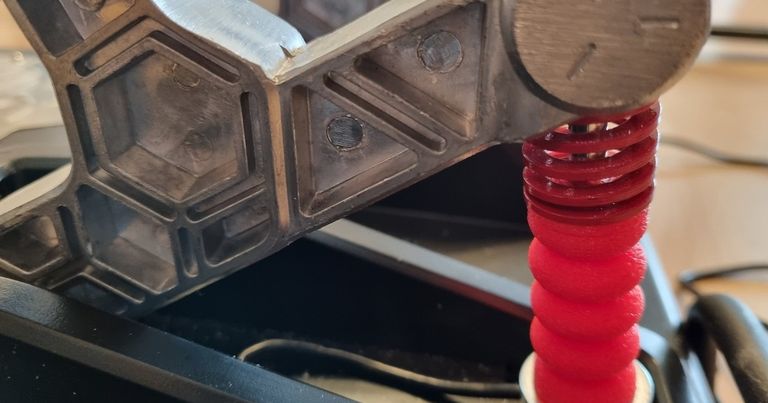
Drive belts, wheels, snap-fits and bumpers that need to flex but hold shape under load
The rigid end of the TPU range at 98 Shore A to 60 Shore D: it prints almost like a rigid filament, runs on Bowden, and posts the best abrasion and tear figures in the group.
Hard TPU is used when an elastomer must flex but should not feel floppy: wheels, feed rollers, drive components, bumpers and firm flexible retainers. Its shape retention and abrasion resistance are useful at repeated contact surfaces. The documented simulator-pedal spring below is a different use of the same principle: a firm elastomer deforms to generate resistance over a controlled travel.
This category extends from nominal 98 Shore A into grades also described on the Shore D scale; those numbers must stay on their stated scales. The harder feel does not eliminate creep or prove fatigue life. A wheel, belt or spring needs its actual load, speed, temperature and deformation considered together. Reinforced commercial timing belts and molded industrial wheels also have structures and processing histories that an unreinforced FDM print does not reproduce.
An orange printed spring installed in a Thrustmaster sim-racing brake pedal. The uploader used Extrudr TPU Medium 98A.
Listing note: “I used TPU with a shore hardness of A98 (Extrudr TPU medium Neon Orange).”
Printables listing uploaded by DonKeulito · CC BY-NC 4.0Original listing · Checked 2026-10-17. This is an uploader report, not an independent material test.Source image · Image bytes unchanged; displayed in full. Noncommercial reuse only.
Representative catalog values. Check the exact grade and its linked conditions before using a setting.
230–260 (Extrudr FLEX HARD)
230–260 (Extrudr FLEX HARD)
50–90 (Extrudr FLEX HARD)
50–90 (Extrudr FLEX HARD)
Open frame is fine
Open frame is fine
60 °C for 12 h (Extrudr FLEX HARD)
60 °C for 12 h (Extrudr FLEX HARD)
Open a topic to explore the complete data. Each value keeps its original conditions, units and dated sources.
| Property and unit | Published value and conditions | Sources and dates |
|---|---|---|
| Base polymer / chemistry | Hard thermoplastic polyurethane at 98 Shore A to about 60 Shore D — the rigid end of the TPU range | 2 sources
|
| Density (g/cm³) | 1.23 (Fillamentum Flexfill 98A); 1.2 (Extrudr FLEX HARD, ISO 2781) | 2 sources
|
| Typical price (USD/kg) | 1 kg spools cluster near 150 | 1 source
|
| Price range across brands (USD/kg) | 95–150 across brands; Proto-pasta Clear Rigid TPU 95, Push Plastic TPU 100A 150 | 2 sources
|
| Market availability (1–5) | Available from several mainstream brands | 3 sources
|
| Spool sizes & diameters | 1.75 and 2.85 mm; 0.5, 0.75 and 1 kg spools | 2 sources
|
| Typical applications | Drive belts, wheels, snap-fits and bumpers that need to flex but hold shape under load | 1 source
|
| Property and unit | Published value and conditions | Sources and dates |
|---|---|---|
| Nozzle temperature (°C) | 230–260 (Extrudr FLEX HARD) | 1 source
|
| Bed temperature (°C) | 50–90 (Extrudr FLEX HARD) | 1 source
|
| Enclosure / chamber requirement (1–5) | Open frame is fine | 1 source
|
| Part cooling fan | 0–30 % (Extrudr FLEX HARD) | 1 source
|
| Bed surface & adhesion aid | PEI sheet or painter's tape; Polymaker warns TPU can over-stick and advises a glue stick as a release agent | 2 sources
|
| Maximum volumetric flow (mm³/s; see test conditions) (mm³/s) | 4.6 (Extrudr FLEX HARD, stated max volumetric speed on a 0.4 mm nozzle) | 1 source
|
| Warping tendency (1–5) | None | 1 source
|
| Overall printing difficulty (1–5) | Easy — minor profile tuning; at this hardness the filament pushes like a rigid material | 1 source
|
| Extruder requirement | Bowden viable at this hardness — Extrudr rates FLEX HARD to 100 mm/s where its soft grades cap lower | 1 source
|
| Property and unit | Published value and conditions | Sources and dates |
|---|---|---|
| Nozzle hardness required (1–4) | Brass fine indefinitely | 1 source
|
| Abrasiveness (1–5) | Non-abrasive | 1 source
|
| Nozzle clog risk (1–5) | Low | 1 source
|
| Heat-creep / jam sensitivity (1–5) | Moderate — good heatbreak cooling needed | 1 source
|
| Hotend requirement | No special hot-end required, but a direct-drive extruder is (Simplify3D) | 1 source
|
| Property and unit | Published value and conditions | Sources and dates |
|---|---|---|
| Moisture absorption (hygroscopicity) (1–5) | Moderate — the TPU family absorbs readily; Extrudr specifies a 12 h dry at 60 °C for FLEX HARD | 2 sources
|
| Drying temperature & time | 60 °C for 12 h (Extrudr FLEX HARD) | 1 source
|
| Symptoms when wet | Bubbling and popping at the nozzle, stringing and a rough surface | 1 source
|
| Effect of moisture on strength | Polymaker groups TPU with the highly hygroscopic materials; no dry-versus-conditioned figures are published | 1 source
|
| Storage requirement | Sealed with desiccant; often kept in a dryer during the print | 1 source
|
| Property and unit | Published value and conditions | Sources and dates |
|---|---|---|
| Tensile strength (XY) (MPa) | 53.7 at break (Fillamentum Flexfill 98A, DIN 53504) | 1 source
|
| Elongation at break (%) | 318 at break (Fillamentum Flexfill 98A, DIN 53504); Extrudr FLEX HARD 490 (ISO 527-2) | 2 sources
|
| Brittleness (1–5) | Very ductile — bends far before failing | 1 source
|
| Hardness (scale-specific) (Shore A / Shore D / Rockwell) | 98 Shore A and 60 Shore D (Fillamentum, ISO 7619-1); Extrudr FLEX HARD 58 Shore D (ISO 868) | 2 sources
|
| Creep resistance / sustained load (1–5) | Poor — no 98A creep test; a printed 95A TPU bar crept from 74.5 to 82.7 mm over 5 days at 1.25 kg | 1 source
|
| Fatigue / repeated-flex resistance (1–5) | Excellent — living hinges viable | 1 source
|
| Elasticity / flexibility (1–5) | Semi-flexible | 2 sources
|
| Wear resistance & friction | Abrasion 23 mm³ (Fillamentum, ISO 4649 method A) and 26 mm³ (Extrudr FLEX HARD, ISO 4649-A) — the best abrasion figures in the group | 2 sources
|
| Property and unit | Published value and conditions | Sources and dates |
|---|---|---|
| Melting point / Vicat (°C) | 190–210 melting (Extrudr FLEX HARD, ISO 3146-C); Vicat A 140 (ISO 306) | 1 source
|
| Property and unit | Published value and conditions | Sources and dates |
|---|---|---|
| UV resistance (1–5) | Good — years with some colour shift; Polymaker lists UV exposure among the conditions TPU withstands | 1 source
|
| Chemical resistance | Withstands industrial solvents and UV exposure (Polymaker) | 1 source
|
| Food contact | Not food safe without specific certification (Polymaker) | 1 source
|
| Biodegradability / compostability | Not biodegradable | 1 source
|
| Recyclability | Not accepted in household plastic collection | 1 source
|
| Property and unit | Published value and conditions | Sources and dates |
|---|---|---|
| Fume toxicity (1–5) | Low hazard — minimal VOC and particle emission; TPU was not among the nine filaments in the chamber study | |
| Ventilation / filtration requirement (1–5) | Open a window / occasional ventilation |
| Property and unit | Published value and conditions | Sources and dates |
|---|---|---|
| Sanding & machining | Difficult to sand or smooth; Polymaker limits post-processing to trimming or tumbling | 1 source
|
| Gluing & solvent welding | Cyanoacrylate bonds TPU; no common solvent welds it | 1 source
|
| Vapour / chemical smoothing | No practical vapour smoothing | 1 source
|
| Support material pairing | Polymaker warns TPU supports are often very difficult to remove | 1 source
|
| Dimensional accuracy & detail | Tear strength 170 kN/m (Fillamentum, ISO 34-1) and 175 kN/m (Extrudr FLEX HARD, ISO 34-1B) | 2 sources
|
| Property and unit | Published value and conditions | Sources and dates |
|---|---|---|
| Soluble in | DMF, DMSO, NMP and THF dissolve TPU; acetone, MEK and cyclohexanone are partial solvents. All laboratory reagents. | 1 source |
| Softened or crazed by | Toluene and benzene swell it up to +50 % by weight at 23 °C; esters swell it severely; ethanol and IPA soften it. | 1 source |
| Solvent welding & smoothing agent | None practical — the true solvents (DMF, THF, NMP) are laboratory reagents and leave the joint swollen and weak. | 1 source |
Values describe representative grades, not every spool. Manufacturer datasheets and independent tests retain their source labels and dates. Printed orientation, test method, conditioning and formulation can change results. Unknown values are —. A listed use is not a certification. Shore A, Shore D and Rockwell hardness are separate scales.
Historical USD/kg snapshots. Read each listing’s sale/from qualifiers, spool mass, source date, shipping and tax notes. Product figures are separate from the material summary.
$34.99 / 1 kg spool, us.store.bambulab.com, Aug 2026
Shore 68D — considerably harder than a nominal 95A TPU, which is what lets it run through the AMS. Bambu allows up to 250 mm/s. Bambu rate this 68 Shore D — harder than the 95A grades, which is why it sits here rather than with them.
Open product listing ↗| Density (g/cm³) | 1.26 (ISO 1183) |
|
|---|---|---|
| Spool sizes & diameters | 1.75 mm, 1 kg on a PC+ABS spool |
|
| Nozzle temperature (°C) | 220–240 |
|
| Bed temperature (°C) | 30–35 |
|
| Recommended chamber temperature (°C) | 25–45 |
|
| Part cooling fan | On |
|
| Equilibrium moisture content at ~50 % RH (%) | 1.20 saturated water absorption at 25 °C, 55 % RH |
|
| Drying temperature & time | 70 °C for 8 h in a blast drying oven, or 80–90 °C for 12 h on the heatbed |
|
| Tensile strength (XY) (MPa) | 22.4 ± 0.6 printed XY, 11.2 ± 0.5 printed Z (ISO 527) |
|
| Young's modulus (MPa) | 1190 printed XY, 600 printed Z (ISO 527) |
|
| Elongation at break (%) | >650 printed XY, 31 printed Z (ISO 527) |
|
| Other impact data | Charpy 124.3 kJ/m² printed XY, 9.6 ± 0.3 printed Z (ISO 179) |
|
| Layer adhesion / Z tensile (MPa) | 11.2 ± 0.5 printed Z (ISO 527) |
|
| Hardness (scale-specific) (Shore A / Shore D / Rockwell) | 68 Shore D |
|
| Melting point / Vicat (°C) | 183 melting point (DSC, 10 °C/min) |
|
$94.99 / 1 kg spool; 500 g $49.99, proto-pasta.com product catalogue, Aug 2026
Polyether-based rigid TPU, UV resistant, holds shape to about 200 °C by Protoplant's account. Discontinued — the pellet feedstock is no longer available.
Open product listing ↗| Nozzle temperature (°C) | From 240 upward |
|
|---|---|---|
| Bed temperature (°C) | None required |
|
| Drying temperature & time | Overnight drying recommended before printing |
|
| Hardness (scale-specific) (Shore A / Shore D / Rockwell) | About 70 Shore D (manufacturer designation) |
|
$149.99 / 1 kg spool, pushplastic.com product catalogue, Aug 2026
Push Plastic recommends a 0.6 mm nozzle at 0.2–0.3 mm layer height and publishes no mechanical data for this grade.
Open product listing ↗| Spool sizes & diameters | 1.75 mm, 1 kg |
|
|---|---|---|
| Nozzle temperature (°C) | 230–250; the hotter end gives better layer adhesion |
|
| Bed temperature (°C) | 60–80 |
|
| Hardness (scale-specific) (Shore A / Shore D / Rockwell) | 100 Shore A (manufacturer designation) |
|
Carbon-filled hard TPU at 70 Shore D for damping mounts and semi-rigid brackets. Extrudr flags it as the one FLEX grade that…
1 product listingTPU with a blowing agent, sold as varioShore, Filaflex Foamy, TPU-Aero and TPU Air: foaming starts near 230 °C and the printed…
6 product listings
Below 85 Shore A the filament will not push through anything but a short constrained direct-drive path. Fiberlogy's 81 Shore A…
4 product listings