 3D Printing Info

Where it is used
Highly compliant seals, soft grips and prosthetic liners
Sources
- FiberFlex 30D Technical Data Sheet · 2026-08 · tds
Below 85 Shore A the filament will not push through anything but a short constrained direct-drive path. Fiberlogy's 81 Shore A grade reaches 870 % elongation at break, the highest in the…
Open in interactive comparison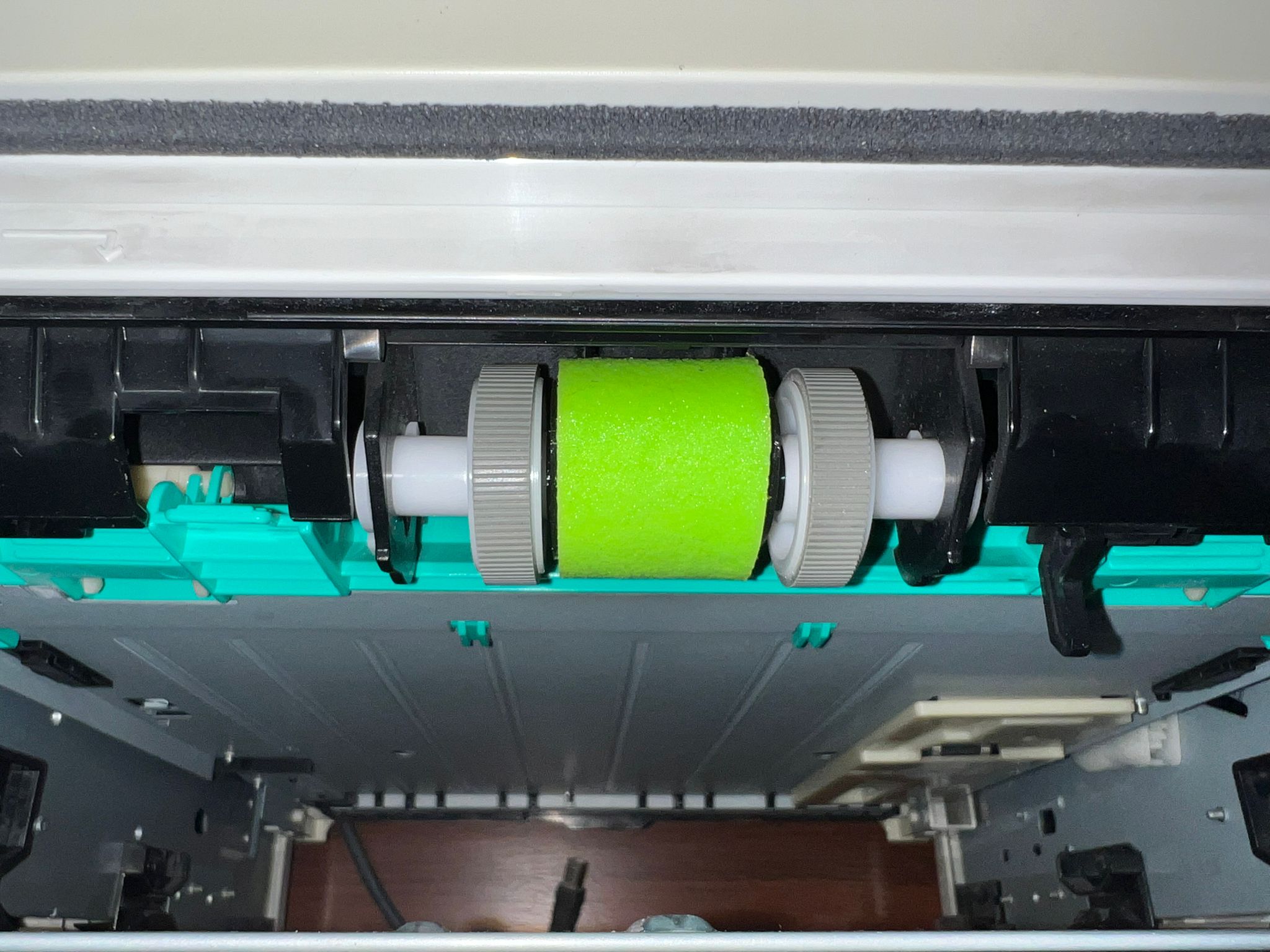
Highly compliant seals, soft grips and prosthetic liners
Below 85 Shore A the filament will not push through anything but a short constrained direct-drive path. Fiberlogy's 81 Shore A grade reaches 870 % elongation at break, the highest in the dataset.
Very soft TPU is useful where the contact surface should conform readily: gripping sleeves, compliant contact pads, flexible covers and feed-roller surfaces. Rather than maintaining a precise position under load, it spreads contact and accommodates movement. The documented paper-feed roller repair below is a good example of this role: the soft printed sleeve works with the existing rigid roller assembly.
The softness is also its limitation. A thin flexible wall can feed poorly through an unsuitable extruder, and a compressed part can continue deforming while the load remains applied. Very high elongation at break is not a measurement of usable elastic travel or repeated-flex life. For rollers and grips, surface texture, wear and pressure determine performance alongside hardness; the softest available material is not automatically the best choice.
The bright green paper-feed roller sleeve is Recreus Filaflex 82A TPU, printed with fuzzy skin. The surrounding roller assembly and printer are separate components.
Listing note: “Mine it's printed with Recreus Filaflex 82a. (The green one)”
Printables listing uploaded by jon · CC BY-NC-SA 4.0Original listing · Checked 2026-10-17. This is an uploader report, not an independent material test.Source image · Image bytes unchanged; displayed in full. Noncommercial reuse only. ShareAlike applies to adaptations.
Representative catalog values. Check the exact grade and its linked conditions before using a setting.
—
—
—50–70 (Fiberlogy FiberFlex 30D)
50–70 (Fiberlogy FiberFlex 30D)
Open frame is fine
—
—
—Open a topic to explore the complete data. Each value keeps its original conditions, units and dated sources.
| Property and unit | Published value and conditions | Sources and dates |
|---|---|---|
| Base polymer / chemistry | Very soft thermoplastic elastomers below 85 Shore A. Fiberlogy's FiberFlex 30D measures 81 Shore A, the softest grade with a published datasheet found here | 1 source
|
| Density (g/cm³) | 1.07 (Fiberlogy FiberFlex 30D, ISO 1183) | 1 source
|
| Typical price (USD/kg) | 1 kg-equivalent spools cluster near 115 | 3 sources
|
| Price range across brands (USD/kg) | 110–122 at 1 kg-equivalent; Recreus 70A 110 and 60A 116 at 500 g, NinjaTek Edge 83A 112, NinjaTek Chinchilla 75A 122; the Recreus 3 kg spools fall to 70–73 | 3 sources
|
| Market availability (1–5) | Niche, a handful of specialist brands | 3 sources
|
| Spool sizes & diameters | 1.75, 2.85 and 3 mm; 0.5, 0.85, 1, 2 and 3 kg spools | 4 sources
|
| Typical applications | Highly compliant seals, soft grips and prosthetic liners | 1 source
|
| Property and unit | Published value and conditions | Sources and dates |
|---|---|---|
| Bed temperature (°C) | 50–70 (Fiberlogy FiberFlex 30D) | 1 source
|
| Enclosure / chamber requirement (1–5) | Open frame is fine | 1 source
|
| Bed surface & adhesion aid | PEI sheet or painter's tape; Polymaker warns TPU can over-stick and advises a glue stick as a release agent | 2 sources
|
| Overall printing difficulty (1–5) | Expert / industrial hardware only — below 85 Shore A the filament buckles in almost any feed path that is not a short, constrained direct drive | 2 sources
|
| Extruder requirement | Direct drive only, with a constrained filament path; Bowden is not viable at this hardness | 2 sources
|
| Property and unit | Published value and conditions | Sources and dates |
|---|---|---|
| Nozzle hardness required (1–4) | Brass fine indefinitely | 1 source
|
| Abrasiveness (1–5) | Non-abrasive | 1 source
|
| Nozzle clog risk (1–5) | High — jams from moisture, heat creep or particles; below 85 Shore A the filament buckles and compresses, and Simplify3D warns that raised feed rates most likely end in a jam | 3 sources
|
| Heat-creep / jam sensitivity (1–5) | Very high — softens in the cold zone readily | 1 source
|
| Hotend requirement | No special hot-end required, but a direct-drive extruder is (Simplify3D) | 1 source
|
| Property and unit | Published value and conditions | Sources and dates |
|---|---|---|
| Moisture absorption (hygroscopicity) (1–5) | Moderate | 1 source
|
| Symptoms when wet | Bubbling and popping at the nozzle, stringing and a rough surface | 1 source
|
| Effect of moisture on strength | Polymaker groups TPU with the highly hygroscopic materials; no dry-versus-conditioned figures are published | 1 source
|
| Storage requirement | Sealed with desiccant; often kept in a dryer during the print | 1 source
|
| Property and unit | Published value and conditions | Sources and dates |
|---|---|---|
| Elongation at break (%) | 870 at break (Fiberlogy FiberFlex 30D, ISO 527) — the highest elongation in the dataset | 1 source
|
| Brittleness (1–5) | Very ductile — bends far before failing | 1 source
|
| Hardness (scale-specific) (Shore A / Shore D / Rockwell) | 81 Shore A and 30 Shore D (Fiberlogy FiberFlex 30D, ISO 7619) | 1 source
|
| Creep resistance / sustained load (1–5) | Poor — no creep test at this hardness; a printed 95A TPU bar crept from 74.5 to 82.7 mm over 5 days at 1.25 kg | 1 source
|
| Fatigue / repeated-flex resistance (1–5) | Excellent — living hinges viable | 1 source
|
| Elasticity / flexibility (1–5) | Rubbery / highly elastic | 1 source
|
| Wear resistance & friction | Tear strength 95 kN/m (Fiberlogy FiberFlex 30D, ISO 34-1) | 1 source
|
| Property and unit | Published value and conditions | Sources and dates |
|---|---|---|
| Melting point / Vicat (°C) | 170 melting (Fiberlogy FiberFlex 30D, DSC) | 1 source
|
| Property and unit | Published value and conditions | Sources and dates |
|---|---|---|
| UV resistance (1–5) | Good — years with some colour shift; Polymaker lists UV exposure among the conditions TPU withstands | 1 source
|
| Chemical resistance | Withstands industrial solvents and UV exposure (Polymaker) | 1 source
|
| Food contact | Not food safe without specific certification (Polymaker) | 1 source
|
| Biodegradability / compostability | Not biodegradable | 1 source
|
| Recyclability | Not accepted in household plastic collection | 1 source
|
| Property and unit | Published value and conditions | Sources and dates |
|---|---|---|
| Fume toxicity (1–5) | Low hazard — minimal VOC and particle emission; TPU was not among the nine filaments in the chamber study | |
| Ventilation / filtration requirement (1–5) | Open a window / occasional ventilation |
| Property and unit | Published value and conditions | Sources and dates |
|---|---|---|
| Sanding & machining | Difficult to sand or smooth; Polymaker limits post-processing to trimming or tumbling | 1 source
|
| Gluing & solvent welding | Cyanoacrylate bonds TPU; no common solvent welds it | 1 source
|
| Vapour / chemical smoothing | No practical vapour smoothing | 1 source
|
| Support material pairing | Polymaker warns TPU supports are often very difficult to remove | 1 source
|
| Property and unit | Published value and conditions | Sources and dates |
|---|---|---|
| Soluble in | DMF, DMSO, NMP and THF dissolve TPU; acetone, MEK and cyclohexanone are partial solvents. All laboratory reagents. | 1 source |
| Softened or crazed by | Toluene and benzene swell it up to +50 % by weight at 23 °C; esters swell it severely; ethanol and IPA soften it. | 1 source |
| Solvent welding & smoothing agent | None practical — the true solvents (DMF, THF, NMP) are laboratory reagents and leave the joint swollen and weak. | 1 source |
Values describe representative grades, not every spool. Manufacturer datasheets and independent tests retain their source labels and dates. Printed orientation, test method, conditioning and formulation can change results. Unknown values are —. A listed use is not a certification. Shore A, Shore D and Rockwell hardness are separate scales.
Historical USD/kg snapshots. Read each listing’s sale/from qualifiers, spool mass, source date, shipping and tax notes. Product figures are separate from the material summary.
$54.90 / 500 g spool = $109.80/kg, recreus.com/en-en (USD storefront), Aug 2026
Handle filaflex-70a; 3 kg spool EUR 204.49 (EUR 68.16/kg).
Open product listing ↗| Spool sizes & diameters | 1.75, 2.20 and 2.85 mm; 500 g, 1 kg and 3 kg |
|
|---|---|---|
| Nozzle temperature (°C) | 240 |
|
| Bed temperature (°C) | Room temperature for small parts; 45–50 for large ones |
|
| Maximum volumetric flow (mm³/s; see test conditions) (mm³/s) | 2.5 on a 0.4 mm nozzle |
|
| Elongation at break (%) | Up to 900 at break (Recreus product page) |
|
| Hardness (scale-specific) (Shore A / Shore D / Rockwell) | 70 Shore A (manufacturer designation) |
|
$112.28 / 1 kg spool (1.75 mm, Snow White), ninjatek.com, Aug 2026
Sold as a TPE at 83 Shore A and printable roughly twice as fast as NinjaFlex. NinjaTek publishes no Edge data sheet — the Edge TDS link on its own product page serves the Eel document — so only the product-page figures are sourced.
Open product listing ↗| Nozzle temperature (°C) | 225–250 |
|
|---|---|---|
| Bed temperature (°C) | room temperature to 50; glue stick suggested |
|
| Maximum volumetric flow (mm³/s; see test conditions) (mm³/s) | 2.4–4.0 at the 30–50 mm/s infill speed NinjaTek specifies, 0.4 mm nozzle, 0.2 mm layer |
|
| Hardness (scale-specific) (Shore A / Shore D / Rockwell) | 83 Shore A (manufacturer designation) |
|
$57.90 / 500 g spool = $115.80/kg, recreus.com/en-en (USD storefront), Aug 2026
Handle filaflex-60a; 3 kg spool EUR 218.89 (EUR 72.96/kg). The softest filament with a retail listing found here.
Open product listing ↗| Spool sizes & diameters | 1.75, 2.20 and 2.85 mm; 500 g, 1 kg and 3 kg |
|
|---|---|---|
| Nozzle temperature (°C) | 235 |
|
| Bed temperature (°C) | Room temperature for small parts; 40–45 for large ones |
|
| Part cooling fan | Off (0 %); 40 % for layers shorter than 10 s |
|
| Maximum volumetric flow (mm³/s; see test conditions) (mm³/s) | 2.0 on a 0.4 mm nozzle; 4.5 on 0.6 mm, 8.0 on 0.8 mm, 12.5 on 1.0 mm |
|
| Drying temperature & time | 55 °C, minimum 1 h |
|
| Elongation at break (%) | 950 at break (Recreus product page) |
|
| Hardness (scale-specific) (Shore A / Shore D / Rockwell) | 60 Shore A (manufacturer designation) |
|
$122.27 / 1 kg spool (1.75 mm, Sky Blue), ninjatek.com, Aug 2026
A TPE blend rather than a polyurethane, matte finish, tested skin-safe on the EpiDerm model. Its data sheet gives -12 °F against -80 °C for Tg, so the glass transition is omitted here.
Open product listing ↗| Density (g/cm³) | 1.13 (ASTM D792) |
|
|---|---|---|
| Nozzle temperature (°C) | 225–235 |
|
| Bed temperature (°C) | room temperature to 40; adheres without glue on standard plates |
|
| Maximum volumetric flow (mm³/s; see test conditions) (mm³/s) | 1.2–2.8 at the 15–35 mm/s infill speed NinjaTek specifies, 0.4 mm nozzle, 0.2 mm layer |
|
| Equilibrium moisture content at ~50 % RH (%) | 0.8 after 24 h (ASTM D570 immersion) — four times NinjaFlex, and not an equilibrium value |
|
| Tensile strength (XY) (MPa) | 22 ultimate and 5 at yield (ASTM D638; specimen type not stated) |
|
| Young's modulus (MPa) | 34 (ASTM D638) |
|
| Elongation at break (%) | 600 at break and 20 at yield (ASTM D638) |
|
| Hardness (scale-specific) (Shore A / Shore D / Rockwell) | 75 Shore A (ASTM D2240) |
|
| Melting point / Vicat (°C) | 180 melting (DSC) |
|