 3D Printing Info
Build volume
360 x 360 x 360 mm, which Prusa states as 46.7 litres
Advertised dimensions; check usable space and variants.
Sources & dates
- Original Prusa XL+ product page (spec block and variant price data) · 2026-08 · vendor
Large-format 360 mm cube CoreXY Prusa with a segmented 16-tile heatbed, in the single-toolhead configuration.
360 x 360 x 360 mm, which Prusa states as 46.7 litres
Advertised dimensions; check usable space and variants.
290 C claimed max nozzle temperature
Published limits; hardware and firmware limits may differ.
$2,128.70 on prusa3d.com, Aug 2026 (lowest listed price for the Single-Tool variant; the Enclosure bundle starts at $2,610.19)
Dated listing, not a live offer. Read the configuration and region.
Understand the hardware, explore compatible changes and find a diagnostic starting point when something goes wrong. Expand the specification sections for every recorded value, condition and original reference.
Dimensions, construction and the hardware that moves the print.
| Property and unit | Published value and conditions | Sources and dates |
|---|---|---|
| Manufacturer & exact marketed model name (verify the exact product identity first) | Original Prusa XL+, Single-Tool variant ("Prusa XL+ Single-Tool" in the e-shop variant data) | 2 sources
|
| Release date (announcement and actual shipping) | The XL+ refresh was announced on 13 August 2026, on sale immediately in all toolhead configurations, with assembled printers shipping later in August 2026 and upgrade kits for existing XL owners from around the end of August. The original Original Prusa XL predates it | |
| Street price (USD; dated snapshot per entry) | $2,128.70 on prusa3d.com, Aug 2026 (lowest listed price for the Single-Tool variant; the Enclosure bundle starts at $2,610.19) | 1 source
|
| Variants & sibling models — and how to tell them apart (spec-contamination risk) | The XL+ is sold in Single-Tool, Dual-Head and Five-Head variants at $2,128.70, $2,768.52 and $3,610.18 respectively (Aug 2026), plus Enclosure bundles and a Critical Infrastructure edition. The frame is the same in all of them - Prusa states the frame is ready for toolheads to be added at any time - so build volume, bed and electronics figures are shared and only the toolhead count and price differ. The XL+ is itself a revision of the Original Prusa XL: the older XL aligned toolheads with a mechanical pin, the XL+ uses a dedicated electronic sensor, adds a nozzle wiper and is claimed to print 10-15% faster | 2 sources
|
| Market position: superseded? successor announced? | Current model; an Original Prusa XL to Prusa XL+ upgrade kit is sold for existing owners | 1 source
|
The model-specific kit encloses the printer and integrates chamber sensing, lighting and filtration controls.
Applies to: XL+ 1-tool configuration; this enclosure is explicitly different from the original XL enclosure.
| Property and unit | Published value and conditions | Sources and dates |
|---|---|---|
| Build volume X×Y×Z (mm) — advertised vs actually usable | 360 x 360 x 360 mm, which Prusa states as 46.7 litres | 1 source
|
| Machine footprint (mm) & clearance needed (cable/spool overhang) | About 700 x 900 x 720 mm (Prusa's own figure is approximate) | 1 source
|
| Net weight (kg) | About 30 kg | 1 source
|
| Frame construction & material | Aluminium extrusions and steel sheets (Prusa's comparison table for the XL) | 1 source |
| Enclosure: open / enclosed; panel material; door/lid | Open frame. The Enclosure for Prusa XL+ is an optional add-on; Prusa says the printer is ready for chamber temperatures up to 60 C, that the new better-sealed enclosure reaches around 50 C on the printer's own waste heat, and that 60 C needs an upcoming chamber heater for which no shipping date has been given |
| Property and unit | Published value and conditions | Sources and dates |
|---|---|---|
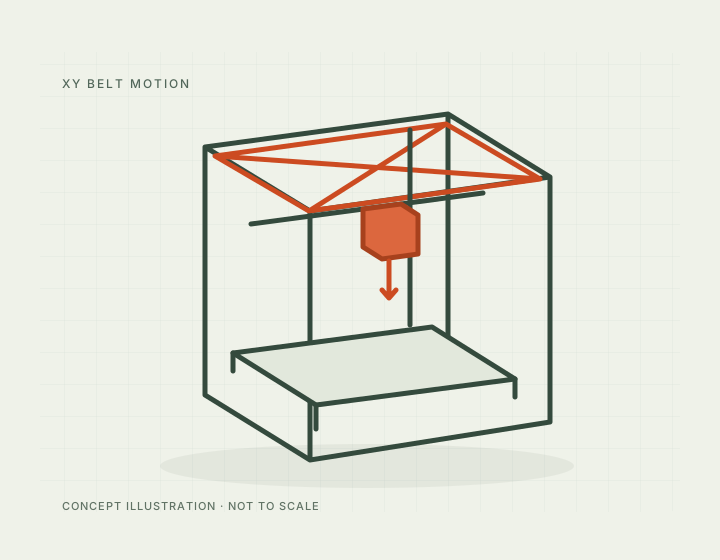
| Kinematics (bedslinger i3 / CoreXY / other) | CoreXY with 1.5 mm GT belts, Input Shaper and Phase Stepping | 1 source
|
| Belts (type, width, e.g. Gates?) | 1.5 mm GT belts | 1 source
|
Extrusion, heating, leveling and material handling.
| Property and unit | Published value and conditions | Sources and dates |
|---|---|---|
| Input shaping supported? Implementation (Klipper IS / Marlin ZV / proprietary) | Input Shaper and Phase Stepping | 1 source
|
| Property and unit | Published value and conditions | Sources and dates |
|---|---|---|
| Type (direct drive / bowden) & design name | Nextruder direct drive; each toolhead carries its own extruder, hotend, nozzle and filament | 1 source
|
| Property and unit | Published value and conditions | Sources and dates |
|---|---|---|
| Hotend design (proprietary/standard; quick-swap mechanism?) | Quick-swap nozzles - 0.25 mm for detail, 0.6/0.8 mm for speed, hardened steel for abrasives, high-flow CHT for throughput; toolheads ship with high-flow nozzles | 1 source
|
| Max nozzle temp claimed AND firmware max temp limit (both values) | 290 C claimed max nozzle temperature | 1 source
|
| Property and unit | Published value and conditions | Sources and dates |
|---|---|---|
| Max bed temp claimed AND firmware limit | 120 C max heatbed temperature | 1 source
|
| Bed surface (material, texture, coating), single/double-sided | Segmented heatbed of 16 individually controlled tiles across the 360 x 360 mm surface, so only the tiles under the part are powered; removable double-sided satin print sheet supplied | 1 source
|
| Property and unit | Published value and conditions | Sources and dates |
|---|---|---|
| Auto bed leveling: probe technology (inductive / strain gauge / load cell / touch probe) | Load-cell sensor - the nozzle is the probe, which Prusa says automatically accounts for nozzle changes, surface textures and thermal expansion and removes manual Z-offsets. Toolhead-to-toolhead alignment on the XL+ uses a separate permanently mounted eddy-current Tool Offset Sensor, replacing the removable mechanical pin used on the original XL |
| Property and unit | Published value and conditions | Sources and dates |
|---|---|---|
| Filament runout sensor (type, location) | Filament sensors fitted; Prusa's comparison table lists two filament sensors for the XL | 1 source |
| Property and unit | Published value and conditions | Sources and dates |
|---|---|---|
| Part-cooling fan(s): count, size, ducting design | 360-degree part cooling on each toolhead, new on the XL+ and matching the MK4S and CORE One arrangement; Prusa states it delivers more airflow and distributes it more evenly around the nozzle. Additional fans and heatsinks cool the electronics. Fan sizes are not published |
| Property and unit | Published value and conditions | Sources and dates |
|---|---|---|
| Officially supported filament list | PLA, PETG, ASA, ABS, PC, PA (nylon), TPU, PVA, HIPS, PP, CPE, PVB and carbon-fibre composites. Prusa states an open material policy - any brand of 1.75 mm filament, no chips and no subscriptions | 1 source
|
Firmware, controls, connections and calibration.
| Property and unit | Published value and conditions | Sources and dates |
|---|---|---|
| Mainboard model & MCU (exact chip markings if teardowns exist) | Custom 32-bit xBuddy electronics with STM32 (Prusa's comparison table for the XL) | 1 source |
The XL+ release history documents a correction for getting stuck during heating when resuming a print. Check the installed version against current official releases.
Applies to: Version-specific XL+ software issue; persistent heater errors still require their own diagnostics.
Prusa’s current XL+ support page provides stock firmware and configuration-specific setup manuals.
Applies to: XL+ with 1 installed tool; preserve its tool count and calibration configuration.
| Property and unit | Published value and conditions | Sources and dates |
|---|---|---|
| Firmware base & current version (Klipper fork / Marlin fork / proprietary) | Open-source firmware - Prusa states "Firmware: Open-source; ships with the full current Prusa feature set", and the XL is covered by the prusa3d/Prusa-Firmware-Buddy source tree | 2 sources |
| Property and unit | Published value and conditions | Sources and dates |
|---|---|---|
| Display: size, type, touch? | 3.5-inch 65k-colour screen with touch control (Prusa's comparison table for the XL) | 1 source |
| On-device UI capabilities (model preview, per-object controls, etc.) | On-device touch UI; Prusa Connect and the Prusa mobile app are optional - Prusa states the machine is fully offline capable | 2 sources |
| WiFi (band/standard), Ethernet, USB ports, SD/flash-drive | Ethernet, optional Wi-Fi; USB drive for print files. Prusa Connect optional and fully offline operation supported | 2 sources |
Published safeguards, support terms and independent evidence.
| Property and unit | Published value and conditions | Sources and dates |
|---|---|---|
| Thermal runaway protection (verify in firmware source if at all possible) | Open-source firmware on the xBuddy platform, which carries hardware overcurrent protection cutting heater and heatbed power above 15 A |
| Property and unit | Published value and conditions | Sources and dates |
|---|---|---|
| Warranty length & support reputation (evidence, not vibes) | 2-year warranty for consumers in the EU, Liechtenstein, Switzerland, Norway and Iceland; 1 year for EU enterprises and 1 year for the rest of the world, which includes the United States. A printer bought from a reseller or privately carries 1 year from the original delivery date and is handled by the reseller. Prusa advertises 24/7 chat and e-mail support in seven languages | 2 sources
|
This guide presents the catalog’s sourced record for this exact model. Source dates belong to each reference; a page update does not mean every specification has been rechecked.
Prices are dated listing snapshots, with configuration, regional and sale conditions. They are not current offers. Unknown values remain unfilled.
Firmware, variants and available accessories can change. Read the original reference before making a purchase or planning a process.
Firmware, modifications and troubleshooting links are checked against the model and stated hardware or firmware revision. A creator’s compatibility claim is not a fit test by this site. Official troubleshooting describes a diagnostic route; individual reports do not establish a failure rate.
This review did not verify printable modifications for this exact model. That is a research gap, not a claim that none exist.