3D Printing Info
CoreXYQIDI

QIDI Q2

140 catalog fields141 catalog sources

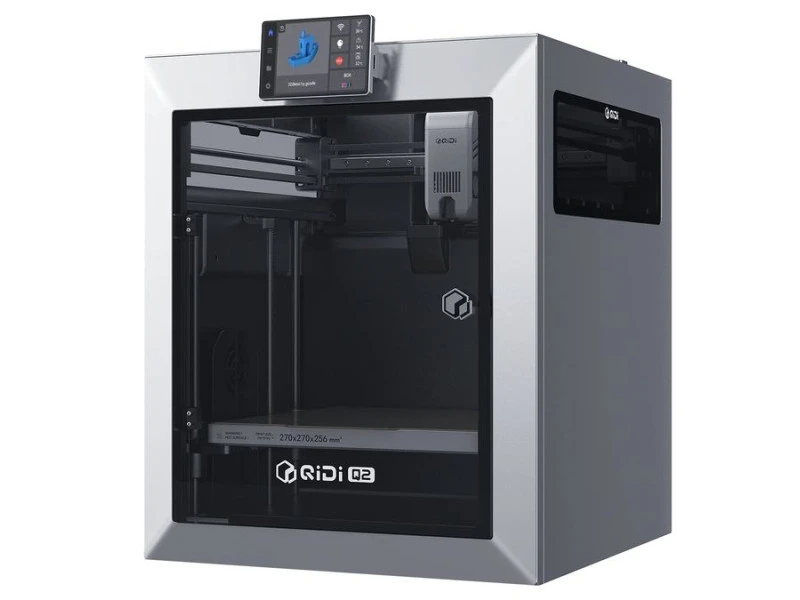
Model referenceQIDI Q2 3D Printer; product image published by Top 3D Shop. Pictured accessories and sample prints may be optional.
Publisher product image · Top 3D Shop · Image source · Top 3D Shop content permission · Proportionally resized and encoded as WebP. No crop or retouch.
Start here

At a glance

Explore this printer

Build volume

Advertised 270 × 270 × 256 mm. Firmware travel: X position_min:-1 / position_endstop:271 / position_max:275; Y position_min:-1 / position_endstop:-1 / position_max:295; Z position_min:-2 / position_max:265. Macro limits max_x_position:270, max_y_position:270, max_z_position:260. Default usable is smaller: QIDI Studio blanks an ≈11 × 16 mm² region at the front-left corner for the filament-cutter stopper

Advertised dimensions; check usable space and variants.

Sources & dates
  • firmware/config/printer.cfg L149-199; firmware/config/gcode_macro.cfg L3-8 ([gcode_macro PRINTER_PARAM]); wiki.qidi3d.com/en/Q2/print-volume-limitations · 2026-08 · local

Nozzle temperature

Claimed 370 °C. Firmware limit max_temp: 375 in [extruder] (with min_temp: 0, min_extrude_temp: 175). Runaway guard [verify_heater extruder] max_error: 120, check_gain_time: 20, hysteresis: 2, heating_gain: 2

Published limits; hardware and firmware limits may differ.

Sources & dates
  • firmware/config/printer.cfg L74-76 (min_temp: 0, max_temp: 375, min_extrude_temp: 175), L317-321; docs/QIDI-Q2-TDS.pdf ("Print Head Temperature ≤ 370℃"); tomshardware.com · 2026-08 · local

Price snapshot

$499.00, identical on QIDI's own US store and on Amazon, checked 2026-08-21. QIDI's collection tile renders "Regular price $698.00 / Sale price from $499.00"

Dated listing, not a live offer. Read the configuration and region.

Sources & dates
  • us.qidi3d.com/products/qidi-q2 (variant JSON: "price":49900, "compare_at_price":null, "available":true); amazon.com/dp/B0FDWK8JD6 (a-price-whole = 499); us.qidi3d.com col · 2026-08 · local
A closer look

Hardware, software & ownership

Full specifications inside each chapter

Understand the hardware, explore compatible changes and find a diagnostic starting point when something goes wrong. Expand the specification sections for every recorded value, condition and original reference.

Machine & motion

Dimensions, construction and the hardware that moves the print.

Model, variants & pricing6 fields
QIDI Q2 — Identity & Market
Property and unitPublished value and conditionsSources and dates
Manufacturer & exact marketed model name (verify the exact product identity first)QIDI Q2 3D Printer. Brand QIDI (traded as Qidi Tech until end-2024). Store SKU Q2001; Amazon ASIN B0FDWK8JD6. Exact legal entity on the nameplate not verified
1 source
  • us.qidi3d.com/products/qidi-q2; docs/QIDI-Q2-TDS.pdf (header "QIDI Q2 Technical Specification"); amazon.com/dp/B0FDWK8JD6 (productTitle); lesimprimantes3d.fr/forum/topic/ · 2026-08 · local
Release date (announcement and actual shipping)Announced and shipping the week of 2025-08-19 → 2025-08-22. Hard timestamps: TDS PDF asset ?v=1755582794 = 2025-08-19; Shopify variant created_at 2025-08-20T16:38:44+08:00; wiki page Q2/intro-Q2 created 2025-08-20T08:43:33Z; first hands-on review 2025-08-20; retail unit in a reviewer's hands 2025-08-24; 3DPrint.com 2025-08-22: "This week, it launched the QIDI Q2"
1 source
  • 3dprint.com/320188/qidi-launches-compact-affordable-qidi-q2-3d-printer-for-home-use/; us.qidi3d.com/products/qidi-q2 (variant JSON); wiki.qidi3d.com/en/Q2/intro-Q2 (page · 2026-08 · local
Launch MSRP (USD)$499 standalone; $649 Combo. Launch promo $469 / $619 for newsletter subscribers until 2025-09-17
1 source
  • 3dprint.com/320188/… ("$499 ($649 for the Q2 and QIDI BOX combo) … $469 … $619 … until September 17th"); us.qidi3d.com/products/qidi-q2; tomshardware.com/3d-printing/qidi · 2026-08 · local
Street price (USD; dated snapshot per entry)$499.00, identical on QIDI's own US store and on Amazon, checked 2026-08-21. QIDI's collection tile renders "Regular price $698.00 / Sale price from $499.00"
1 source
  • us.qidi3d.com/products/qidi-q2 (variant JSON: "price":49900, "compare_at_price":null, "available":true); amazon.com/dp/B0FDWK8JD6 (a-price-whole = 499); us.qidi3d.com col · 2026-08 · local
Variants & sibling models — and how to tell them apart (spec-contamination risk)Q2 $499 (chamber heater ✔, camera ✔, 3-in-1 filter ✔, 350 W + 280 W, 18.1 kg). Q2C $379 (chamber heating "No", AI camera "No", camera/filter Optional, 350 W, 16.9 kg) — all else identical: 270×270×256, 402×438×494, 370 °C, 120 °C bed, 600 mm/s, 20 000 mm/s², load-cell leveling, bimetal nozzle. Q2 Combo $649 = Q2 + QIDI Box ($228 separately). Polar Cooler $199 add-on ([output_pin Polar_cooler], M106 P4). Larger siblings: Plus 4 $699 (305×305×280), Max4 $1,049 (390×390×340, 800 mm/s, 3rd-gen chamber), Plus5 (2026)
1 source
  • qidi3d.com/blogs/news/qidi-3d-printer-comparison (QIDI's own 2026 lineup table); us.qidi3d.com/products/q2c (spec table: "Chamber Temperature No", "AI Camera Detection No · 2026-08 · local
Market position: superseded? successor announced?Still current and in stock 2026-08-21. It is the successor to the Q1 Pro (which QIDI lists Sold Out). No Q2 successor announced; the Q2C (2025-11) is a cheaper de-featured sibling, not a replacement. QIDI has since launched the Plus5 in a higher tier, and the shared "PLUS5/Q2/Q2C" spare-part naming shows the platform is being carried forward
1 source
  • us.qidi3d.com/products/qidi-q2 ("In stock, ready to ship"); 3dwork.io/en/qidi-q2-review/ ("the Q2 arrives as its successor" to the Q1 Pro); qidi3d.com/pages/warranty-poli · 2026-08 · local
Printable modification

Q2 lid riser designs

QIDI publishes downloadable Q2 riser designs from identified contributors, providing alternate top-cover spacing and mounting arrangements.

Applies to: Q2 physical design only; obtain matching files and any required hardware from the linked listing.

Creator listing Sources & dates
Size, frame & enclosure6 fields
QIDI Q2 — Physical & Frame
Property and unitPublished value and conditionsSources and dates
Build volume X×Y×Z (mm) — advertised vs actually usableAdvertised 270 × 270 × 256 mm. Firmware travel: X position_min:-1 / position_endstop:271 / position_max:275; Y position_min:-1 / position_endstop:-1 / position_max:295; Z position_min:-2 / position_max:265. Macro limits max_x_position:270, max_y_position:270, max_z_position:260. Default usable is smaller: QIDI Studio blanks an ≈11 × 16 mm² region at the front-left corner for the filament-cutter stopper
1 source
  • firmware/config/printer.cfg L149-199; firmware/config/gcode_macro.cfg L3-8 ([gcode_macro PRINTER_PARAM]); wiki.qidi3d.com/en/Q2/print-volume-limitations · 2026-08 · local
Machine footprint (mm) & clearance needed (cable/spool overhang)402 × 438 × 494 mm. Shipping carton 480 × 520 × 585 mm
1 source
  • docs/QIDI-Q2-TDS.pdf ("Dimensions 402*438*494 mm", "Package Dimensions 480*520*585mm"); us.qidi3d.com/products/qidi-q2 (FAQ); tomshardware.com/3d-printing/qidi-q2-combo-r · 2026-08 · local
Net weight (kg)Net 18.1 kg; gross (boxed) 23.5 kg
1 source
  • docs/QIDI-Q2-TDS.pdf ("Net Weight: 18.1kg", "Gross Weight: 23.5kg"); lesimprimantes3d.fr/forum/topic/63168 ("le colis pèse 24 kg, l'imprimante elle-même ne pesant qu'un p · 2026-08 · local
Frame construction & materialScrewed steel chassis with injection-moulded plastic outer panels; CoreXY motion frame marketed as "full metal frame and bearings". Shell "Glass and Plastic"
1 source
  • docs/QIDI-Q2-TDS.pdf ("Shell: Glass and Plastic", "Chassis: Steel"); lesimprimantes3d.fr/forum/topic/63168 ("solide cadre acier associé à des parois en matière plastique" · 2026-08 · local
Enclosure: open / enclosed; panel material; door/lidFully enclosed. Front glass door (magnetic, opens ~100°); tinted glass top that slides back like a sunroof with two locking tabs; tinted plexiglass side windows; black plastic rear. Interior panels flame-retardant. Sealing strip bonded around lid perimeter and door
1 source
  • lesimprimantes3d.fr/test-qidi-q2-20251030/ and /forum/topic/63168 ("capot en verre fumé bleu/violet", "une bande d'étanchéité", door "s'ouvre sur 100°"); tomshardware.com · 2026-08 · local
Passive chamber temperature reached (if enclosed; measured values preferred)No instrumented passive (heater-off) chamber figure exists for this machine
1 source
  • (searched tomshardware.com/3d-printing/qidi-q2-combo-review, toms3d.org Q2 review, lesimprimantes3d.fr test + forum 63168 pages 1–2, 3dwork.io, androidpctv.com, insidethe · 2026-08 · local
Motion system8 fields
QIDI Q2 — Kinematics & Motion Hardware
Property and unitPublished value and conditionsSources and dates
Kinematics (bedslinger i3 / CoreXY / other)CoreXY — kinematics:corexy
1 source
  • firmware/config/printer.cfg L117 ([printer]); docs/QIDI-Q2-TDS.pdf ("XY Structure: CoreXY"); tomshardware.com/3d-printing/qidi-q2-combo-review · 2026-08 · local
X-axis guide type (rods / linear rails / V-wheels; size)MGN12 linear rail (QIDI: "High Hardness Linear Guide Rail")
1 source
  • lesimprimantes3d.fr/forum/topic/63168 ("un rail de guidage (MGN12) permet les déplacements"); docs/QIDI-Q2-TDS.pdf ("X Axis: High Hardness Linear Guide Rail"); tomshardwa · 2026-08 · local
Y-axis guide typeTwo Ø8 mm hardened hollow linear steel shafts (one each side) in LMU8UU ball bushings
1 source
  • lesimprimantes3d.fr/forum/topic/63168 ("une tige linéaire de diamètre 8 mm associée à une douille à billes LMU8UU (une tige et douille de chaque côté)"); docs/QIDI-Q2-TDS · 2026-08 · local
Z-axis: leadscrew count & type, sync mechanism, anti-backlashTwo lead screws, two fully independent motors and drivers ([stepper_z] + [stepper_z1]), rotation_distance: 4 (4 mm lead), guided on Ø10 mm linear shafts. Sync is software Z_TILT_ADJUST (points 10,137 and 260,137; z_positions -15,137 / 285,137; retries:2, retry_tolerance:0.05), run at the start of every print. No anti-backlash nut documented
1 source
  • firmware/config/printer.cfg L181-224; docs/QIDI-Q2-TDS.pdf ("Z Axis: Dual Independent Lead Screw Motors, 10mm Linear Shafts and Screws"); tomshardware.com/3d-printing/qid · 2026-08 · local
Belts (type, width, e.g. Gates?)1.5GT profile, 7 mm wide, QIDI-custom "higher tooth density". rotation_distance: 38.82 on X and Y
1 source
  • firmware/config/printer.cfg L154, L170; lesimprimantes3d.fr/test-qidi-q2-20251030/ ("des courroies de 7 mm de pas 1,5 mm"); docs/QIDI-Q2-TDS.pdf ("CoreXY, 1.5GT Belt"); u · 2026-08 · local
Stepper motors (frame size, step angle, brand if known)X/Y/Z: "42-48 High-Speed Motor" (NEMA 17, 42 mm frame, 48 mm body). Extruder: round NEMA 14 pancake. All full_steps_per_rotation: 200 → 1.8°. QIDI publishes X/Y motor constants in-config: resistance 3.7 Ω, inductance 4 mH, holding torque 0.73 N·m, rated current 2.0 A, 200 steps/rev
1 source
  • firmware/config/printer.cfg L136-146 ([motor_constants qidi_x_y]), L71, L155, L171, L187, L207; docs/QIDI-Q2-TDS.pdf ("Motor: 42-48 High-Speed Motor"); lesimprimantes3d.f · 2026-08 · local
Stepper drivers (exact model e.g. TMC2209; UART/SPI; sensorless homing?)5 drivers. Mainboard: 2 × TMC2240 (X, Y — software SPI, cs_pin PC12/PD2, spi_speed:200000, run_current: 1.07, stealthchop_threshold:0, sensorless homing via diag0_pin + driver_SGT:1) and 2 × TMC2209 (Z, Z1 — UART PC5/PB7, run_current: 1.07, stealthchop_threshold: 9999999999, diag_pin + driver_SGTHRS:140). Toolhead: 1 × TMC2209 (extruder — UART THR:PC13, run_current: 0.857, stealthchop_threshold: 0)
1 source
  • firmware/config/printer.cfg L103-107, L227-271; docs/QIDI-Q2-TDS.pdf ("Stepper Motor Driver: TMC2240"); lesimprimantes3d.fr/test-qidi-q2-20251030/ ("2 TMC2240 (axes X et · 2026-08 · local
Microstepping / interpolation settings (firmware evidence)X, Y, extruder: microsteps: 16. Z and Z1: microsteps: 128. interpolate: True on every driver
1 source
  • firmware/config/printer.cfg L70, L153, L169, L185, L205 (microsteps); L105, L234, L249, L259, L268 (interpolate) · 2026-08 · local
Speed & acceleration10 fields
QIDI Q2 — Speed & Acceleration
Property and unitPublished value and conditionsSources and dates
Max print speed (claimed, mm/s)600 mm/s (QIDI words it precisely as "Max Speed of Tool Head")
1 source
  • docs/QIDI-Q2-TDS.pdf; us.qidi3d.com/products/qidi-q2; tomshardware.com/3d-printing/qidi-q2-combo-review; lesimprimantes3d.fr/test-qidi-q2-20251030/; 3dwork.io/en/qidi-q2- · 2026-08 · local
Recommended/typical print speedQIDI FAQ: ~300 mm/s for high-speed PLA/ABS. Actually achieved on stock QIDI Studio profiles (fran6p, per-material averages): PLA ~140–230, TPU 95A ~80, PETG-GF ~200, ABS ~280, PET-CF ~220, PAHT-GF ~170 mm/s. Tom's Hardware real jobs averaged 45–170 mm/s
1 source
  • us.qidi3d.com/products/qidi-q2 (FAQ); lesimprimantes3d.fr/test-qidi-q2-20251030/ (per-print "Vitesse d'impression"); tomshardware.com/3d-printing/qidi-q2-combo-review (17 · 2026-08 · local
Max travel speed600 mm/s — max_velocity: 600 is global and therefore also the travel ceiling. Z: max_z_velocity: 20. The fastest move anywhere in the shipped macros is F30000 = 500 mm/s (a single G0 X260 Y5 F30000 park move at the end of PRINT_START); every other rapid is F18000–F20000 (300–333 mm/s)
1 source
  • firmware/config/printer.cfg L118, L120; firmware/config/gcode_macro.cfg L148-149, L160-162, L177-188 (F18000/F20000), L267 (G0 X260 Y5 F30000) · 2026-08 · local
Max acceleration (claimed, mm/s²)20 000 mm/s²
1 source
  • docs/QIDI-Q2-TDS.pdf; us.qidi3d.com/products/qidi-q2; qidi3d.com/blogs/news/qidi-3d-printer-comparison; lesimprimantes3d.fr/test-qidi-q2-20251030/; 3dwork.io/en/qidi-q2-r · 2026-08 · local
Firmware velocity limit (`max_velocity` or Marlin equivalent — exact value)Max_velocity: 600
1 source
  • firmware/config/printer.cfg L118 · 2026-08 · local
Firmware acceleration limit (`max_accel` / `DEFAULT_MAX_ACCELERATION` — exact value)Max_accel: 20000; max_z_accel: 500. QIDI's M204 override additionally forces ACCEL_TO_DECEL = ACCEL / 2 on every slicer-emitted M204; QIDI's own macros run M204 S10000 (→ accel-to-decel 5000) and M204 S5000 during nozzle cleaning
1 source
  • firmware/config/printer.cfg L119, L121; firmware/config/gcode_macro.cfg L961-974 (SET_VELOCITY_LIMIT ACCEL={s} + SET_VELOCITY_LIMIT ACCEL_TO_DECEL={s/2}), L273, L364, L39 · 2026-08 · local
Jerk / square-corner-velocity setting (exact value)Square_corner_velocity: 8 mm/s (Klipper default 5). Extruder instantaneous_corner_velocity: 10.000
1 source
  • firmware/config/printer.cfg L122, L97 · 2026-08 · local
Max volumetric flow claimed (mm³/s)QIDI publishes no headline flow figure. The operative vendor claims are the QIDI Studio filament caps observed on a retail machine: PLA silk 8, PLA generic 15, TPU 95A-HF 4, generic PETG 12, ABS 25, PET-CF 14, PAHT-GF 10 mm³/s
1 source
  • lesimprimantes3d.fr/test-qidi-q2-20251030/ (each print block lists "Profil filament: … (débit volumétrique N mm3/s)"); qidi3d.com/blogs/news/qidi-3d-printer-comparison (" · 2026-08 · local
Max volumetric flow independently measured (mm³/s, method)No CNC-Kitchen-style stepped-flow / extrusion-ratio test of the Q2 exists in any source found
1 source
  • (searched tomshardware.com Q2 review, toms3d.org, lesimprimantes3d.fr test + forum thread pages 1–2, 3dwork.io, androidpctv.com, insidethegeek.fr, p3d.mx, heatforge3d.com · 2026-08 · local
Real-world speed benchmarks (e.g. Benchy time from third-party tests)Benchy, three independent runs: 25 min total = 17 min printing + ~8 min pre-print routine (fran6p, QIDI Studio "fast Benchy"); ≈18 min (3DWork); 20 min PLA (AndroidPCtv, who also logged an 18 min ABS print). Tom's Hardware jobs: ABS-GF propeller 1 h 41 m @150 mm/s; PA11-CF vice 2 h 44 m @100 mm/s; PolyMax PC screw ~1 h @75 mm/s; NylonG flour bomb ~10 h over two plates @150 mm/s; TPU Koosie 5 h 17 m @45 mm/s; riser plates ~11 h each @170 mm/s
1 source
  • lesimprimantes3d.fr/test-qidi-q2-20251030/ ("Impression annoncée pour une durée de dix-sept minutes … presque huit minutes de préparation … Au bout de vingt-cinq minutes" · 2026-08 · local

Printing system

Extrusion, heating, leveling and material handling.

Vibration compensation5 fields
QIDI Q2 — Vibration Compensation / Input Shaping
Property and unitPublished value and conditionsSources and dates
Input shaping supported? Implementation (Klipper IS / Marlin ZV / proprietary)Yes — stock Klipper [input_shaper] + [resonance_tester], not a proprietary re-implementation
1 source
  • firmware/config/printer.cfg L24-30 ([resonance_tester]), L473-477 (SAVE_CONFIG [input_shaper]); firmware/klippy/input_shaper.py and shaper_defs.py L96-101 (unmodified ups · 2026-08 · local
Accelerometer: present? model (ADXL345 / LIS2DW12 / …), location(s), countOne (1) accelerometer: an ST LIS2DW-family part (LIS2DW12), soldered on the A-10 toolhead board. Software SPI on the toolhead MCU: cs_pin:THR:PA10, sclk THR:PA5, mosi THR:PA7, miso THR:PA6, axes_map: y, z, -x
1 source
  • firmware/config/printer.cfg L109-114 ([lis2dw]), L27 (accel_chip:lis2dw); firmware/klippy/lis2dw.py L11, L28 (REG_LIS2DW_WHO_AM_I_ADDR = 0x0F, LIS2DW_DEV_ID = 0x44 — the · 2026-08 · local
Calibration mode: automatic per-print / user-run routine / factory-fixed valuesNot per print. Run once at commissioning and on user demand. PRINT_START calls AUTOTUNE_SHAPERS, which is a macro with an empty gcode body (variable_autotune_shapers: 'ei' and nothing else) — it performs no measurement. Real calibration paths: the ~15-minute first-boot self-check, or the user macro M901 (m104 S0 → G28 → SHAPER_CALIBRATE → SAVE_CONFIG). SHAPER_CALIBRATE is renamed to RESHAPER_CALIBRATE and wrapped with FREQ_START=20 FREQ_END=150
1 source
  • firmware/config/gcode_macro.cfg L213-215 (PRINT_START → AUTOTUNE_SHAPERS), L288-290 ([gcode_macro AUTOTUNE_SHAPERS] — gcode: body is empty), L400-403 ([gcode_macro SHAPER · 2026-08 · local
Shaper type & default frequencies (firmware evidence preferred)The published SAVE_CONFIG block records shaper_type_x = 3hump_ei, shaper_freq_x = 68.8; shaper_type_y = mzv, shaper_freq_y = 42.2. Search parameters: accel_per_hz: 150, max_smoothing: 0.25, probe point 135, 135, 10; sweep range forced to 20–150 Hz by the wrapper macro
1 source
  • firmware/config/printer.cfg L24-30, L473-477; firmware/config/gcode_macro.cfg L400-403; firmware/klippy/resonance_tester.py L52-56 (upstream defaults min_freq 5., accel_p · 2026-08 · local
Effectiveness evidence (ringing/VFA tests from reviews)Mixed, and the strongest source is negative. Sanladerer: "The parts have some VFAs visible — the printer doesn't do the motor microstepping matching thing with the drivers"; with QIDI's corrective slowed profile "ringing and VFAs show up more visibly". Positive counterweights: AndroidPCtv "layers are well defined and no errors are visible"; InsideTheGeek "surfaces bien lisses, peu de résonances"; fran6p rates print quality 9.6/10 after re-running IS himself
1 source
  • toms3d.org/2025/09/30/wannabe-or-klipper-based-powerhouse-its-complicated-💀-with-the-qidi-q2/; androidpctv.com/qidi-q2-qidi-box-review/; insidethegeek.fr/qidi-q2-test-com · 2026-08 · local
Extrusion pressure control5 fields
QIDI Q2 — Extrusion Pressure Control
Property and unitPublished value and conditionsSources and dates
Pressure advance (Klipper) / linear advance (Marlin) supported?Yes — Klipper pressure advance
1 source
  • firmware/config/printer.cfg L94 · 2026-08 · local
Enabled by default? Factory value? (firmware evidence)Yes: pressure_advance: 0.032, a single global value applied to all materials
1 source
  • firmware/config/printer.cfg L94; toms3d.org Q2 review ("from the factory, the printer is already dialed in to precisely the same values that I found") · 2026-08 · local
Auto-calibration for PA/LA? How does it work?None on the printer. There is no PA macro anywhere in gcode_macro.cfg and nothing in PRINT_START. What QIDI provides instead is a tuning-tower generator in QIDI Studio with written instructions on where to save the result — a manual, user-driven workflow
1 source
  • firmware/config/gcode_macro.cfg (full file — the only PA-related entry is [gcode_macro M900] → SET_PRESSURE_ADVANCE, a passive setter); toms3d.org Q2 review ("in Qidi Stu · 2026-08 · local
Any physical nozzle pressure / load-cell extrusion sensing?No. A load cell exists but is wired only as the Z probe, via QIDI's proprietary [probe_air] section (a CS1237 24-bit ADC reading the nozzle-contact strain gauge). It is never read for extrusion force
1 source
  • firmware/config/printer.cfg L421-435 ([probe_air], sensor_type: c_sensor, sclk_pin: THR:PB3, dout_pin: THR:PB4); firmware/klippy/probe_air.py (whole file: from. import ai · 2026-08 · local
Related settings (PA smooth time etc., firmware values)Pressure_advance_smooth_time: 0.03 (Klipper default 0.040). Also max_extrude_cross_section: 500, instantaneous_corner_velocity: 10.000, max_extrude_only_distance: 1000.0, max_extrude_only_velocity: 5000, max_extrude_only_accel: 5000, smooth_time: 0.000001 (extruder temperature smoothing, effectively disabled)
1 source
  • firmware/config/printer.cfg L77, L95-100 · 2026-08 · local
Extruder6 fields
QIDI Q2 — Extruder
Property and unitPublished value and conditionsSources and dates
Type (direct drive / bowden) & design nameDirect drive, dual-drive-gear extruder integrated into the toolhead; no QIDI product name for the design. Driven by a round NEMA 14 pancake motor. Toolhead overall size 54 × 88 × 120 mm
1 source
  • docs/QIDI-Q2-TDS.pdf ("Extruder Gear: Hardened Steel Dual Gears"); tomshardware.com/3d-printing/qidi-q2-combo-review ("hardened steel, dual geared extruder"); lesimpriman · 2026-08 · local
Gear ratio & drive gear material1517:170 = 8.9235:1 in firmware (QIDI rounds it to "8.9:1"); rotation_distance: 53.7. Gears are hardened steel, both driven
1 source
  • firmware/config/printer.cfg L68-69 (rotation_distance: 53.7, gear_ratio: 1517:170); docs/QIDI-Q2-TDS.pdf ("Transmission Ratio 8.9:1", "Hardened Steel Dual Gears"); 3dwork · 2026-08 · local
Filament diameter1.75 mm
1 source
  • firmware/config/printer.cfg L73 (filament_diameter: 1.75); docs/QIDI-Q2-TDS.pdf · 2026-08 · local
Filament path (PTFE-lined? all-metal? reverse bowden?)Reverse-bowden PTFE from the external side spool to the toolhead, then a short all-metal path through the extruder into the hotend. The hotend's own ~10 mm steel filament-inlet tube feeds a ~10 mm heatbreak — no PTFE in or near the melt zone. A filament cutter sits between the extruder and the hotend
1 source
  • lesimprimantes3d.fr/forum/topic/63168 (nozzle assembly breakdown: "tube d'entrée du filament (≃ 10 mm)", "heatbreak (≃ 10 mm)"; "Entre les deux se trouve le coupe-filamen · 2026-08 · local
Claimed extrusion force / grip (if published)QIDI publishes no extrusion-force or grip figure, and no reviewer measured one
1 source
  • (searched docs/QIDI-Q2-TDS.pdf, us.qidi3d.com/products/qidi-q2 full spec table and FAQ, qidi3d.com lineup comparison, plus all eight hands-on reviews — no N or kgf figure · 2026-08 · local
Auto load/unload routineYes, screen- and macro-driven. M604 = load (heat → G1 E80 F400), M603 = unload (heat → retract 10 mm → cut filament → retract 60 mm → nozzle wipe). With a QIDI Box, E_LOAD SLOT=16 / E_UNLOAD SLOT=16 are used instead, and runout can trigger AUTO_RELOAD_FILAMENT when auto_reload_detect = 1
1 source
  • firmware/config/gcode_macro.cfg L841-909 (M603, M604); firmware/config/printer.cfg L36-47 (runout_gcode → AUTO_RELOAD_FILAMENT); firmware/config/saved_variables.cfg.bak L · 2026-08 · local
Hotend & nozzle10 fields
QIDI Q2 — Hotend & Nozzle
Property and unitPublished value and conditionsSources and dates
Hotend design (proprietary/standard; quick-swap mechanism?)Proprietary QIDI "Bimetal hot end" — a ceramic-heater cartridge assembly. Swap procedure is 2 connectors + 2 screws after removing the front and rear covers; no tools-free quick-swap. Sold as a complete unit for $34.99
1 source
  • wiki.qidi3d.com/en/Q2/Replacehotend (full 8-step procedure: unload filament, power off, remove front cover, remove rear cover plate, "Disconnect the two hot end connector · 2026-08 · local
Max nozzle temp claimed AND firmware max temp limit (both values)Claimed 370 °C. Firmware limit max_temp: 375 in [extruder] (with min_temp: 0, min_extrude_temp: 175). Runaway guard [verify_heater extruder] max_error: 120, check_gain_time: 20, hysteresis: 2, heating_gain: 2
1 source
  • firmware/config/printer.cfg L74-76 (min_temp: 0, max_temp: 375, min_extrude_temp: 175), L317-321; docs/QIDI-Q2-TDS.pdf ("Print Head Temperature ≤ 370℃"); tomshardware.com · 2026-08 · local
Heater cartridge power (W)No wattage published or measured for the hotend heater
1 source
  • (searched docs/QIDI-Q2-TDS.pdf, us.qidi3d.com/products/qidi-q2, wiki.qidi3d.com/en/Q2/Replacehotend, us.qidi3d.com/products/q2-bimetal-hot-end, and all eight hands-on rev · 2026-08 · local
Temperature sensor type (thermistor model / thermocouple) & ratingK-type thermocouple read by a MAX6675 SPI converter. sensor_type: MAX6675, sensor_pin: THR:PB12, spi_bus: spi2, spi_speed: 2000000. QIDI's driver applies a deliberate +3 % scale trim: MAX6675_MULT = 0.25 * 1.03 with the in-source Chinese comment "提高百分之3温度,使实际温度降低" (raise the reported temperature by 3 % so the actual temperature comes down)
1 source
  • firmware/config/printer.cfg L79-86; firmware/klippy/spi_temperature.py L222-245 (MAX6675_SCALE = 3, MAX6675_MULT = 0.25 * 1.03, fault decode: "Device ID error", "Thermoco · 2026-08 · local
Stock nozzle size & sizes included in box0.4 mm fitted; no spare nozzles in the box (the accessory list contains a "Spare Parts Kit" whose contents QIDI does not enumerate). Optional sizes 0.2 / 0.6 / 0.8 mm
1 source
  • docs/QIDI-Q2-TDS.pdf ("Nozzle Diameter 0.4mm, 0.2/0.6/0.8 mm Optional"); firmware/config/printer.cfg L72 (nozzle_diameter: 0.400); wiki.qidi3d.com/en/Q2/acc-in-the-box (1 · 2026-08 · local
Stock nozzle material (brass / hardened steel / plated copper / composite tip)Bimetal with a hardened-steel tip. Upgrade available: tungsten-carbide bimetal
1 source
  • docs/QIDI-Q2-TDS.pdf ("Nozzle: Bimetal Nozzle"); us.qidi3d.com/products/qidi-q2 ("Bimetal hardened steel nozzle for increased durability"); tomshardware.com/3d-printing/q · 2026-08 · local
Nozzle mount standard (V6 / MK8 / Unicorn / proprietary) & swap procedureProprietary screw-in "all-in-one" nozzle assembly, ≈53 mm overall (the Plus 4 equivalent is ≈51.5 mm — not interchangeable). Swap: cut filament → purge → remove silicone sock (heat to 220 °C if stuck) → keep nozzle at 220 °C → socket wrench → fit new nozzle → torque 1.5–2.0 N·m hot → cool → refit sock
1 source
  • wiki.qidi3d.com/en/Q2/Replace-nozzle (six steps, 220 °C twice, socket wrench); wiki.qidi3d.com/en/Q2/Maintenance-Manual ("Tighten the nozzle while hot to 1.5–2.0 N·m"); l · 2026-08 · local
Available nozzle sizes/materials (official + third-party compatibility)Official only. Hardened-steel bimetal 2-pack $29.99 in 0.2 / 0.4 / 0.6 / 0.8 mm; tungsten-carbide bimetal single $59.99 in 0.4 / 0.6 / 0.8 mm. Both variant lists read "PLUS5/Q2/Q2C". Silicone socks 5-pack $6.99. Third-party compatibility
1 source
  • us.qidi3d.com/products/q2-bimetal-nozzles2pc (variants "PLUS5/Q2/Q2C / 0.2mm, 0.4mm, 0.6mm, 0.8mm", all in stock, $29.99); us.qidi3d.com/products/q2-tungsten-carbide-bime · 2026-08 · local
All-metal hotend? PTFE near melt zone?All-metal (plus ceramic). No PTFE anywhere near the melt zone. Assembly, front to back: hardened-steel-tipped nozzle body ≈30 mm → ceramic transition ≈3 mm → heatbreak ≈10 mm → steel filament-inlet tube ≈10 mm. QIDI markets it as a "ceramic throat"
1 source
  • lesimprimantes3d.fr/forum/topic/63168 ("Elle est constituée de quatre parties : buse … (longueur ≃ 30 mm), transition en céramique (3 mm), heatbreak (≃ 10 mm), tube d'ent · 2026-08 · local
Melt-zone / high-flow design details (CHT-style, length)Not a high-flow design and not marketed as one. QIDI describes it as "Ceramic Plate Heating, Multi-metal" with "Only Need 40s Heating from 30℃ to 220℃", plus a "new heat dissipation module to reduce clogging". No CHT-style splitter or extended melt zone is claimed or observed. Melt-zone length not published; the nozzle body is ≈30 mm of the ≈53 mm assembly
1 source
  • docs/QIDI-Q2-TDS.pdf; us.qidi3d.com/products/qidi-q2 (FAQ: "QIDI will also release a high-flow nozzle in the future to support even faster printing"); lesimprimantes3d.fr · 2026-08 · local
Build plate & heating6 fields
QIDI Q2 — Heated Bed & Surface
Property and unitPublished value and conditionsSources and dates
Max bed temp claimed AND firmware limitClaimed 120 °C. Firmware [heater_bed] max_temp: 125 (with min_temp: -60, max_power: 1.0, pwm_cycle_time: 0.1, PID Kp=71.231 Ki=1.218 Kd=1041.758)
1 source
  • firmware/config/printer.cfg L273-287; docs/QIDI-Q2-TDS.pdf ("Hot Bed Temperature ≤ 120℃"); tomshardware.com/3d-printing/qidi-q2-combo-review ("the bed goes to 120°C"); le · 2026-08 · local
Bed heater type (DC/AC mains) & wattage24 V DC resistive heater bonded to a 3 mm aluminium plate, fed from the 350 W 24 V PSU. Wattage
1 source
  • lesimprimantes3d.fr/test-qidi-q2-20251030/ ("Le plateau chauffant (24 V) est constitué d'une plaque d'aluminium de 3 mm recouverte d'une base magnétique"); docs/QIDI-Q2-T · 2026-08 · local
Heat-up time to 60°C (measured preferred)Under 4 minutes to 60 °C from 20 °C ambient, glass lid fitted and door closed, after a bed PID calibration. Full measured curve: 60 °C <4 min · 70 °C <5 min · 80 °C <6 min 30 s · 90 °C <8 min 30 s · 100 °C <11 min · 110 °C <15 min · 120 °C <21 min
1 source
  • lesimprimantes3d.fr/test-qidi-q2-20251030/ ("Quelques mesures de montée en température du lit, départ à 20 °C, vitre supérieure en place et porte fermée. Le PID du lit a · 2026-08 · local
Bed surface (material, texture, coating), single/double-sidedDouble-sided textured PEI on a magnetic spring-steel flex plate, sitting on a magnetic base bonded to the 3 mm aluminium bed. The gold/"golden PEI" side is the one QIDI's spaghetti detection is calibrated for. Rear corners have location lips to centre the sheet
1 source
  • docs/QIDI-Q2-TDS.pdf ("Printing Plate: Double-sided PEI Magnetic Build Plate"); us.qidi3d.com/products/qidi-q2 ("Dual-Sided Textured PEI Plate"); tomshardware.com/3d-prin · 2026-08 · local
Magnetic removable plate? Spare plate availability & costYes, magnetic removable flex plate. Spares: Q2 Dual-sided PEI Plate $32.99 (variant "Q2/Q2C", in stock) and Q2 Dual-sided smooth Plate $49.99 (variant "Q2/Q2C", in stock)
1 source
  • us.qidi3d.com/products/q2-dual-sided-pei-plate ($32.99); us.qidi3d.com/products/q2-dual-sided-smooth-plate ($49.99); us.qidi3d.com/products/qidi-cool-plate-pro (also in Q · 2026-08 · local
Bed thermal uniformity (third-party thermal imaging if available)No thermal-camera or multi-point bed survey of the Q2 exists in any source found
1 source
  • (searched all eight hands-on reviews plus the two French forum threads; AndroidPCtv performed the only thermal inspection and reported only a qualitative result: "the sys · 2026-08 · local
Leveling & Z-offset6 fields
QIDI Q2 — Leveling & Z-Offset
Property and unitPublished value and conditionsSources and dates
Auto bed leveling: probe technology (inductive / strain gauge / load cell / touch probe)Load cell / strain gauge in the toolhead, using the nozzle itself as the contact sensor ("zero offset"). Read by a CS1237 24-bit ADC on the A-10 toolhead board, exposed through QIDI's proprietary Klipper section [probe_air] (sensor_type: c_sensor, sclk_pin: THR:PB3, dout_pin: THR:PB4, voltage: 4.95, delta_v: 0.08, speed: 5, lift_speed: 5, samples: 2, sample_retract_dist: 3, samples_result: average, samples_tolerance: 0.02, samples_tolerance_retries: 10)
1 source
  • firmware/config/printer.cfg L421-435; firmware/klippy/probe_air.py (entire file — a 4-line shim into the compiled air.cpython-39-aarch64-linux-gnu.so); lesimprimantes3d.f · 2026-08 · local
Mesh grid size (probe point count — firmware evidence)6 × 6 = 36 points, mesh_min: 10,10 → mesh_max: 260,260, algorithm: lagrange, mesh_pps: 2, 2, horizontal_move_z: 5, speed: 100. KAMP adaptive meshing is layered on top (mesh_margin: 10, fuzz_amount: 0), so a small part probes only its own footprint plus 10 mm
1 source
  • firmware/config/printer.cfg L439-448, L479-497 (saved [bed_mesh kamp]: x_count = 6, y_count = 6, min_x/min_y 15.0, max_x/max_y 260.0); firmware/config/KAMP_Settings.cfg L · 2026-08 · local
Auto Z-offset (nozzle-touch etc.) or manual (paper method)?Fully automatic — "zero offset", no paper method. The nozzle taps the plate and the load cell defines Z0; the residual trim in the published config is z_offset: -0.07. Persisted via SAVE_VARIABLE VARIABLE=z_offset and re-applied by set_zoffset at every print start; save_zoffset writes it back at print end but only if the live offset is < 0.5 mm
1 source
  • firmware/config/printer.cfg L428 (z_offset:-0.07); firmware/config/gcode_macro.cfg L19-28 (save_zoffset, set_zoffset), L276 (set_zoffset in PRINT_START), L717-719 (M290 → · 2026-08 · local
Manual leveling screws/knobs present?Yes — four bed screws, declared in [bed_screws] at 30,30 / 240,30 / 240,240 / 30,240, with four helper macros (move_screw1…move_screw4) that drive the nozzle to each screw at Z0 for manual tramming
1 source
  • firmware/config/printer.cfg L49-57 ([bed_screws], screw1 "Front left", screw2 "Front right", screw3 "Last right", screw4); firmware/config/gcode_macro.cfg L766-788 (move_ · 2026-08 · local
Gantry-leveling / Z-tilt routine?Yes — Z_TILT_ADJUST, run automatically at the start of every print. Two probe points 10,137 and 260,137; motor positions -15,137 and 285,137; speed: 150, horizontal_move_z: 5, retries: 2, retry_tolerance: 0.05
1 source
  • firmware/config/printer.cfg L212-224 ([z_tilt]); firmware/config/gcode_macro.cfg L256 (Z_TILT_ADJUST inside PRINT_START), L755 (also inside the M4029 full-calibration mac · 2026-08 · local
Leveling workflow (forced per print? saved mesh? adaptive mesh?)Forced every print, and it is slow. PRINT_START sequence: AUTOTUNE_SHAPERS (no-op) → DISABLE_ALL_SENSOR → heat bed → G28 → set chamber → CLEAR_NOZZLE (long purge + wipe + cool to <150 °C) → CUT_FILAMENT_1 → M104 S140 + G4 P3000 → G28 → Z_TILT_ADJUST → M190/M191 wait for bed + chamber → G4 P3000 → G29 (= BED_MESH_CALIBRATE PROFILE=kamp + SAVE_CONFIG_QD) → M109 → print. G31/G32 toggle between "mesh every print" (k=1, default) and "load saved default profile" (k=0)
1 source
  • firmware/config/gcode_macro.cfg L213-278 (PRINT_START), L926-959 (G29, G31, G32), L57-150 (CLEAR_NOZZLE); wiki.qidi3d.com/en/Q2/how-to-disable-auto-leveling; lesimprimant · 2026-08 · local
Hardware & upgrades

QIDI BOX material system

Adds automated filament changing using the manufacturer’s model-specific connection and setup procedure.

Applies to: Q2 connection procedure and current model firmware required.

Manufacturer documentation Sources & dates
Filament handling6 fields
QIDI Q2 — Filament Handling & Detection
Property and unitPublished value and conditionsSources and dates
Filament runout sensor (type, location)Mechanical switch in the toolhead, immediately above the extruder drive gears. [filament_switch_sensor filament_switch_sensor], switch_pin: !THR:PA1, pause_on_runout: True, event_delay: 3.0, pause_delay: 0.5. Runout emits M118 Filament run out and, if auto_reload_detect == 1, calls AUTO_RELOAD_FILAMENT
1 source
  • firmware/config/printer.cfg L36-47; firmware/config/saved_variables.cfg.bak L2 (auto_reload_detect = 1); docs/QIDI-Q2-TDS.pdf ("Filament Run Out Sensor: Yes"); us.qidi3d. · 2026-08 · local
Tangle/snag detection (exact mechanism, if any — do not accept marketing wording at face value)None on the printer itself. Tangle detection exists only when a QIDI Box is attached, and QIDI says so in writing: "Tangle Detection (QIDI BOX required)". No mechanism is disclosed for how the Box detects tangles
1 source
  • docs/QIDI-Q2-TDS.pdf ("Filament Tangle Detection: Yes (QIDI BOX required)"); us.qidi3d.com/products/qidi-q2 ("Filament Detection: Run Out Sensor (mounted above extruder), · 2026-08 · local
Clog detection (mechanism, if any)None on the printer. The toolhead has a filament *presence* switch only; a teardown states plainly that there is no blocked-filament detection. QIDI's marketing mentions clog detection only in QIDI Box contexts
1 source
  • lesimprimantes3d.fr/forum/topic/63168 ("un interrupteur détectant la présence (ou l'absence) de filament, mais pas de détection d'un filament bloqué"); firmware/config/pr · 2026-08 · local
Filament change support (M600 / UI-driven)UI- and macro-driven; there is no M600. M0 and M25 are both remapped to PAUSE; PAUSE parks the head at X88/Y287, retracts 5 mm, drops the hotend to 0 and extends the idle timeout to 72 h; RESUME refuses to continue unless the runout sensor sees filament ("Please load filament"). Load/unload is M604/M603 from the screen
1 source
  • firmware/config/gcode_macro.cfg L481-522 (PAUSE, SET_IDLE_TIMEOUT TIMEOUT=259200), L524-612 (RESUME_PRINT, RESUME), L729-736 (M0, M25), L841-909 (M603, M604) · 2026-08 · local
Spool holder location & max spool size; drybox compatibilityExternal spool holder on the left side, assembled from a filament extension bracket + fixing block + spool holder + holder cover. QIDI publishes no maximum spool dimensions for the printer's own holder. When feeding from a QIDI Box, supported spools are Ø195–202 mm, 70–72 mm wide. Drybox story = the QIDI Box (dries to 65 °C while printing)
1 source
  • wiki.qidi3d.com/en/Q2/acc-in-the-box (items 1–4: Filament Extension Bracket, Extension Bracket Fixing Block, Filament Spool Holder, Holder Cover); androidpctv.com/qidi-q2 · 2026-08 · local
Multi-material/multi-color capability or official upgrade pathOfficial path = the QIDI Box, $228, sold bundled as the Q2 Combo ($649). 4 spools per Box, up to 4 Boxes = 16 materials; NFC auto-ID for QIDI filament; hardened-steel dual-gear feeders; built-in dryer to 65 °C that runs during printing; unit is 357 × 300 × 234 mm, 4.3 kg, 245 W. Firmware support is present but gated: [include box.cfg] ships with all four box includes commented out, and box_count = 0 by default. Independent verdict on the Box is strongly negative
1 source
  • us.qidi3d.com/products/qidi-box ($228, variants incl. "Q2 / In Stock"); firmware/config/box.cfg (entire file: four commented-out includes); firmware/config/saved_variable · 2026-08 · local
Cooling & filtration6 fields
QIDI Q2 — Cooling & Air Handling
Property and unitPublished value and conditionsSources and dates
Part-cooling fan(s): count, size, ducting designOne 5015 radial blower, bottom-mounted in the toolhead, feeding dual air ducts around the nozzle. [fan_generic cooling_fan] on THR:PA8, cycle_time: 0.010, kick_start_time: 0.100, tachometer on THR:PA9 (tachometer_ppr: 2). Addressed as M106 P0
1 source
  • firmware/config/printer.cfg L367-378; firmware/config/gcode_macro.cfg L665-672 (M106 P0 → cooling_fan); wiki.qidi3d.com/en/Q2/intro-Q2 ("The Q2 is equipped with a 5015 ra · 2026-08 · local
Auxiliary part-cooling fan?Yes — a large side-mounted radial fan on the right-hand chamber wall (fran6p estimates ~120 mm radial). [fan_generic auxiliary_cooling_fan] on PB15, tachometer PC4. Addressed as M106 P2
1 source
  • firmware/config/printer.cfg L389-399; firmware/config/gcode_macro.cfg L657-663; docs/QIDI-Q2-TDS.pdf ("Auxiliary Part Cooling Fan: 4-Pin PWM Fan with RPM Feedback"); wiki · 2026-08 · local
Heatbreak/hotend fanOne 2510 axial fan on the toolhead heatsink. [heater_fan hotend_fan] on THR:PA11, tied to the extruder heater with heater_temp: 50.0, fan_speed: 1.0, shutdown_speed: 1.0, tachometer THR:PA12
1 source
  • firmware/config/printer.cfg L353-365; lesimprimantes3d.fr/test-qidi-q2-20251030/ ("un 2510 axial refroidit le radiateur quand la température de la buse passe au-dessus de · 2026-08 · local
Chamber/exhaust fan & filtration (activated carbon / HEPA)Three distinct chamber air devices. (1) Chamber heater fan: a 92 mm radial on the left wall that blows across the PTC element, drawing air in at the top and expelling at the bottom to create circulation — [controller_fan chamber_fan] on PB14, slaved to heater: chamber, tachometer PC6. (2) Chamber circulation fan: [fan_generic chamber_circulation_fan] on PA10, addressed as M106 P3 and driven to S255 automatically whenever CHAMBER == 0 at print start. (3) Rear exhaust: an 8025 axial pushing chamber air out through a 3-in-1 filter — G3 pre-filter + H12 HEPA + coconut-shell activated carbon, with pre-drilled holes for a user-fitted external duct adapter
1 source
  • firmware/config/printer.cfg L329-351 (chamber_circulation_fan, chamber_fan); firmware/config/gcode_macro.cfg L226-228 ({% if chambertemp == 0 %} M106 P3 S255 {% endif %}) · 2026-08 · local
Electronics bay coolingA 4010 axial fan on the rear controller-bay wall — [controller_fan board_fan] on PA9, slaved to stepper: stepper_z, stepper_z1, fan_speed: 1.0, shutdown_speed: 1.0. Because QIDI enables both Z steppers at boot ([delayed_gcode PRINTER_INIT]), this fan runs essentially all the time. The PSU has its own unregulated fan that also runs constantly. The controller bay is sealed from the heated chamber
1 source
  • firmware/config/printer.cfg L380-386; firmware/config/gcode_macro.cfg L311-318 ([delayed_gcode PRINTER_INIT] → SET_STEPPER_ENABLE STEPPER=stepper_z enable=1, stepper_z1 e · 2026-08 · local
Fan control (PWM? RPM feedback? firmware evidence)Software PWM with RPM feedback on four of six fans. The three [fan_generic] sections use cycle_time: 0.0100 with hardware_pwm: false and kick_start_time: 0.100; [controller_fan board_fan] sets cycle_time: 0.01 but no hardware_pwm key; [heater_fan hotend_fan] and [controller_fan chamber_fan] set neither cycle_time nor hardware_pwm (Klipper defaults apply). Tachometer inputs (tachometer_ppr: 2, tachometer_poll_interval: 0.0015) are configured on: part cooling (THR:PA9), hotend fan (THR:PA12), auxiliary (PC4), chamber heater fan (PC6). The chamber circulation fan and the board fan have no tachometer. QIDI's TDS matches: hot end / model / auxiliary / chamber-heating fans are "4-Pin PWM Fan with RPM Feedback"; motherboard fan and chamber circulation fan are "Voltage-controlled Fan"
1 source
  • firmware/config/printer.cfg L330-399 (all six fan sections; hardware_pwm: false at L334, L373, L394 only; tachometer_pin at L347, L363, L376, L397 only); docs/QIDI-Q2-TDS · 2026-08 · local
Supported materials6 fields
QIDI Q2 — Materials Support
Property and unitPublished value and conditionsSources and dates
Officially supported filament listHeadline: "PLA, ABS, ASA, PETG, TPU, PA, PC, Carbon/Glass Fiber Reinforced Polymer, etc." The authoritative list is in firmware — officiall_filas_list.cfg enumerates 50 QIDI filament profiles with min/max nozzle temperatures, including: PPS-CF 300–350, PPS-GF 300–350, PAHT-CF 300–320, PAHT-GF 300–320, UltraPA-CF25 300–320, PET-CF 280–320, PET-GF 280–320, PA-CF 260–300, PA12-CF 260–300, UltraPA 260–300, PC 240–280, PC/ABS-FR 260–280, ABS / ABS-GF / ABS-Metal / ABS-Odorless 240–280, ASA / ASA-Aero / ASA-CF 240–280, PETG 220–280, PETG-CF / PETG-GF 240–270, PLA 190–240, PLA-CF 210–250, PVA 210–250, TPEE 230–260, PEBA 230–260, TPU 95A-HF / TPU-Aero / TPU-AERO 64D 200–250, plus support materials for PLA, PAHT and PET/PA. A separate drying.conf gives on-bed drying recipes (bed 90 °C / chamber 60 °C / 720 min for most engineering materials)
1 source
  • firmware/config/officiall_filas_list.cfg (entire file, [fila1]–[fila50], each with filament, min_temp, max_temp, box_min_temp, box_max_temp, type); firmware/config/drying · 2026-08 · local
PLA/PETG/TPU results & constraints (min TPU shore hardness)PLA: prints well but the lid must be slid open — with it closed, Sanladerer suffered heat creep and "had me tearing apart the toolhead to pick bits of bulged-out PLA out of the extruder for over an hour". fran6p ran PLA at 230 °C / bed 55 °C, ~140–230 mm/s, door open + lid ajar. PETG: works (fran6p PETG-GF 255 °C / 75 °C / ~200 mm/s) but stock profiles produce "gross artifacting around the bridging area" and overhang-transition under-extrusion; it also bonds hard to the PEI (fran6p added +0.1 mm Z-offset; P3D says it "easily damages the build plate surface coating"). TPU: official minimum 95A ("For materials softer than 85A, print quality may be affected"); with a QIDI Box the minimum is 64D. fran6p ran QIDI TPU95A-HF at 230 °C / 55 °C / ~80 mm/s with a Z-offset tweak; Tom's ran 72D TPU from an external spool at 45 mm/s "flawless glossy outer surface" — but the same TPU jammed in the Box
1 source
  • toms3d.org Q2 review (PLA heat-creep incident; "gross artifacting around the bridging area of horizontal holes"); lesimprimantes3d.fr/test-qidi-q2-20251030/ (per-material · 2026-08 · local
ABS/ASA feasibility (enclosure/chamber constraints, warping reports)This is what the machine is for, and it is the best-corroborated claim in the dossier. fran6p: QIDI ABS Rapido at nozzle 270 °C / bed 90 °C / chamber 60 °C, ~280 mm/s, flow cap 25 mm³/s, no smell during printing. Tom's Hardware: Bambu ABS-GF propeller parts "came out flawless" at 150 mm/s. InsideTheGeek: ASA-CF "pas de warping, pièces solides"; ABS "surplombs bien gérés, bonne précision". HeatForge3D after ~3 months: "it prints ABS as easily as PLA. No warping, no splitting, even on large functional parts with sharp corners." Tom's overall: "It won't break a sweat printing ABS or ASA"
1 source
  • lesimprimantes3d.fr/test-qidi-q2-20251030/ ("Matériau: Qidi ABS Rapido … Température de la buse: 270 °C … lit: 90 °C … chambre: 60 °C … Vitesse ~280 mm/s … je n'ai pas se · 2026-08 · local
PC / Nylon / CF-filled feasibility (nozzle & extruder wear constraints)Demonstrated across five independent reviewers and six material families. Tom's Hardware: Prusament PA11-CF vice jaws at bed 120 °C / chamber 65 °C / nozzle 295 °C, 2 h 44 m @100 mm/s, "without any problem or warping"; Polymaker PolyMax PC screw ~1 h @75 mm/s; MatterHackers NylonG "no layer lines, warping or wisps". fran6p: QIDI PET-CF at 320 °C / 80 °C, ~220 mm/s (one failure traced to spool-coil drag, not the machine — a fresh spool completed cleanly); QIDI PAHT-GF at 310 °C / 80 °C / chamber 40 °C, ~170 mm/s. Sanladerer: PPS-CF "did print just fine". InsideTheGeek: PC "poignée imprimée solide, résultat impeccable", PA (Easy PE) satisfactory, PAHT-CF variable by brand. P3D: PPS-CF "successfully produced high-strength engineering components". Wear: hardened-steel dual drive gears + hardened-steel bimetal nozzle as standard, with a tungsten-carbide nozzle at $59.99
1 source
  • tomshardware.com/3d-printing/qidi-q2-combo-review ("With the bed at 120°C, the chamber and QIDI box cranked to 65°C and the nozzle not quite maxed out at 295°C, the Q2 pr · 2026-08 · local
Effective material ceiling given hotend+bed+chamber limits (reasoned, cite limits)Ceiling is PPS-CF / PPS-GF class (≤350 °C nozzle), and the binding constraint is the 65 °C chamber, not the 370 °C nozzle. Limits: nozzle 370 claimed / max_temp: 375 firmware; bed 120 claimed / max_temp: 125 firmware; chamber 65 °C, hard-clamped in the M141/M191 macros (heater_generic max_temp: 70), and additionally disabled above Z 230 mm (z_max_limit: 230). QIDI's own filament table stops at PPS-CF/PPS-GF 300–350 °C. Genuinely out of reach: PEI/ULTEM, PEEK, PEKK, PPSU — Sanladerer names these as materials the 370 °C hotend unlocks, but they need a 120–160 °C chamber to avoid delamination and warping, and the Q2 provides 65 °C
1 source
  • firmware/config/printer.cfg L75 (max_temp: 375), L287 (max_temp: 125), L289-302 ([heater_generic chamber] max_temp:70, z_max_limit:230); firmware/config/gcode_macro.cfg L · 2026-08 · local
Filament profile ecosystem in the recommended slicerQIDI Studio (a Bambu Studio fork, itself a PrusaSlicer/Slic3r descendant), with QIDI profiles for all 50 firmware-listed filaments and NFC auto-selection for QIDI spools. OrcaSlicer and PrusaSlicer are officially supported ("since the QIDI Q2 runs on Klipper firmware, it is also fully compatible with … OrcaSlicer and PrusaSlicer"), with the caveat "certain advanced features may not be supported". Profile quality is the Q2's most-criticised software attribute
1 source
  • docs/QIDI-Q2-TDS.pdf ("Slicer: QIDI Studio and other third-party software, such as PrusaSlicer, Orca etc, but certain advanced features may not be supported"); us.qidi3d. · 2026-08 · local

Software & workflow

Firmware, controls, connections and calibration.

Electronics & power6 fields
QIDI Q2 — Electronics & Power
Property and unitPublished value and conditionsSources and dates
Mainboard model & MCU (exact chip markings if teardowns exist)Three boards, three MCUs. Mainboard "X-9-3" (v1.3.0): MCU is a GD32F425 — "functionally a clone of the STM32F407", running at 168 MHz; carries 2 × TMC2240 + 2 × TMC2209 under large heatsinks, plus MOSFETs; enumerates as 1d50:614e OpenMoko, Inc. QIDI_MAIN_V2_1.0.4 (/dev/serial/by-id/usb-Klipper_QIDI_MAIN_V2_1.0.4_52A832373534350534343539-if00). Toolhead board "A-10": MCU GD32F303 (declared to Klipper as an STM32F103), on UART /dev/ttyS4 at 500000 baud, 24 V supply. QIDI Box board (if fitted): STM32F401, usb-Klipper_QIDI_BOX_V2_1.1.x
1 source
  • firmware/config/printer.cfg L10-13 ([mcu THR] serial: /dev/ttyS4, baud: 500000); lesimprimantes3d.fr/test-qidi-q2-20251030/ ("La sérigraphie sur le PCB … indique X-9-3 (v · 2026-08 · local
Host computer (SoC, RAM, storage) if firmware runs on embedded LinuxSeparate SBC "X-9-1" (v1.5) mounted inside the chamber on the left, above the chamber heater, under a two-screw plastic cover. Rockchip RK3308B-S, quad-core ARM Cortex-A35, 408–1104 MHz (CPU max MHz: 1104.0000, BogoMIPS 48.00, aarch64), 512 MB Winbond RAM (MemTotal: 498752 kB), soldered 32 GB eMMC (29.14 GiB / 61 112 320 sectors, GPT, 6 partitions, root = /dev/mmcblk0p6 29.1 GB ext4). Wi-Fi/BT: Realtek RTL8821CS on a pigtail antenna. Also on-board: Ethernet header, screen ribbon, camera USB, links to the mainboard, toolhead and QIDI Box, and two unused FAN/LED headers
1 source
  • lesimprimantes3d.fr/test-qidi-q2-20251030/ and /forum/topic/63168 (silkscreen X-9-1 (v1.5); cat /proc/device-tree/model = "Rockchip RK3308B-S evb analog mic v11 board"; f · 2026-08 · local
PSU (brand, wattage, rail voltage)350 W, 24 V (~15 A), model CZL-350D-24, mounted under the printer with its own unregulated, always-on fan and a removable wiring cover. It feeds the boards, fans, motors and the heated bed. The chamber PTC heater is not on this rail — it is wired directly to mains and switched by an SSR
1 source
  • lesimprimantes3d.fr/test-qidi-q2-20251030/ ("Sa puissance de 350 W (24 V / ≃ 15 A) … Son ventilateur tournant constamment est audible machine à l'arrêt"; "Le chauffage de · 2026-08 · local
Input voltage (110/220 V, switch or auto)110 V / 220–240 V AC, 50/60 Hz, region-specific models. It is not auto-ranging: the PSU has a manual two-position 230 V / 120 V selector switch, and a label on the rear panel states the factory setting
1 source
  • docs/QIDI-Q2-TDS.pdf ("Voltage: 110V / 220–240V AC, 50/60Hz (region-specific models available)"); lesimprimantes3d.fr/test-qidi-q2-20251030/ and /forum/topic/63168 ("Qidi · 2026-08 · local
Total rated power drawRated 350 W + 280 W chamber heating = 630 W peak. Measured in use: ≈160 W printing PLA, 27 W idle
1 source
  • docs/QIDI-Q2-TDS.pdf ("Rated Power: 350W+280W(Chamber Heating)"); us.qidi3d.com/products/qidi-q2; qidi3d.com/blogs/news/qidi-3d-printer-comparison ("Rated power: 350 W + · 2026-08 · local
Expansion headers / spare ports (fans, steppers, GPIO, USB host)Present but undocumented. Mainboard X-9-3 carries an "Expansion Interface Signal Port" plus several unused fan/motor/thermistor headers. SBC X-9-1 has two unused FAN/LED headers, a USB-OTG/USB-C port (used for maskrom eMMC flashing), and serial-console pins. User-facing: one USB 2.0 host port on the side of the screen (gcode + offline firmware update). QIDI publishes no pinout
1 source
  • wiki.qidi3d.com/en/Q2/Q2-Motherboard-Schematic (labelled port map: 1 "Expansion Interface Signal Port", 12 "AC Module Signal Port", 13 "LED Port", 22 "Network Signal Port · 2026-08 · local
Firmware & software

Official Q2 stock firmware

Use the manufacturer’s model-specific update instructions and release history when maintaining the factory software.

Applies to: Q2 package only; this is an official update route, not verified FreeDi compatibility.

Manufacturer documentation Sources & dates
Firmware & openness12 fields
QIDI Q2 — Firmware & Openness
Property and unitPublished value and conditionsSources and dates
Firmware base & current version (Klipper fork / Marlin fork / proprietary)Klipper (QIDI fork, base ≈0.12.x) + Moonraker (QIDI fork) + Fluidd + Crowsnest, on Debian 11 bullseye. Not Marlin, not proprietary. Latest field version seen: 01.01.02.04 (2026-08); wiki documents to V01.01.02.03. Sub-firmware at.04: MCU 02.01.01.09, toolhead 02.02.01.08, Box 02.03.01.13. GitHub source releases: Q2_V1.1.0 (2026-01-05), Q2_V1.1.1 (2026-01-19)
1 source
  • github.com/QIDITECH/QIDI_Q2 (README: "QIDI Q2 is a 3D printer that uses Klipper as its foundation"; releases list); firmware/config/printer.cfg (whole file is stock Klipp · 2026-08 · local
Source code availability (repos, GPL compliance status, last update date)Partial, and materially non-compliant. github.com/QIDITECH/QIDI_Q2 (GPL-3.0, created 2026-01-05 — i.e. ~4.5 months after the printer shipped — last push 2026-01-19, two commits) contains klipper/klippy/ (Python host), fluidd/, part of moonraker/, and config/. It does not contain the MCU firmware source (src/, Makefile,.config), and 10 klippy/extras modules ship as compiled aarch64 binaries: air.cpython-39-…so (the probe), heater_air_core.cpython-39-…so (the chamber heater controller), cs1237.…so, hx711.…so, box_detect.so, box_extras.so, box_rfid.so, box_stepper.so, buttons_irq.so, aht20_f.so. QIDITECH/klipper has branches only for PLUS4/Q1_Pro/main (last real commit 2023) — no Q2 branch
1 source
  • github.com/QIDITECH/QIDI_Q2 (tree at 3f6bcc8, 1033 blobs: 726 fluidd, 216 klipper, 71 moonraker, 13 config, 5 other, + LICENSE + README; 1055 total tree entries including · 2026-08 · local
Root/SSH access: possible? official or community methodYes. The vendor-documented path is mks / makerbase + sudo su, and that is the only path anyone has demonstrated on a Q2. QIDI's own wiki walks users through connecting with "any SSH connection software" and logging in with user mks, password makerbase, then running sudo apt install …; sudo su from there gives a full root shell. Whether you can SSH in *directly as root* is on the Q2 — the one reviewer who published transcripts says he could not, but explicitly because the root password was unknown to him, not because he showed the login refused
1 source
  • wiki.qidi3d.com/en/Memo/System-Time-Modification ("using any SSH connection software to access the printer's LINUX system … Please log in with mks and password: makerbase · 2026-08 · local
Moonraker / Mainsail / Fluidd or other open API available (stock vs after mods)?All stock, no mods needed. Moonraker listens on 0.0.0.0:7125 with trusted_clients covering 10/8, 127/8, 169.254/16, 172.16/12, 192.168/16, fe80::/10, ::1, plus [octoprint_compat], [history], [file_manager] enable_object_processing: True and [timelapse]. Fluidd is the shipped web UI (QIDI-modified build v1.30.4 / "1.30.5-ab46ef6"), reachable on the printer IP and on port 10088. Mainsail, Mobileraker, Obico-style clients and KIAUH all install fine
2 sources
Notable community firmware/mods (names, repos, what they add)Two active mainline-Klipper projects, and one notable absence. (1) MisterSheikh/Qidi_Q2_Mainline_Klipper — GPL-3.0, created 2026-02-25, 57 stars, pushed 2026-08-21: a patchset giving mainline Klipper on stock Q2 electronics (GD32F425 USB CDC fix, GD32F425 MCU temperature without crashing, Katapult builds, GD32F303 SPI2 mapping for hardware-SPI MAX6675, CS1237 integrated into mainline load_cell/load_cell_probe, optional 200 MHz/120 MHz overclock builds; pinned to Klipper 9c1ae230eaebd5ec4df76d5a87537e2f35defab0). (2) n3oney/qidi-q2-klipper — "mainline klipper, kalico, katapult on the Qidi Q2, without an ST-Link", created 2026-07-29, pushed 2026-08-21. (3) 53Aries/klipper branches Q2, Dev-Q2, feature/gd32f425-support. FreeDi does *not* support the Q2
1 source
  • github.com/MisterSheikh/Qidi_Q2_Mainline_Klipper (README + docs/config_changes.md; API metadata: stars 57, created 2026-02-25T13:45:39Z, pushed 2026-08-21T00:40:29Z, GPL- · 2026-08 · local
Firmware update mechanism (OTA/USB) & update cadence historyTwo paths. *OTA:* screen → "Check for updates" → download and apply. *Offline:* put a QD_Update folder at the root of a USB stick containing QD_Q2_SOC (installed via apt) and optionally QD_Q2_MCU, QD_Q2_THR; insert into the screen's USB-A port; after success the files are renamed.bak and an offline_update_log-YYYYMMDD_HHMMSS.txt is written. Cadence observed in the wild: 1.1.1 → 1.1.1.1 (by 2026-02) → 01.01.02.01 (2026-06) →.02 →.03 (2026-07) →.04 (2026-08)
1 source
  • lesimprimantes3d.fr/test-qidi-q2-20251030/ ("La procédure de mise à jour manuelle utilise la clé USB contenant à la racine un dossier QD_Update … QD_Q2_SOC (un fichier in · 2026-08 · local
G-code flavor & notable custom G-codes/macrosKlipper flavour with [gcode_arcs] resolution: 1.0 (G2/G3), [exclude_object], [pause_resume], [display_status], [virtual_sdcard], [respond], [save_variables], [force_move] enable_force_move: True. Custom set: M141/M191 chamber set/wait (both clamp the target to 65 °C), M106 P0/P2/P3/P4 (part / auxiliary / chamber-circulation / Polar Cooler), M107, M204 (also forces accel-to-decel = accel/2), M290 Z trim, M303 PID, M900 PA, M901 input-shaper calibrate+save, M603/M604 unload/load, M4029 full auto-calibration, M4030/M4031 bed-position init via reverse Z homing, G29/G31/G32 mesh calibrate / mesh-mode toggles, M0/M25→PAUSE, M84 (also force-disables all steppers), plus CLEAR_NOZZLE, CUT_FILAMENT_1, MOVE_TO_TRASH, SHAKE_OOZE, EXTRUSION_AND_FLUSH, BEEP, LED_ON/LED_OFF, SAVE_CONFIG_QD, RESUME_INTERRUPTED, DETECT_INTERRUPTION and the BOX_* family
1 source
  • firmware/config/gcode_macro.cfg (whole file, 1004 lines — M141 L634-639 and M191 L642-651 both use TARGET= min of s and 65 (Jinja min-filter on [s, 65]); [gcode_arcs] L91 · 2026-08 · local
Root shell: exact method (official setting toggle / vendor-documented / community exploit / none). Is root persistent across OTA firmware updates, or wiped each update?Method: vendor-documented SSH as mks / makerbase, then sudo su. No exploit, no jailbreak, no hidden toggle. (Direct root@ SSH may also work — QIDI's sibling Plus 4 image ships root SSH enabled with the same makerbase password — but this is untested on the Q2; see N3.) Root access itself survives OTA (the account and sudo rights are part of the shipped image and updates are apt-installed packages, not full reflashes) — but user customisations do not: QIDI updates replace printer.cfg and overwrite many files under ~/printer_data/config and the user home. There is also a root-running vendor agent, qidi-client.service (/home/qidi/QIDI_Client/bin/qidiclient), that owns some config state and silently reverts user edits. Complication: newer firmware appears to use a qidi user alongside/instead of mks
1 source
  • wiki.qidi3d.com/en/Memo/System-Time-Modification; lesimprimantes3d.fr/test-qidi-q2-20251030/ ("Quand une mise à jour a lieu (en-ligne ou hors-ligne), le fichier printer.c · 2026-08 · local
Userland: OS base (Debian/Ubuntu/Buildroot/OpenWrt/busybox-only), package manager present (`apt`/`opkg`/`ipkg`/none), CPU architecture (armv7 / aarch64 / mips / x86), and free space on the writable partition. A busybox/no-apt rootfs with a few MB free is a red flag — say so.Debian GNU/Linux 11.8 "bullseye" (PRETTY_NAME="Debian GNU/Linux 11 (bullseye)", /etc/debian_version = 11.8), aarch64 / arm64, kernel 5.10.160 (KERNEL="5.10 - rk3308_linux_defconfig"), systemd 247, Python 3.9.2, apt present and fully functional. Rootfs /dev/mmcblk0p6, ext4, rw, 29.1 GB on the 32 GB eMMC. Standard Debian userland — openssh-server, nginx, ffmpeg, bluez, net-tools, rsync, sudo, openvpn, ntfs-3g, python3.9-dev all installed; git installable on demand. 512 MB RAM is the real constraint, not storage. This is emphatically not a busybox/no-apt rootfs
1 source
  • lesimprimantes3d.fr/test-qidi-q2-20251030/ and /forum/topic/63168 (verbatim cat /etc/os-release, cat /etc/debian_version, lscpu, uname/dmesg banner "Linux version 5.10.16 · 2026-08 · local
Native Tailscale feasibility: can `tailscaled` run persistently on-device? Cite concrete evidence — community guides, wiki entries, forum posts, or repos of people actually doing it on THIS model. Note whether it needs `/dev/net/tun` (kernel TUN support) and whether the kernel provides it, plus whether userspace-networking mode is the only option. Distinguish "someone did it" from "should theoretically work."Very likely to work, but nobody has publicly done it on a Q2 — treat as "should work", not "someone did it". In favour: aarch64 Debian 11 with working apt is exactly Tailscale's supported deb target; there is ~29 GB of writable ext4 and systemd 247 to host tailscaled as a normal service; and, decisively for TUN, openvpn 2.5.1 is already installed in the stock image, which in its default dev tun mode requires /dev/net/tun — strong circumstantial evidence the kernel provides TUN. Against: no one has posted ls -l /dev/net/tun, zcat /proc/config.gz or a tailscale up transcript for this model; the kernel is a vendor rk3308_linux_defconfig 5.10 build with no published source or config, so CONFIG_TUN is inferred, not proven; and with 512 MB RAM already implicated in Klipper shutdowns, adding a daemon is not free. The strongest evidence is a sibling model, added: the community qidi-community/Plus4-Wiki publishes a *secure remote access* guide that installs Tailscale on the printer itself over SSH with the stock one-liner (curl -fsSL https://tailscale.com/install.sh piped into sh), after which "your printer appear[s] in the list of machines" in the Tailscale admin console, and tells users to add the Tailscale CGNAT range 100.64.0.0/24 to Moonraker's trusted_clients. That is a working on-device tailscaled on a QIDI Klipper printer of the same MKS/Debian userland family — but it is the Plus 4, a different SoC and a different kernel build, so it does not settle CONFIG_TUN on the Q2's rk3308_linux_defconfig
1 source
  • lesimprimantes3d.fr/forum/topic/63168 (sudo apt list --upgradable output includes openvpn/oldoldstable-security 2.5.1-3+deb11u1 arm64, i.e. openvpn is installed; lsmod sh · 2026-08 · local
SSH daemon: present by default or must be installed/enabled? Default credentials if documented. Does an OTA update disable it or reset the password?Openssh-server is installed and enabled by default — SSH works out of the box with no toggle. Documented credentials: mks / makerbase (published by QIDI itself on the wiki, so effectively a universal default password). Root has no known SSH password; privilege escalation is via sudo. Whether an OTA resets the password or the account is — no source tested it, and the mks→qidi account change across firmware generations means it cannot be assumed stable
1 source
  • lesimprimantes3d.fr/forum/topic/63168 (sudo apt list --upgradable lists openssh-server, openssh-client, openssh-sftp-server, ssh as installed packages; live sessions show · 2026-08 · local
Filesystem persistence: is the rootfs read-only or overlay-mounted? Do user-installed binaries and init/systemd services survive reboot and survive firmware updates? Is there a supported place to persist customizations?Rootfs is a plain read-write ext4 partition — not read-only, not overlay-mounted. /dev/mmcblk0p6 on / type ext4 (rw,relatime,sync), 29.1 GB. User-installed binaries and systemd services persist across reboot — demonstrated by an owner running Klippain Shake&Tune, KlipperBackup, a reinstalled KIAUH and Samba on a retail unit. They do not reliably survive QIDI firmware updates: printer.cfg is replaced (a backup is kept) and updates "écrasent de nombreux fichiers de configuration". The supported-in-practice persistence pattern is community-invented: keep your changes in your own include files and re-add a single [include …] line to printer.cfg after each update
1 source
  • lesimprimantes3d.fr/forum/topic/63168 (mount output verbatim; fdisk -l showing the 6-partition GPT); lesimprimantes3d.fr/test-qidi-q2-20251030/ ("À la fin du fichier prin · 2026-08 · local
Problems & troubleshooting

Local connection or file-transfer failure

Check the same-network connection, correct printer IP and slicer selection. A configured Fluidd account also changes the file-transfer authentication requirements.

Applies to: Q2; LAN-only mode and cloud connectivity are distinct settings.

Official troubleshooting Sources & dates
Connectivity, display & camera7 fields
QIDI Q2 — Connectivity, UI & Camera
Property and unitPublished value and conditionsSources and dates
Display: size, type, touch?4.3-inch, 480 × 272, capacitive touchscreen. Controller is a Goodix capacitive touch panel on I²C; the panel is driven over a parallel RGB framebuffer from the RK3308B (rockchip-drm display-subsystem: [drm] fb0). It plugs in without tools, tilts back ~45° and carries a USB 2.0 host port on its right side. Spare $74.99
1 source
  • docs/QIDI-Q2-TDS.pdf ("Display Screen: 4.3 Inch 480*272 Touch Screen"); us.qidi3d.com/products/qidi-q2; lesimprimantes3d.fr/test-qidi-q2-20251030/ (dmesg: "input: Goodix · 2026-08 · local
On-device UI capabilities (model preview, per-object controls, etc.)Levelling, temperature control (nozzle / bed / chamber), job load and print control, extruder load/unload, filament menu with QIDI Box slot assignment and colour selection, network setup, firmware update, speed/flow tuning, Z-offset trim, exclude-object, multi-colour, filament drying, model preview/thumbnails, language selection, beeper and LED toggles. The UI binary is ~/QD_Q2/bin/client (13.4 MB) with.bin asset packs in ~/QD_Q2/access (preview, exclude_object, multi_color, box_dry, leveling, adjust, printing_setting, consumables, …)
1 source
  • lesimprimantes3d.fr/test-qidi-q2-20251030/ and /forum/topic/63168 (full ls QD_Q2/access listing and ls -al QD_Q2/bin showing client 13 372 952 bytes + start.sh); androidp · 2026-08 · local
WiFi (band/standard), Ethernet, USB ports, SD/flash-driveWi-Fi 2.4 GHz only, IEEE 802.11 b/g/n, 18 dBm EIRP max per QIDI's TDS — although the fitted radio is a Realtek RTL8821CS, which is a dual-band 2.4/5 GHz + Bluetooth part. Gigabit-style RJ45 Ethernet (cable included in the box). One USB 2.0 host port on the side of the screen (gcode transfer + offline firmware update). 32 GB internal eMMC for storage. No SD card slot
1 source
  • docs/QIDI-Q2-TDS.pdf ("Connectivity: Wi-Fi; Ethernet; USB"; "Wifi Frequency Bands: 2.4 GHz"; "Transmitter Power (EIRP): 18 dBm (MAX)"; "Protocol: IEEE 802.11b/g/n"; "Stor · 2026-08 · local
Cloud service & phone app; LAN-only mode possible?LAN-only is fully supported and is the default posture. Moonraker + Fluidd are reachable directly on the printer's IP with no account; QIDI Studio connects over LAN by IP; an Ethernet cable is in the box. Cloud/remote is optional via QIDI Cloud plus the QIDI Link mobile app — which QIDI is discontinuing in favour of QIDIMaker (announced in the V01.01.02.01 release notes: "Adapted to QIDIMaker; QIDILink will be discontinued")
1 source
  • wiki.qidi3d.com/en/Q2/firmware-release-history (V01.01.02.01 "Adapted to QIDIMaker; QIDILink will be discontinued"); toms3d.org Q2 review ("they are doing everything loca · 2026-08 · local
Camera: built-in / optional? Resolution & framerate (verify — marketing often omits real fps)Built-in on the Q2 (optional on the Q2C). Module is a USB webcam using an icSpring CH9221 (lsusb: 32e6:9221 icSpring icspring camera), mounted inside the chamber on the right. Factory configuration is 640 × 480 — not the advertised "up to 1080P". It can be raised by editing crowsnest.conf / webcam.txt; QIDI's own wiki example sets -r 1080x720 -f 10 and warns "Do not set the frame rate higher than 10 FPS. Higher frame rates may affect printer performance." A reviewer ran 1280 × 720 @ 10 fps successfully. Spare $39.99
1 source
  • lesimprimantes3d.fr/test-qidi-q2-20251030/ ("Sa résolution fixée en usine à 640 x 480 pixels peut être augmentée en modifiant le fichier crowsnest.conf. Pour ma part, je · 2026-08 · local
Camera features: live monitor, timelapse, AI failure detection (spaghetti detection) — how real is it?Live view ✔ (Fluidd and QIDI Studio), timelapse ✔ ([timelapse] in moonraker.conf, ~/printer_data/timelapse/). AI spaghetti detection ✔ and genuinely on-device — it runs as a local systemd service (algo_app), grabs a frame every T seconds, scores candidate regions against a threshold, and confirms a failure only when enough spatially consistent positives accumulate; sensitivity Low/Medium/High; works in LAN-only mode with no internet. But it is documented by QIDI as conditional and is judged not worth enabling by two independent reviewers, and it is implicated in system instability by a third
1 source
  • wiki.qidi3d.com/en/Q2/Spaghetti_detection ("performed entirely onboard … Spaghetti Detection is currently available only when printing with light-colored filament on the · 2026-08 · local
LED chamber/toolhead lightingOne LED strip in the top front of the chamber, driven by [output_pin caselight] pin: PC9, pwm: false, value: 1 (on by default, on/off only — no dimming). Macros LED_ON / LED_OFF; QIDI's wiki documents SET_PIN PIN=caselight VALUE=1/0 for slicer automation. No toolhead light
1 source
  • firmware/config/printer.cfg L415-419; firmware/config/gcode_macro.cfg L999-1004 (LED_ON, LED_OFF); wiki.qidi3d.com/en/Q2/how-to-control-LED-light; 3dwork.io/en/qidi-q2-re · 2026-08 · local
Calibration & everyday use7 fields
QIDI Q2 — Calibration Routines & QoL
Property and unitPublished value and conditionsSources and dates
One-touch auto-calibration suite: what exactly does it calibrate?Two distinct routines. *First-boot self-check* (~7 steps, ~15 min) covers position init, nozzle clean, hotend and bed PID, bed mesh, resonance compensation / input shaping, and a chamber heat + fan check. *On-demand full calibration* is the M4029 macro: DISABLE_ALL_SENSOR → preheat bed → reset saved z_offset to 0 → M4031 (reverse-home Z twice at 80 % driver current to re-seat the bed) → G28 → CLEAR_NOZZLE HOTEND=260 → cool to 140 °C → Z_TILT_ADJUST → G28 → BED_MESH_CALIBRATE → park → SAVE_CONFIG
1 source
  • firmware/config/gcode_macro.cfg L738-763 (M4029), L790-818 (M4030, M4031), L694-705 (M303→PID_CALIBRATE), L721-727 (M901); lesimprimantes3d.fr/test-qidi-q2-20251030/ ("ch · 2026-08 · local
PID autotune exposed to user?Yes. M303 E-1 S<temp> → PID_CALIBRATE HEATER=heater_bed; M303 E0 S<temp> → PID_CALIBRATE HEATER=extruder. Both standard Klipper. Factory values are in the shipped config: extruder Kp=33.555 Ki=4.76 Kd=59.141; bed Kp=71.231 Ki=1.218 Kd=1041.758; chamber Kp=63.418 Ki=1.342 Kd=749.125
1 source
  • firmware/config/gcode_macro.cfg L694-705 ([gcode_macro M303]); firmware/config/printer.cfg L89-92 (extruder PID), L278-284 (bed PID, with an older commented-out set), L29 · 2026-08 · local
Flow-rate calibration toolingIn the slicer, not on the printer. QIDI Studio (a Bambu Studio fork) ships a Calibration tab that generates flow-rate and pressure-advance test objects with written instructions on interpreting and saving results. On the machine side, M221 (flow %) is reset to 100 by PRINT_END/CANCEL_PRINT, and M900 sets pressure advance live
1 source
  • toms3d.org Q2 review ("in Qidi Studio, you get a tuning tab that will generate a standard tuning tower for you. To dial in just that, it gives you instructions on how to · 2026-08 · local
Belt tension check/indicatorsNo indicator, no gauge, no firmware check — but tensioning is designed to be easy. There are two access openings at the rear that expose the belt tensioners so belts can be re-tensioned without disassembling anything, and QIDI publishes a dedicated wiki procedure
1 source
  • androidpctv.com/qidi-q2-qidi-box-review/ ("We have two openings to tension the straps comfortably without disassembling anything"); wiki.qidi3d.com/en/Q2/Adjustment-belt; · 2026-08 · local
First-layer inspection featuresNo dedicated first-layer scan or auto-inspection. What exists: the chamber camera live view in Fluidd/QIDI Studio for manual watching, and the AI's build-chamber clearance check at the start of a print (Sanladerer). The Q2's actual first-layer strategy is preventative — nozzle-as-probe zero-offset plus a fresh Z-tilt and adaptive mesh on every print — rather than inspective
1 source
  • toms3d.org Q2 review ("it should be able to do spaghetti detection based on a standard object classifier model, but also build chamber clearance monitoring at the start o · 2026-08 · local
Skew calibrationNot provided. No [skew_correction] section exists in the shipped configuration, no skew macro is defined, and no reviewer or wiki page mentions a skew routine
1 source
  • firmware/config/printer.cfg (497 lines — no [skew_correction]); firmware/config/gcode_macro.cfg (1004 lines — no skew macro); (also searched wiki.qidi3d.com/en/Q2 page in · 2026-08 · local
Assembly level & time from unbox to first printEffectively pre-assembled. Steps: remove the glass lid, lift the machine out, cut cable ties and remove packing plastics, remove the base-plate transit screws, remove foam under the platform, clip on the side spool-holder arm, plug in the touchscreen (no tools), power on and follow the screen. QIDI claims "unbox to print in 10 min"; the realistic figure is ~10 minutes of assembly plus ~15 minutes of unskippable self-check
1 source
  • tomshardware.com/3d-printing/qidi-q2-combo-review ("The QIDI Q2 is almost fully assembled from the factory. The touch screen must be plugged in and attaches without tools · 2026-08 · local
Interruption recovery3 fields
QIDI Q2 — Power-Loss & Interruption Recovery
Property and unitPublished value and conditionsSources and dates
Power-loss recovery: mechanism (how is state saved? capacitor / eeprom / file on shutdown?)File-on-disk state, not a capacitor. Klipper [save_variables] writes to /home/mks/printer_data/config/saved_variables.cfg. The save_last_file macro — called at the end of PRINT_START, i.e. once per print — stores was_interrupted=True, print_temp, bed_temp and the chamber target (hot_temp); LOG_Z stores power_resume_z; the bed-mesh profile name is stored by G29. Recovery is driven by two shell scripts, registered as [gcode_shell_command POWER_LOSS_RESUME] → bash /home/mks/scripts/plr/plr.sh (timeout 120 s) and [gcode_shell_command UPDATE_GCODE_LINES] → bash /home/mks/scripts/plr/update_gcode_lines.sh, which rebuild a truncated /.temp/plr.gcode; RESUME_INTERRUPTED then runs set_zoffset, reloads the mesh profile and prints that file
1 source
  • firmware/config/plr.cfg (entire file: [gcode_shell_command POWER_LOSS_RESUME], [gcode_shell_command UPDATE_GCODE_LINES], save_last_file, CLEAR_LAST_FILE, LOG_Z, RESUME_IN · 2026-08 · local
Verified working? Third-party test results; resume seam qualityNo third party has tested power-loss recovery on the Q2. The only characterisation is QIDI's own, and it is candid: recovery "cannot guarantee a perfectly seamless continuation. In most cases, a small visual mark or texture change will be visible at the recovery layer", and it should be treated as "a print salvage feature, not a guarantee of flawless results". A hard limit applies: the default pause window is 72 hours, beyond which the print cannot be resumed
1 source
  • wiki.qidi3d.com/en/Q2/power-loss-recover (quoted text; "The default pause time limit is 72 hours"); firmware/config/gcode_macro.cfg L516 (SET_IDLE_TIMEOUT TIMEOUT=259200 · 2026-08 · local
Filament-runout pause/resume behaviorRunout pauses automatically. pause_on_runout: True + runout_gcode → M118 Filament run out, and if auto_reload_detect == 1 it calls AUTO_RELOAD_FILAMENT (Box). The PAUSE macro then: saves Z-hop/target-temp/fan-speed/chamber target into RESUME_PRINT variables, disables the runout sensor, saves gcode state, retracts 5 mm, lifts Z by 5 mm, parks at X88 / Y287, sets hotend to 0 °C, extends idle timeout to 72 h, and de-energises the extruder stepper. RESUME refuses to continue unless filament is detected ("Please load filament"); on resume it reheats, restores the chamber setpoint, purges E150 by default, wipes with four X shuttles, restores state and resumes
1 source
  • firmware/config/printer.cfg L36-47 ([filament_switch_sensor]); firmware/config/gcode_macro.cfg L481-522 (PAUSE), L524-584 (RESUME_PRINT), L587-612 (RESUME), L7-8 (clear_x · 2026-08 · local

Safety, support & testing

Published safeguards, support terms and independent evidence.

Safety5 fields
QIDI Q2 — Safety
Property and unitPublished value and conditionsSources and dates
Thermal runaway protection (verify in firmware source if at all possible)Yes — stock Klipper verify_heater on all three heaters, plus a dedicated second chamber thermistor, plus an unspecified anti-runaway safety on the PTC element. Firmware: [verify_heater extruder] max_error:120, check_gain_time:20, hysteresis:2, heating_gain:2; [verify_heater heater_bed] max_error:400, check_gain_time:120, hysteresis:2, heating_gain:1; [verify_heater chamber] max_error:300, check_gain_time:480, hysteresis:5, heating_gain:1. Independent second sensor: [temperature_sensor Chamber_Thermal_Protection_Sensor] on PA2, max_temp:130. Host-side, every heater PWM is armed with MAX_HEAT_TIME = 10.0 s (mcu_pwm.setup_max_duration), so a host/MCU stall kills the heaters within 10 s
1 source
  • firmware/config/printer.cfg L304-327 (three [verify_heater] blocks), L311-315 (Chamber_Thermal_Protection_Sensor); firmware/klippy/verify_heater.py (stock Kevin O'Connor · 2026-08 · local
Certifications (UL/ETL/CE/FCC — verify, don't assume)MET Laboratories (NRTL, recognised by OSHA — valid for US and Canada) and IECEE CB. QIDI markets the Q2 as "First MET-Certified 3D Printer" and "Compliance with federal safety standards". Interior panels are flame-retardant. No FCC ID located
1 source
  • tomshardware.com/3d-printing/qidi-q2-combo-review ("the machine is certified by MET for product safety in the US and Canada and IECEE CB internationally"); 3dprint.com/32 · 2026-08 · local
Hardware safety: fusing, strain reliefs, belt covers, pinch pointsGood in the areas that matter for fire, weaker on cabling. Positive: flame-retardant chamber panels; the electronics bay is sealed from the heated chamber with no opening between them; X and Y motors sit outside the chamber; the PSU sits under the machine behind a removable protective plate and contains its own thermal cut-out switch in the heatsink; the mains-powered chamber heater is switched by an SSR rather than a mechanical relay. Negative: no belt covers anywhere, open CoreXY pinch points inside the enclosure (mitigated only by the door), and two independently reported loose-connection problems
1 source
  • lesimprimantes3d.fr/test-qidi-q2-20251030/ ("Cet endroit ne possède pas d'ouverture sur l'intérieur de l'imprimante, ce qui est une bonne chose pour éviter des transferts · 2026-08 · local
Firmware safety limits (max temp cutoffs — exact values)Nozzle max_temp: 375 (min_temp: 0, min_extrude_temp: 175, max_power: 1). Bed max_temp: 125 (min_temp: -60, max_power: 1.0, pwm_cycle_time: 0.1). Chamber heater [heater_generic chamber] max_temp: 70, max_power: 1, plus z_max_limit: 230 (heater inhibited above Z 230 mm) — and the M141/M191 macros hard-clamp any requested chamber target to 65 °C (TARGET= min of s and 65 (Jinja min-filter on [s, 65])). Chamber protection sensor max_temp: 130. Global heater PWM watchdog MAX_HEAT_TIME = 10.0 s. Idle timeout 43 200 s (12 h), which on expiry runs M106 S0, M104 S0, M140 S0, M141 S0, DISABLE_BOX_HEATER
1 source
  • firmware/config/printer.cfg L74-76, L87 (extruder), L277, L285-287 (bed), L289-302 (chamber, incl. z_max_limit:230), L311-315 (protection sensor), L450-459 ([idle_timeout · 2026-08 · local
Known safety incidents / recalls / fire reports (with sources)None found for the QIDI Q2. No CPSC or Health Canada recall, no fire report, no safety advisory naming the Q2 in any source searched, as of 2026-08-21. Sibling caution: Fabbaloo reported (April 2025) "Reports Emerge of Fires Caused by Qidi Plus 4 3D Printer", with commentary that QIDI should consider recalling those machines. That is the Plus 4, a different model on different electronics and a different chamber-heater implementation — do not attribute it to the Q2
1 source
  • (searched: web queries for "QIDI Q2" recall / fire / safety incident 2026; cpsc.gov recall results returned only the unrelated Bambu Lab A1 recall; all eight hands-on rev · 2026-08 · local
Noise & power consumption3 fields
QIDI Q2 — Noise & Power Consumption
Property and unitPublished value and conditionsSources and dates
Noise: claimed dB and independently measured dB (distance/method)QIDI publishes no dB figure. Four independent measurements, broadly consistent: 56 dB normal printing, rising to 65 dB with a QIDI Box attached (AndroidPCtv); ≈45–50 dB printing PLA/TPU/PETG with the door open and lid ajar, <65 dB including head-movement noise (fran6p); 50–60 dB normal printing (3DWork); 65 dB at high speed (P3D). At idle: >30 dB and never silent (InsideTheGeek)
1 source
  • androidpctv.com/qidi-q2-qidi-box-review/ ("the printer reaches a level of 56 dB in normal use, with BOX we can reach 65 dB"); lesimprimantes3d.fr/test-qidi-q2-20251030/ ( · 2026-08 · local
Silent/quiet mode available?No. There is no quiet mode, and idle noise is structural. Two fans run continuously by design: the PSU fan is unregulated, and the controller-bay 4010 fan is slaved to the Z stepper drivers which QIDI enables at boot via [delayed_gcode PRINTER_INIT] — so it spins from power-on until the end of a print. Community fixes exist and work: [controller_fan board_fan] idle_timeout: 600 / idle_speed: 1.0; a printed fan silencer; a 50 °C thermal switch in series with the PSU fan; a Noctua 4010 swap; or a Mean Well LRS-350-24 PSU (~€40) with a thermally regulated fan
1 source
  • firmware/config/printer.cfg L380-386 ([controller_fan board_fan] stepper: stepper_z,stepper_z1); firmware/config/gcode_macro.cfg L311-318 (PRINTER_INIT enables both Z ste · 2026-08 · local
Power draw: idle / PLA print / high-temp print (measured preferred)Idle 27 W (InsideTheGeek estimates ~€35/year if left plugged in). PLA printing ≈160 W. High-temperature (chamber-heated) draw not measured by anyone — rated ceiling is 350 W + 280 W chamber = 630 W
1 source
  • insidethegeek.fr/qidi-q2-test-complet-et-avis-sur-la-nouvelle-imprimante-3d-de-chez-qidi-2025/ ("Consommation en veille: 27 W (~35 €/an si laissée branchée)"; "En impress · 2026-08 · local
Support & ecosystem6 fields
QIDI Q2 — Reliability, Support & Ecosystem
Property and unitPublished value and conditionsSources and dates
Warranty length & support reputation (evidence, not vibes)1-year warranty, 14-day no-reason return, "Lifetime Tech Guidance"; dedicated address Q2support@qidi3d.com / Q2support02@qidi3d.com; QIDI's GitHub README promises replies "within twelve hours". Remedy ladder: email diagnosis → software updates → free replacement parts → partial/full refund or replacement for major manufacturing defects. Support reputation is genuinely bimodal
1 source
  • us.qidi3d.com/products/qidi-q2 ("Warranty 1-Year Coverage", "14-Day No Reason Return", "Expert Support: Lifetime Tech Guidance"); qidi3d.com/pages/warranty-policy-after-s · 2026-08 · local
Common failure points (from long-term reviews/forums, with sources)Ranked by severity and independence: (1) Toolhead MCU communication loss — "MCU THR unable to connect" — bricks the machine (HeatForge3D, unusable >1 month; issue #13 mcu_box1/main MCU going silent; issue #16 an update "skipped mcu firmware" leaving at least three owners stuck). (2) Klipper mcu shutdown / timer too close — fran6p's dominant failure mode, which stopped when he disabled the on-device AI service (512 MB RAM). (3) Firmware-update regressions — thumbnails (#17), can't print from web/slicer (#14, #22 still open at.04), Moonraker API 404 (#15), Box control (#18/#19/#23/#24/#25). (4) z_offset silently resetting to 0 after a cancelled/failed print (#9, two users). (5) Rubber nozzle wiper detaching — held by "a little piece of stick tape" which "started giving out", and the metal primary wiper bar fell into the purge bin (Sanladerer). (6) PEI plate behaviour — over-adhesion and coating damage (Sanladerer, P3D) *or* under-adhesion needing a wash after every print (French owner) — see I4. (7) Loose power cable / loose hotend power cable (HeatForge3D, 3DWork). (8) PLA heat-creep clog if the lid is left closed (Sanladerer). (9) Wi-Fi drop-outs; hidden SSID unsupported (#3). (10) Filament-cutter blade consumption — the cut runs on every print start and blades went out of stock
1 source
  • heatforge3d.com/en/blogs/tuote-arvostelut/qidi-q2-rehellinen-kokemus; github.com/QIDITECH/QIDI_Q2/issues/3, /7, /9, /13, /14, /15, /16, /17, /18, /19, /22, /23, /24, /25; · 2026-08 · local
Spare parts availability & pricing (nozzle, hotend, plate, board, belts)Comprehensive first-party catalogue, all listed for the Q2, checked 2026-08-21. Motion/electronics: Q2 Motherboard $120.00, Q2 AP Board $120.00, Q2 Screen $74.99, Q2 Print-head Cable (6-pin) $9.99, Q2 Adapter Plate $29.99. Hotend/extruder: Q2 Bimetal hot end $34.99, Q2 Extruder $29.99, Bimetal Nozzles 2-pack $29.99 (0.2/0.4/0.6/0.8), Tungsten Carbide Bimetal Nozzle $59.99 (0.4/0.6/0.8), Hotend Silicone Sock ×5 $6.99. Bed: Dual-sided PEI Plate $32.99, Dual-sided Smooth Plate $49.99. Air/thermal: Q2 Heater with fan $34.99 (region-specific), 3-in-1 Air Filter $9.99 (*out of stock*), Auxiliary Fan $24.99, Model Cooling Fan $14.99, Hotend Cooling Fan $9.99 (*out of stock*), Motherboard Fan $5.99. Consumables: Cutter Blade ×5 $4.99, Nozzle Wiper $5.99, Wiper Silicone Case ×5 $2.99, Filament Runout Sensor $9.99, Camera $39.99
1 source
  • us.qidi3d.com product endpoints, each fetched individually 2026-08-21: /products/q2-motherboard, /q2-ap-board, /q2-screen, /q2-bimetal-hot-end, /q2-extruder, /q2-bimetal- · 2026-08 · local
Community size (subreddit size, wiki quality, Discord/Facebook groups)Vendor-side: strong. Community-side: small and Q2-specific participation is thin. QIDI runs an official Discord (invite discord.gg/BxzyFNck, surfaced in the Q2 repo), an actively maintained wiki with ~40 Q2-specific pages, and a GitHub tracker for the Q2 with 25 items — 21 issues + 4 pull requests (verified via the REST API 2026-08-21; 18 issues and all 4 PRs still open) where staff sometimes reply. Independent hubs: r/QidiTech3D on Reddit (thread 1q84txg "Open Klipper on Q2" is cited by the FreeDi maintainer), a QIDI Facebook group, and an active lesimprimantes3d.fr French forum section with at least three Q2 threads. Hard number available for Q2 enthusiast demand: the FreeDi maintainer's own tally of people requesting Q2 support — "Interested via discord: 32, reddit: 4, git: 9" — and ~€105 crowdfunded toward a developer unit by 2026-01-23. Subreddit and Discord member counts (not fetched)
1 source
Mod/upgrade ecosystemOfficially curated printables, an active hardware-mod scene, and two mainline-firmware projects. QIDI's own wiki hosts community STLs: 4 styles of lid riser, 4 styles of waste/purge bin, a top spool holder for TPU, a top glass screw cover to prevent PTFE wear, an enlarged lid grab handle, and a glass-lid storage rack. Hardware mods documented by owners: PSU fan silencer + 50 °C thermal switch, Noctua 4010 board fan, Mean Well LRS-350-24 PSU swap, exhaust ducting to outside (pre-drilled holes provided). Software: Klippain Shake&Tune, KlipperBackup, KIAUH (reinstall official), Mainsail, Mobileraker, Samba file sharing, plus the two mainline-Klipper ports (N5). Paid upgrades from QIDI: QIDI Box $228, Polar Cooler $199
1 source
  • wiki.qidi3d.com/en/Q2/Printable-Components (full credited list: Q2 Riser styles 1–4 incl. "Q2 Lid Riser V2.5", WasteBin styles 1–4, "Top spool holder for TPU", "Top glass · 2026-08 · local
Long-term (6–12 month) reliability reportsNo 12-month report exists. Longest documented use: ~3 km of filament / 350+ hours over ~2 months (fran6p, published 2025-10-30) — verdict "je suis plutôt satisfait", reliability scored 8.6/10, with all faults software-related and resolved without part replacement. ~3 months of ownership (HeatForge3D, published 2025-11-14) — "when it works, the print quality is excellent … the chamber performance is outstanding", but the machine was unusable for over a month with an unresolved MCU THR error: "too unreliable to depend on day to day". ~1 month (P3D, 7.5/10). ~2 weeks (InsideTheGeek). The most recent review (3DWork, 2026-04-07, i.e. ~8 months after launch) reports "incidents have been few … The occasional jam, mainly when using the QIDI BOX"
1 source
  • lesimprimantes3d.fr/test-qidi-q2-20251030/ ("Après presque 3 km de filament et un peu plus de 350 h d'impressions … je suis plutôt satisfait"; "Fiabilité - 8.6"); heatfor · 2026-08 · local
Independent measurements5 fields
QIDI Q2 — Independently Measured Performance
Property and unitPublished value and conditionsSources and dates
Dimensional accuracy measurements (third-party, with numbers)0.089 mm — mean of the mean X and Y errors, scored 5/5 on the reviewer's own published calibration protocol, measured with calipers on the standard test set printed with stock QIDI Studio profiles and no user tuning beyond the factory self-check
1 source
  • lesimprimantes3d.fr/test-qidi-q2-20251030/ ("Précision dimensionnelle : 5/5 (0,089 moyenne des erreurs moyennes X et Y)"; test conditions stated earlier in the article: " · 2026-08 · local
Surface quality / VFA / ringing assessmentsSplit, and the split is informative. *Negative (most technical source):* Sanladerer — on stock profiles "the parts have some VFAs visible — the printer doesn't do the motor microstepping matching thing with the drivers", plus "visible curling on overhang edges, even with PETG", "gross artifacting around the bridging area", and "flow inconsistencies … with all materials"; with QIDI's corrective slowed profile the artefacts largely vanish but "now the parts are slightly more glossy, and ringing and VFAs show up more visibly". *Positive:* fran6p 9.6/10 print quality (after re-running input shaping himself and dropping max_accel to 4000); AndroidPCtv "layers well defined, no errors visible"; InsideTheGeek "surfaces bien lisses, peu de résonances"; Tom's ABS-GF parts "came out flawless"; 3DWork "the factory profiles are reasonably well tuned"
1 source
  • toms3d.org/2025/09/30/…-with-the-qidi-q2/; lesimprimantes3d.fr/test-qidi-q2-20251030/ ("Qualité d'impression - 9.6"); androidpctv.com/qidi-q2-qidi-box-review/; insidetheg · 2026-08 · local
Benchmark print times (source + settings)Benchy: 25 min wall-clock = 17 min print + ~8 min pre-print routine, QIDI Studio "fast Benchy" profile, stock settings (fran6p); ≈18 min (3DWork); 20 min in PLA (AndroidPCtv, who also logged 18 min for an ABS Buddha). Real parts (Tom's Hardware, all 0.2 mm layer): ABS-GF propeller 1 h 41 m @150 mm/s avg; PA11-CF vice jaws 2 h 44 m @100 mm/s; PolyMax PC screw ~1 h @75 mm/s; NylonG flour bomb ~10 h across two plates @150 mm/s; Inland Rainbow TPU Koosie 5 h 17 m @45 mm/s; PETG riser plates ~11 h each @170 mm/s. fran6p's per-material speeds: PLA 140–230, TPU ~80, PETG-GF ~200, ABS ~280, PET-CF ~220, PAHT-GF ~170 mm/s
1 source
  • lesimprimantes3d.fr/test-qidi-q2-20251030/; 3dwork.io/en/qidi-q2-review/; androidpctv.com/qidi-q2-qidi-box-review/; tomshardware.com/3d-printing/qidi-q2-combo-review · 2026-08 · local
First-layer consistency reportsStrong and well corroborated, with one systematic caveat and one dissenting owner. Tom's Hardware: the load-cell nozzle-tap "gave me excellent first layers with a perfect Z offset". HeatForge3D over ~3 months: "prints stick extremely well … The adhesion is strong and reliable even after several prints without re-cleaning … I've never had a print failure that would trigger the AI camera." fran6p ran ~350 h with few failures, none first-layer. QIDI markets it as "Zero-offset, Perfect first layer". Caveat: the load-cell probe requires a scrupulously clean nozzle — which is exactly why the ~8-minute pre-print clean exists. Dissent: one French owner needs to wash the PEI plate after every print to get first-layer adhesion, versus his Neptune 4 Pro needing only occasional IPA
1 source
  • tomshardware.com/3d-printing/qidi-q2-combo-review; heatforge3d.com; lesimprimantes3d.fr/test-qidi-q2-20251030/; us.qidi3d.com/products/qidi-q2; lesimprimantes3d.fr/forum/ · 2026-08 · local
Review scores from major outlets (list outlet + score + date)Tom's Hardware — 3 / 5 (Denise Bertacchi, 2025-11-07; article covers the Combo, and the score is dragged down by the QIDI Box: pros "Fast Core XY; Bimetal hardened steel nozzle; Heated chamber with multi-sensor temperature control; Fully Enclosed with activated carbon filtration; MET and IECEE CB Product Safety Certification"; cons "QIDI Box not ready; Tight bend In PTFE path to extruder requires DIY riser; Touch Screen interferes with door"). lesimprimantes3d.fr — 9.4 / 10 (fran6p, 2025-10-30; print quality 9.6, reliability 8.6, ecosystem 9.6, usability 9.5, value 9.5; weak points "Retard Qidi Box, Durée préparation impression, Non-respect Open source"). AndroidPCtv — 90 % (2025-08). P3D — 7.5 / 10 (Nov 2025; high-temp 9.5, print quality 8.0, user experience 6.0, value 7.5). 3DWork — no numeric score (2026-04-07, positive). Thomas Sanladerer — no score, explicitly undecided: "right now, I'm just really torn on what to think about the Q2"
1 source
  • tomshardware.com/3d-printing/qidi-q2-combo-review (schema.org reviewRating: "ratingValue": "3", "bestRating": "5"; datePublished 2025-11-07T13:00:00+00:00; positiveNotes/ · 2026-08 · local
Read with context

Sources & notes

How to read this guide

This guide presents the catalog’s sourced record for this exact model. Source dates belong to each reference; a page update does not mean every specification has been rechecked.

Prices are dated listing snapshots, with configuration, regional and sale conditions. They are not current offers. Unknown values remain unfilled.

Firmware, variants and available accessories can change. Read the original reference before making a purchase or planning a process.

Catalog references141 sources
  • us.qidi3d.com/products/qidi-q2; docs/QIDI-Q2-TDS.pdf (header "QIDI Q2 Technical Specification"); amazon.com/dp/B0FDWK8JD6 (productTitle); lesimprimantes3d.fr/forum/topic/ · 2026-08 · local
  • 3dprint.com/320188/qidi-launches-compact-affordable-qidi-q2-3d-printer-for-home-use/; us.qidi3d.com/products/qidi-q2 (variant JSON); wiki.qidi3d.com/en/Q2/intro-Q2 (page · 2026-08 · local
  • 3dprint.com/320188/… ("$499 ($649 for the Q2 and QIDI BOX combo) … $469 … $619 … until September 17th"); us.qidi3d.com/products/qidi-q2; tomshardware.com/3d-printing/qidi · 2026-08 · local
  • us.qidi3d.com/products/qidi-q2 (variant JSON: "price":49900, "compare_at_price":null, "available":true); amazon.com/dp/B0FDWK8JD6 (a-price-whole = 499); us.qidi3d.com col · 2026-08 · local
  • qidi3d.com/blogs/news/qidi-3d-printer-comparison (QIDI's own 2026 lineup table); us.qidi3d.com/products/q2c (spec table: "Chamber Temperature No", "AI Camera Detection No · 2026-08 · local
  • us.qidi3d.com/products/qidi-q2 ("In stock, ready to ship"); 3dwork.io/en/qidi-q2-review/ ("the Q2 arrives as its successor" to the Q1 Pro); qidi3d.com/pages/warranty-poli · 2026-08 · local
  • firmware/config/printer.cfg L149-199; firmware/config/gcode_macro.cfg L3-8 ([gcode_macro PRINTER_PARAM]); wiki.qidi3d.com/en/Q2/print-volume-limitations · 2026-08 · local
  • docs/QIDI-Q2-TDS.pdf ("Dimensions 402*438*494 mm", "Package Dimensions 480*520*585mm"); us.qidi3d.com/products/qidi-q2 (FAQ); tomshardware.com/3d-printing/qidi-q2-combo-r · 2026-08 · local
  • docs/QIDI-Q2-TDS.pdf ("Net Weight: 18.1kg", "Gross Weight: 23.5kg"); lesimprimantes3d.fr/forum/topic/63168 ("le colis pèse 24 kg, l'imprimante elle-même ne pesant qu'un p · 2026-08 · local
  • docs/QIDI-Q2-TDS.pdf ("Shell: Glass and Plastic", "Chassis: Steel"); lesimprimantes3d.fr/forum/topic/63168 ("solide cadre acier associé à des parois en matière plastique" · 2026-08 · local
  • lesimprimantes3d.fr/test-qidi-q2-20251030/ and /forum/topic/63168 ("capot en verre fumé bleu/violet", "une bande d'étanchéité", door "s'ouvre sur 100°"); tomshardware.com · 2026-08 · local
  • (searched tomshardware.com/3d-printing/qidi-q2-combo-review, toms3d.org Q2 review, lesimprimantes3d.fr test + forum 63168 pages 1–2, 3dwork.io, androidpctv.com, insidethe · 2026-08 · local
  • firmware/config/printer.cfg L117 ([printer]); docs/QIDI-Q2-TDS.pdf ("XY Structure: CoreXY"); tomshardware.com/3d-printing/qidi-q2-combo-review · 2026-08 · local
  • lesimprimantes3d.fr/forum/topic/63168 ("un rail de guidage (MGN12) permet les déplacements"); docs/QIDI-Q2-TDS.pdf ("X Axis: High Hardness Linear Guide Rail"); tomshardwa · 2026-08 · local
  • lesimprimantes3d.fr/forum/topic/63168 ("une tige linéaire de diamètre 8 mm associée à une douille à billes LMU8UU (une tige et douille de chaque côté)"); docs/QIDI-Q2-TDS · 2026-08 · local
  • firmware/config/printer.cfg L181-224; docs/QIDI-Q2-TDS.pdf ("Z Axis: Dual Independent Lead Screw Motors, 10mm Linear Shafts and Screws"); tomshardware.com/3d-printing/qid · 2026-08 · local
  • firmware/config/printer.cfg L154, L170; lesimprimantes3d.fr/test-qidi-q2-20251030/ ("des courroies de 7 mm de pas 1,5 mm"); docs/QIDI-Q2-TDS.pdf ("CoreXY, 1.5GT Belt"); u · 2026-08 · local
  • firmware/config/printer.cfg L136-146 ([motor_constants qidi_x_y]), L71, L155, L171, L187, L207; docs/QIDI-Q2-TDS.pdf ("Motor: 42-48 High-Speed Motor"); lesimprimantes3d.f · 2026-08 · local
  • firmware/config/printer.cfg L103-107, L227-271; docs/QIDI-Q2-TDS.pdf ("Stepper Motor Driver: TMC2240"); lesimprimantes3d.fr/test-qidi-q2-20251030/ ("2 TMC2240 (axes X et · 2026-08 · local
  • firmware/config/printer.cfg L70, L153, L169, L185, L205 (microsteps); L105, L234, L249, L259, L268 (interpolate) · 2026-08 · local
  • docs/QIDI-Q2-TDS.pdf; us.qidi3d.com/products/qidi-q2; tomshardware.com/3d-printing/qidi-q2-combo-review; lesimprimantes3d.fr/test-qidi-q2-20251030/; 3dwork.io/en/qidi-q2- · 2026-08 · local
  • us.qidi3d.com/products/qidi-q2 (FAQ); lesimprimantes3d.fr/test-qidi-q2-20251030/ (per-print "Vitesse d'impression"); tomshardware.com/3d-printing/qidi-q2-combo-review (17 · 2026-08 · local
  • firmware/config/printer.cfg L118, L120; firmware/config/gcode_macro.cfg L148-149, L160-162, L177-188 (F18000/F20000), L267 (G0 X260 Y5 F30000) · 2026-08 · local
  • docs/QIDI-Q2-TDS.pdf; us.qidi3d.com/products/qidi-q2; qidi3d.com/blogs/news/qidi-3d-printer-comparison; lesimprimantes3d.fr/test-qidi-q2-20251030/; 3dwork.io/en/qidi-q2-r · 2026-08 · local
  • firmware/config/printer.cfg L118 · 2026-08 · local
  • firmware/config/printer.cfg L119, L121; firmware/config/gcode_macro.cfg L961-974 (SET_VELOCITY_LIMIT ACCEL={s} + SET_VELOCITY_LIMIT ACCEL_TO_DECEL={s/2}), L273, L364, L39 · 2026-08 · local
  • firmware/config/printer.cfg L122, L97 · 2026-08 · local
  • lesimprimantes3d.fr/test-qidi-q2-20251030/ (each print block lists "Profil filament: … (débit volumétrique N mm3/s)"); qidi3d.com/blogs/news/qidi-3d-printer-comparison (" · 2026-08 · local
  • (searched tomshardware.com Q2 review, toms3d.org, lesimprimantes3d.fr test + forum thread pages 1–2, 3dwork.io, androidpctv.com, insidethegeek.fr, p3d.mx, heatforge3d.com · 2026-08 · local
  • lesimprimantes3d.fr/test-qidi-q2-20251030/ ("Impression annoncée pour une durée de dix-sept minutes … presque huit minutes de préparation … Au bout de vingt-cinq minutes" · 2026-08 · local
  • firmware/config/printer.cfg L24-30 ([resonance_tester]), L473-477 (SAVE_CONFIG [input_shaper]); firmware/klippy/input_shaper.py and shaper_defs.py L96-101 (unmodified ups · 2026-08 · local
  • firmware/config/printer.cfg L109-114 ([lis2dw]), L27 (accel_chip:lis2dw); firmware/klippy/lis2dw.py L11, L28 (REG_LIS2DW_WHO_AM_I_ADDR = 0x0F, LIS2DW_DEV_ID = 0x44 — the · 2026-08 · local
  • firmware/config/gcode_macro.cfg L213-215 (PRINT_START → AUTOTUNE_SHAPERS), L288-290 ([gcode_macro AUTOTUNE_SHAPERS] — gcode: body is empty), L400-403 ([gcode_macro SHAPER · 2026-08 · local
  • firmware/config/printer.cfg L24-30, L473-477; firmware/config/gcode_macro.cfg L400-403; firmware/klippy/resonance_tester.py L52-56 (upstream defaults min_freq 5., accel_p · 2026-08 · local
  • toms3d.org/2025/09/30/wannabe-or-klipper-based-powerhouse-its-complicated-💀-with-the-qidi-q2/; androidpctv.com/qidi-q2-qidi-box-review/; insidethegeek.fr/qidi-q2-test-com · 2026-08 · local
  • firmware/config/printer.cfg L94 · 2026-08 · local
  • firmware/config/printer.cfg L94; toms3d.org Q2 review ("from the factory, the printer is already dialed in to precisely the same values that I found") · 2026-08 · local
  • firmware/config/gcode_macro.cfg (full file — the only PA-related entry is [gcode_macro M900] → SET_PRESSURE_ADVANCE, a passive setter); toms3d.org Q2 review ("in Qidi Stu · 2026-08 · local
  • firmware/config/printer.cfg L421-435 ([probe_air], sensor_type: c_sensor, sclk_pin: THR:PB3, dout_pin: THR:PB4); firmware/klippy/probe_air.py (whole file: from. import ai · 2026-08 · local
  • firmware/config/printer.cfg L77, L95-100 · 2026-08 · local
  • docs/QIDI-Q2-TDS.pdf ("Extruder Gear: Hardened Steel Dual Gears"); tomshardware.com/3d-printing/qidi-q2-combo-review ("hardened steel, dual geared extruder"); lesimpriman · 2026-08 · local
  • firmware/config/printer.cfg L68-69 (rotation_distance: 53.7, gear_ratio: 1517:170); docs/QIDI-Q2-TDS.pdf ("Transmission Ratio 8.9:1", "Hardened Steel Dual Gears"); 3dwork · 2026-08 · local
  • firmware/config/printer.cfg L73 (filament_diameter: 1.75); docs/QIDI-Q2-TDS.pdf · 2026-08 · local
  • lesimprimantes3d.fr/forum/topic/63168 (nozzle assembly breakdown: "tube d'entrée du filament (≃ 10 mm)", "heatbreak (≃ 10 mm)"; "Entre les deux se trouve le coupe-filamen · 2026-08 · local
  • (searched docs/QIDI-Q2-TDS.pdf, us.qidi3d.com/products/qidi-q2 full spec table and FAQ, qidi3d.com lineup comparison, plus all eight hands-on reviews — no N or kgf figure · 2026-08 · local
  • firmware/config/gcode_macro.cfg L841-909 (M603, M604); firmware/config/printer.cfg L36-47 (runout_gcode → AUTO_RELOAD_FILAMENT); firmware/config/saved_variables.cfg.bak L · 2026-08 · local
  • wiki.qidi3d.com/en/Q2/Replacehotend (full 8-step procedure: unload filament, power off, remove front cover, remove rear cover plate, "Disconnect the two hot end connector · 2026-08 · local
  • firmware/config/printer.cfg L74-76 (min_temp: 0, max_temp: 375, min_extrude_temp: 175), L317-321; docs/QIDI-Q2-TDS.pdf ("Print Head Temperature ≤ 370℃"); tomshardware.com · 2026-08 · local
  • (searched docs/QIDI-Q2-TDS.pdf, us.qidi3d.com/products/qidi-q2, wiki.qidi3d.com/en/Q2/Replacehotend, us.qidi3d.com/products/q2-bimetal-hot-end, and all eight hands-on rev · 2026-08 · local
  • firmware/config/printer.cfg L79-86; firmware/klippy/spi_temperature.py L222-245 (MAX6675_SCALE = 3, MAX6675_MULT = 0.25 * 1.03, fault decode: "Device ID error", "Thermoco · 2026-08 · local
  • docs/QIDI-Q2-TDS.pdf ("Nozzle Diameter 0.4mm, 0.2/0.6/0.8 mm Optional"); firmware/config/printer.cfg L72 (nozzle_diameter: 0.400); wiki.qidi3d.com/en/Q2/acc-in-the-box (1 · 2026-08 · local
  • docs/QIDI-Q2-TDS.pdf ("Nozzle: Bimetal Nozzle"); us.qidi3d.com/products/qidi-q2 ("Bimetal hardened steel nozzle for increased durability"); tomshardware.com/3d-printing/q · 2026-08 · local
  • wiki.qidi3d.com/en/Q2/Replace-nozzle (six steps, 220 °C twice, socket wrench); wiki.qidi3d.com/en/Q2/Maintenance-Manual ("Tighten the nozzle while hot to 1.5–2.0 N·m"); l · 2026-08 · local
  • us.qidi3d.com/products/q2-bimetal-nozzles2pc (variants "PLUS5/Q2/Q2C / 0.2mm, 0.4mm, 0.6mm, 0.8mm", all in stock, $29.99); us.qidi3d.com/products/q2-tungsten-carbide-bime · 2026-08 · local
  • lesimprimantes3d.fr/forum/topic/63168 ("Elle est constituée de quatre parties : buse … (longueur ≃ 30 mm), transition en céramique (3 mm), heatbreak (≃ 10 mm), tube d'ent · 2026-08 · local
  • docs/QIDI-Q2-TDS.pdf; us.qidi3d.com/products/qidi-q2 (FAQ: "QIDI will also release a high-flow nozzle in the future to support even faster printing"); lesimprimantes3d.fr · 2026-08 · local
  • firmware/config/printer.cfg L273-287; docs/QIDI-Q2-TDS.pdf ("Hot Bed Temperature ≤ 120℃"); tomshardware.com/3d-printing/qidi-q2-combo-review ("the bed goes to 120°C"); le · 2026-08 · local
  • lesimprimantes3d.fr/test-qidi-q2-20251030/ ("Le plateau chauffant (24 V) est constitué d'une plaque d'aluminium de 3 mm recouverte d'une base magnétique"); docs/QIDI-Q2-T · 2026-08 · local
  • lesimprimantes3d.fr/test-qidi-q2-20251030/ ("Quelques mesures de montée en température du lit, départ à 20 °C, vitre supérieure en place et porte fermée. Le PID du lit a · 2026-08 · local
  • docs/QIDI-Q2-TDS.pdf ("Printing Plate: Double-sided PEI Magnetic Build Plate"); us.qidi3d.com/products/qidi-q2 ("Dual-Sided Textured PEI Plate"); tomshardware.com/3d-prin · 2026-08 · local
  • us.qidi3d.com/products/q2-dual-sided-pei-plate ($32.99); us.qidi3d.com/products/q2-dual-sided-smooth-plate ($49.99); us.qidi3d.com/products/qidi-cool-plate-pro (also in Q · 2026-08 · local
  • (searched all eight hands-on reviews plus the two French forum threads; AndroidPCtv performed the only thermal inspection and reported only a qualitative result: "the sys · 2026-08 · local
  • firmware/config/printer.cfg L421-435; firmware/klippy/probe_air.py (entire file — a 4-line shim into the compiled air.cpython-39-aarch64-linux-gnu.so); lesimprimantes3d.f · 2026-08 · local
  • firmware/config/printer.cfg L439-448, L479-497 (saved [bed_mesh kamp]: x_count = 6, y_count = 6, min_x/min_y 15.0, max_x/max_y 260.0); firmware/config/KAMP_Settings.cfg L · 2026-08 · local
  • firmware/config/printer.cfg L428 (z_offset:-0.07); firmware/config/gcode_macro.cfg L19-28 (save_zoffset, set_zoffset), L276 (set_zoffset in PRINT_START), L717-719 (M290 → · 2026-08 · local
  • firmware/config/printer.cfg L49-57 ([bed_screws], screw1 "Front left", screw2 "Front right", screw3 "Last right", screw4); firmware/config/gcode_macro.cfg L766-788 (move_ · 2026-08 · local
  • firmware/config/printer.cfg L212-224 ([z_tilt]); firmware/config/gcode_macro.cfg L256 (Z_TILT_ADJUST inside PRINT_START), L755 (also inside the M4029 full-calibration mac · 2026-08 · local
  • firmware/config/gcode_macro.cfg L213-278 (PRINT_START), L926-959 (G29, G31, G32), L57-150 (CLEAR_NOZZLE); wiki.qidi3d.com/en/Q2/how-to-disable-auto-leveling; lesimprimant · 2026-08 · local
  • firmware/config/printer.cfg L36-47; firmware/config/saved_variables.cfg.bak L2 (auto_reload_detect = 1); docs/QIDI-Q2-TDS.pdf ("Filament Run Out Sensor: Yes"); us.qidi3d. · 2026-08 · local
  • docs/QIDI-Q2-TDS.pdf ("Filament Tangle Detection: Yes (QIDI BOX required)"); us.qidi3d.com/products/qidi-q2 ("Filament Detection: Run Out Sensor (mounted above extruder), · 2026-08 · local
  • lesimprimantes3d.fr/forum/topic/63168 ("un interrupteur détectant la présence (ou l'absence) de filament, mais pas de détection d'un filament bloqué"); firmware/config/pr · 2026-08 · local
  • firmware/config/gcode_macro.cfg L481-522 (PAUSE, SET_IDLE_TIMEOUT TIMEOUT=259200), L524-612 (RESUME_PRINT, RESUME), L729-736 (M0, M25), L841-909 (M603, M604) · 2026-08 · local
  • wiki.qidi3d.com/en/Q2/acc-in-the-box (items 1–4: Filament Extension Bracket, Extension Bracket Fixing Block, Filament Spool Holder, Holder Cover); androidpctv.com/qidi-q2 · 2026-08 · local
  • us.qidi3d.com/products/qidi-box ($228, variants incl. "Q2 / In Stock"); firmware/config/box.cfg (entire file: four commented-out includes); firmware/config/saved_variable · 2026-08 · local
  • firmware/config/printer.cfg L367-378; firmware/config/gcode_macro.cfg L665-672 (M106 P0 → cooling_fan); wiki.qidi3d.com/en/Q2/intro-Q2 ("The Q2 is equipped with a 5015 ra · 2026-08 · local
  • firmware/config/printer.cfg L389-399; firmware/config/gcode_macro.cfg L657-663; docs/QIDI-Q2-TDS.pdf ("Auxiliary Part Cooling Fan: 4-Pin PWM Fan with RPM Feedback"); wiki · 2026-08 · local
  • firmware/config/printer.cfg L353-365; lesimprimantes3d.fr/test-qidi-q2-20251030/ ("un 2510 axial refroidit le radiateur quand la température de la buse passe au-dessus de · 2026-08 · local
  • firmware/config/printer.cfg L329-351 (chamber_circulation_fan, chamber_fan); firmware/config/gcode_macro.cfg L226-228 ({% if chambertemp == 0 %} M106 P3 S255 {% endif %}) · 2026-08 · local
  • firmware/config/printer.cfg L380-386; firmware/config/gcode_macro.cfg L311-318 ([delayed_gcode PRINTER_INIT] → SET_STEPPER_ENABLE STEPPER=stepper_z enable=1, stepper_z1 e · 2026-08 · local
  • firmware/config/printer.cfg L330-399 (all six fan sections; hardware_pwm: false at L334, L373, L394 only; tachometer_pin at L347, L363, L376, L397 only); docs/QIDI-Q2-TDS · 2026-08 · local
  • firmware/config/printer.cfg L10-13 ([mcu THR] serial: /dev/ttyS4, baud: 500000); lesimprimantes3d.fr/test-qidi-q2-20251030/ ("La sérigraphie sur le PCB … indique X-9-3 (v · 2026-08 · local
  • lesimprimantes3d.fr/test-qidi-q2-20251030/ and /forum/topic/63168 (silkscreen X-9-1 (v1.5); cat /proc/device-tree/model = "Rockchip RK3308B-S evb analog mic v11 board"; f · 2026-08 · local
  • lesimprimantes3d.fr/test-qidi-q2-20251030/ ("Sa puissance de 350 W (24 V / ≃ 15 A) … Son ventilateur tournant constamment est audible machine à l'arrêt"; "Le chauffage de · 2026-08 · local
  • docs/QIDI-Q2-TDS.pdf ("Voltage: 110V / 220–240V AC, 50/60Hz (region-specific models available)"); lesimprimantes3d.fr/test-qidi-q2-20251030/ and /forum/topic/63168 ("Qidi · 2026-08 · local
  • docs/QIDI-Q2-TDS.pdf ("Rated Power: 350W+280W(Chamber Heating)"); us.qidi3d.com/products/qidi-q2; qidi3d.com/blogs/news/qidi-3d-printer-comparison ("Rated power: 350 W + · 2026-08 · local
  • wiki.qidi3d.com/en/Q2/Q2-Motherboard-Schematic (labelled port map: 1 "Expansion Interface Signal Port", 12 "AC Module Signal Port", 13 "LED Port", 22 "Network Signal Port · 2026-08 · local
  • github.com/QIDITECH/QIDI_Q2 (README: "QIDI Q2 is a 3D printer that uses Klipper as its foundation"; releases list); firmware/config/printer.cfg (whole file is stock Klipp · 2026-08 · local
  • github.com/QIDITECH/QIDI_Q2 (tree at 3f6bcc8, 1033 blobs: 726 fluidd, 216 klipper, 71 moonraker, 13 config, 5 other, + LICENSE + README; 1055 total tree entries including · 2026-08 · local
  • wiki.qidi3d.com/en/Memo/System-Time-Modification ("using any SSH connection software to access the printer's LINUX system … Please log in with mks and password: makerbase · 2026-08 · local
  • firmware/config/moonraker.conf (entire file); github.com/QIDITECH/QIDI_Q2 README ("we've adapted Moonraker … We also use Fluidd as one of the ways for users to interact w · 2026-08 · doc
  • firmware/config/moonraker.conf (entire file); github.com/QIDITECH/QIDI_Q2 README ("we've adapted Moonraker … We also use Fluidd as one of the ways for users to interact w · 2026-08 · doc
  • github.com/MisterSheikh/Qidi_Q2_Mainline_Klipper (README + docs/config_changes.md; API metadata: stars 57, created 2026-02-25T13:45:39Z, pushed 2026-08-21T00:40:29Z, GPL- · 2026-08 · local
  • lesimprimantes3d.fr/test-qidi-q2-20251030/ ("La procédure de mise à jour manuelle utilise la clé USB contenant à la racine un dossier QD_Update … QD_Q2_SOC (un fichier in · 2026-08 · local
  • firmware/config/gcode_macro.cfg (whole file, 1004 lines — M141 L634-639 and M191 L642-651 both use TARGET= min of s and 65 (Jinja min-filter on [s, 65]); [gcode_arcs] L91 · 2026-08 · local
  • wiki.qidi3d.com/en/Memo/System-Time-Modification; lesimprimantes3d.fr/test-qidi-q2-20251030/ ("Quand une mise à jour a lieu (en-ligne ou hors-ligne), le fichier printer.c · 2026-08 · local
  • lesimprimantes3d.fr/test-qidi-q2-20251030/ and /forum/topic/63168 (verbatim cat /etc/os-release, cat /etc/debian_version, lscpu, uname/dmesg banner "Linux version 5.10.16 · 2026-08 · local
  • lesimprimantes3d.fr/forum/topic/63168 (sudo apt list --upgradable output includes openvpn/oldoldstable-security 2.5.1-3+deb11u1 arm64, i.e. openvpn is installed; lsmod sh · 2026-08 · local
  • lesimprimantes3d.fr/forum/topic/63168 (sudo apt list --upgradable lists openssh-server, openssh-client, openssh-sftp-server, ssh as installed packages; live sessions show · 2026-08 · local
  • lesimprimantes3d.fr/forum/topic/63168 (mount output verbatim; fdisk -l showing the 6-partition GPT); lesimprimantes3d.fr/test-qidi-q2-20251030/ ("À la fin du fichier prin · 2026-08 · local
  • docs/QIDI-Q2-TDS.pdf ("Display Screen: 4.3 Inch 480*272 Touch Screen"); us.qidi3d.com/products/qidi-q2; lesimprimantes3d.fr/test-qidi-q2-20251030/ (dmesg: "input: Goodix · 2026-08 · local
  • lesimprimantes3d.fr/test-qidi-q2-20251030/ and /forum/topic/63168 (full ls QD_Q2/access listing and ls -al QD_Q2/bin showing client 13 372 952 bytes + start.sh); androidp · 2026-08 · local
  • docs/QIDI-Q2-TDS.pdf ("Connectivity: Wi-Fi; Ethernet; USB"; "Wifi Frequency Bands: 2.4 GHz"; "Transmitter Power (EIRP): 18 dBm (MAX)"; "Protocol: IEEE 802.11b/g/n"; "Stor · 2026-08 · local
  • wiki.qidi3d.com/en/Q2/firmware-release-history (V01.01.02.01 "Adapted to QIDIMaker; QIDILink will be discontinued"); toms3d.org Q2 review ("they are doing everything loca · 2026-08 · local
  • lesimprimantes3d.fr/test-qidi-q2-20251030/ ("Sa résolution fixée en usine à 640 x 480 pixels peut être augmentée en modifiant le fichier crowsnest.conf. Pour ma part, je · 2026-08 · local
  • wiki.qidi3d.com/en/Q2/Spaghetti_detection ("performed entirely onboard … Spaghetti Detection is currently available only when printing with light-colored filament on the · 2026-08 · local
  • firmware/config/printer.cfg L415-419; firmware/config/gcode_macro.cfg L999-1004 (LED_ON, LED_OFF); wiki.qidi3d.com/en/Q2/how-to-control-LED-light; 3dwork.io/en/qidi-q2-re · 2026-08 · local
  • firmware/config/gcode_macro.cfg L738-763 (M4029), L790-818 (M4030, M4031), L694-705 (M303→PID_CALIBRATE), L721-727 (M901); lesimprimantes3d.fr/test-qidi-q2-20251030/ ("ch · 2026-08 · local
  • firmware/config/gcode_macro.cfg L694-705 ([gcode_macro M303]); firmware/config/printer.cfg L89-92 (extruder PID), L278-284 (bed PID, with an older commented-out set), L29 · 2026-08 · local
  • toms3d.org Q2 review ("in Qidi Studio, you get a tuning tab that will generate a standard tuning tower for you. To dial in just that, it gives you instructions on how to · 2026-08 · local
  • androidpctv.com/qidi-q2-qidi-box-review/ ("We have two openings to tension the straps comfortably without disassembling anything"); wiki.qidi3d.com/en/Q2/Adjustment-belt; · 2026-08 · local
  • toms3d.org Q2 review ("it should be able to do spaghetti detection based on a standard object classifier model, but also build chamber clearance monitoring at the start o · 2026-08 · local
  • firmware/config/printer.cfg (497 lines — no [skew_correction]); firmware/config/gcode_macro.cfg (1004 lines — no skew macro); (also searched wiki.qidi3d.com/en/Q2 page in · 2026-08 · local
  • tomshardware.com/3d-printing/qidi-q2-combo-review ("The QIDI Q2 is almost fully assembled from the factory. The touch screen must be plugged in and attaches without tools · 2026-08 · local
  • firmware/config/plr.cfg (entire file: [gcode_shell_command POWER_LOSS_RESUME], [gcode_shell_command UPDATE_GCODE_LINES], save_last_file, CLEAR_LAST_FILE, LOG_Z, RESUME_IN · 2026-08 · local
  • wiki.qidi3d.com/en/Q2/power-loss-recover (quoted text; "The default pause time limit is 72 hours"); firmware/config/gcode_macro.cfg L516 (SET_IDLE_TIMEOUT TIMEOUT=259200 · 2026-08 · local
  • firmware/config/printer.cfg L36-47 ([filament_switch_sensor]); firmware/config/gcode_macro.cfg L481-522 (PAUSE), L524-584 (RESUME_PRINT), L587-612 (RESUME), L7-8 (clear_x · 2026-08 · local
  • firmware/config/officiall_filas_list.cfg (entire file, [fila1]–[fila50], each with filament, min_temp, max_temp, box_min_temp, box_max_temp, type); firmware/config/drying · 2026-08 · local
  • toms3d.org Q2 review (PLA heat-creep incident; "gross artifacting around the bridging area of horizontal holes"); lesimprimantes3d.fr/test-qidi-q2-20251030/ (per-material · 2026-08 · local
  • lesimprimantes3d.fr/test-qidi-q2-20251030/ ("Matériau: Qidi ABS Rapido … Température de la buse: 270 °C … lit: 90 °C … chambre: 60 °C … Vitesse ~280 mm/s … je n'ai pas se · 2026-08 · local
  • tomshardware.com/3d-printing/qidi-q2-combo-review ("With the bed at 120°C, the chamber and QIDI box cranked to 65°C and the nozzle not quite maxed out at 295°C, the Q2 pr · 2026-08 · local
  • firmware/config/printer.cfg L75 (max_temp: 375), L287 (max_temp: 125), L289-302 ([heater_generic chamber] max_temp:70, z_max_limit:230); firmware/config/gcode_macro.cfg L · 2026-08 · local
  • docs/QIDI-Q2-TDS.pdf ("Slicer: QIDI Studio and other third-party software, such as PrusaSlicer, Orca etc, but certain advanced features may not be supported"); us.qidi3d. · 2026-08 · local
  • firmware/config/printer.cfg L304-327 (three [verify_heater] blocks), L311-315 (Chamber_Thermal_Protection_Sensor); firmware/klippy/verify_heater.py (stock Kevin O'Connor · 2026-08 · local
  • tomshardware.com/3d-printing/qidi-q2-combo-review ("the machine is certified by MET for product safety in the US and Canada and IECEE CB internationally"); 3dprint.com/32 · 2026-08 · local
  • lesimprimantes3d.fr/test-qidi-q2-20251030/ ("Cet endroit ne possède pas d'ouverture sur l'intérieur de l'imprimante, ce qui est une bonne chose pour éviter des transferts · 2026-08 · local
  • firmware/config/printer.cfg L74-76, L87 (extruder), L277, L285-287 (bed), L289-302 (chamber, incl. z_max_limit:230), L311-315 (protection sensor), L450-459 ([idle_timeout · 2026-08 · local
  • (searched: web queries for "QIDI Q2" recall / fire / safety incident 2026; cpsc.gov recall results returned only the unrelated Bambu Lab A1 recall; all eight hands-on rev · 2026-08 · local
  • androidpctv.com/qidi-q2-qidi-box-review/ ("the printer reaches a level of 56 dB in normal use, with BOX we can reach 65 dB"); lesimprimantes3d.fr/test-qidi-q2-20251030/ ( · 2026-08 · local
  • firmware/config/printer.cfg L380-386 ([controller_fan board_fan] stepper: stepper_z,stepper_z1); firmware/config/gcode_macro.cfg L311-318 (PRINTER_INIT enables both Z ste · 2026-08 · local
  • insidethegeek.fr/qidi-q2-test-complet-et-avis-sur-la-nouvelle-imprimante-3d-de-chez-qidi-2025/ ("Consommation en veille: 27 W (~35 €/an si laissée branchée)"; "En impress · 2026-08 · local
  • us.qidi3d.com/products/qidi-q2 ("Warranty 1-Year Coverage", "14-Day No Reason Return", "Expert Support: Lifetime Tech Guidance"); qidi3d.com/pages/warranty-policy-after-s · 2026-08 · local
  • heatforge3d.com/en/blogs/tuote-arvostelut/qidi-q2-rehellinen-kokemus; github.com/QIDITECH/QIDI_Q2/issues/3, /7, /9, /13, /14, /15, /16, /17, /18, /19, /22, /23, /24, /25; · 2026-08 · local
  • us.qidi3d.com product endpoints, each fetched individually 2026-08-21: /products/q2-motherboard, /q2-ap-board, /q2-screen, /q2-bimetal-hot-end, /q2-extruder, /q2-bimetal- · 2026-08 · local
  • github.com/QIDITECH/QIDI_Q2/issues (25 items = 21 issues + 4 PRs, staff-monitored) and /issues/2 (Discord invite https://discord.gg/BxzyFNck); wiki.qidi3d.com/en/Q2 (page · 2026-08 · doc
  • wiki.qidi3d.com/en/Q2/Printable-Components (full credited list: Q2 Riser styles 1–4 incl. "Q2 Lid Riser V2.5", WasteBin styles 1–4, "Top spool holder for TPU", "Top glass · 2026-08 · local
  • lesimprimantes3d.fr/test-qidi-q2-20251030/ ("Après presque 3 km de filament et un peu plus de 350 h d'impressions … je suis plutôt satisfait"; "Fiabilité - 8.6"); heatfor · 2026-08 · local
  • lesimprimantes3d.fr/test-qidi-q2-20251030/ ("Précision dimensionnelle : 5/5 (0,089 moyenne des erreurs moyennes X et Y)"; test conditions stated earlier in the article: " · 2026-08 · local
  • toms3d.org/2025/09/30/…-with-the-qidi-q2/; lesimprimantes3d.fr/test-qidi-q2-20251030/ ("Qualité d'impression - 9.6"); androidpctv.com/qidi-q2-qidi-box-review/; insidetheg · 2026-08 · local
  • lesimprimantes3d.fr/test-qidi-q2-20251030/; 3dwork.io/en/qidi-q2-review/; androidpctv.com/qidi-q2-qidi-box-review/; tomshardware.com/3d-printing/qidi-q2-combo-review · 2026-08 · local
  • tomshardware.com/3d-printing/qidi-q2-combo-review; heatforge3d.com; lesimprimantes3d.fr/test-qidi-q2-20251030/; us.qidi3d.com/products/qidi-q2; lesimprimantes3d.fr/forum/ · 2026-08 · local
  • tomshardware.com/3d-printing/qidi-q2-combo-review (schema.org reviewRating: "ratingValue": "3", "bestRating": "5"; datePublished 2025-11-07T13:00:00+00:00; positiveNotes/ · 2026-08 · local
Ownership research & coverage

Firmware, modifications and troubleshooting links are checked against the model and stated hardware or firmware revision. A creator’s compatibility claim is not a fit test by this site. Official troubleshooting describes a diagnostic route; individual reports do not establish a failure rate.

Compare QIDI Q2 with another printer