3D Printing Info
Nylon & composites · Material guide

High-temperature CF nylon (PAHT-CF)

Long-chain carbon-fibre nylon reaching 194 °C HDT at 0.45 MPa and 170 °C at 1.8 MPa, with saturated moisture uptake of 0.88 % — a third of the same maker's PA6-CF.

2 product listings2 brands
Open in interactive comparison
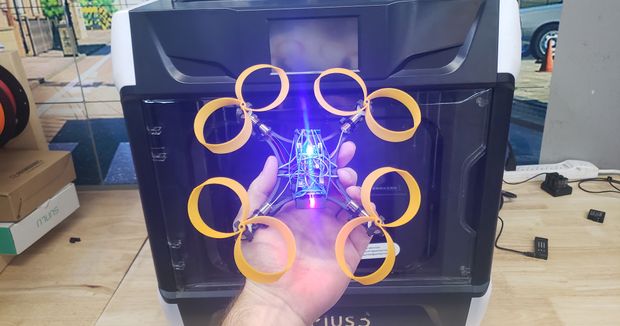
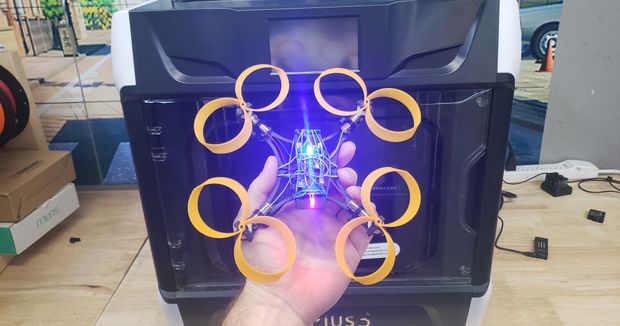
Toroidal Drone Frame and Housings shown in the blake3dcake Printables listing; reported material: High-temperature CF nylon (PAHT-CF)
Reported material: High-temperature CF nylon (PAHT-CF)Toroidal Drone Frame and Housings Printables listing uploaded by blake3dcake · CC BY-SA 4.0Source image · Image bytes unchanged; displayed in full. ShareAlike applies to adaptations.

Understand the material

At a glance

Before you print

Setup difficulty
Expert / industrial hardware only
Nozzle wear
Highly abrasive — standard CF composite; Polymaker puts brass nozzle life at roughly 9 h on PA612-CF15
Read conditions and sources ↓
Read the full material overview

Long-chain carbon-fibre nylon reaching 194 °C HDT at 0.45 MPa and 170 °C at 1.8 MPa, with saturated moisture uptake of 0.88 % — a third of the same maker's PA6-CF.

Applications

PAHT-CF and related long-chain carbon-filled nylons are selected for rigid machine parts that encounter both warmth and changing humidity. Compared with PA6 composites, the long-chain matrix reduces moisture-driven changes while the fibres maintain bending stiffness. Polymaker and Amesos used PA612-CF for agricultural-drone water-pump mounting plates, where the mounting had to accommodate the pumps and withstand their mechanical loading.

The category name covers different formulations rather than a single resin specification. Bambu PAHT-CF and Polymaker PA612-CF15 have different thermal and conditioned-property results, which changes how each should be sized for a warm, loaded component. Lower moisture sensitivity does not mean none, and the loaded heat-deflection figures should not be read as a continuous service temperature. Layer orientation still governs weak attachment features.

  • Agricultural-drone water-pump mounting plates ↗

    FDM · Polymaker PolyMide PA612-CF, a PA612 carbon-fibre filament · Documented case

    Amesos designed and tested mounting plates for agricultural-drone pumps; Polymaker selected PolyMide PA612-CF for the required rigidity and mechanical and thermal performance. The case concerns this long-chain nylon composite, not all products sold as PAHT-CF.

Sources
Plan your printer setup

Printing quick reference

All print settings ↓

Representative catalog values. Check the exact grade and its linked conditions before using a setting.

02

Bed temperature (°C)

—

Full value & sources

—

—
Go deeper when you need to

Properties & source data

64 documented fields

Open a topic to explore the complete data. Each value keeps its original conditions, units and dated sources.

Material & market7 fields
High-temperature CF nylon (PAHT-CF) — Identity & Market
Property and unitPublished value and conditionsSources and dates
Base polymer / chemistryHigh-temperature carbon-fibre nylon. Bambu Lab's PAHT-CF and Polymaker's PA612-CF15 both use a long-chain polyamide matrix for lower moisture uptake than PA6
2 sources
Density (g/cm³)1.03 (Polymaker PA612-CF15) and 1.06 (Bambu Lab), ISO 1183
2 sources
Typical price (USD/kg)1 kg-equivalent spools cluster near 60
2 sources
Price range across brands (USD/kg)50–70 across brands; Bambu Lab 50, Polymaker Fiberon PA612-CF15 70
2 sources
Market availability (1–5)Available from several mainstream brands
2 sources
Spool sizes & diameters1.75 mm; 0.5 and 1 kg spools
2 sources
Typical applicationsUnder-bonnet and near-motor parts needing 170 °C-plus heat deflection with less humidity drift than PA6
2 sources
Print settings9 fields
High-temperature CF nylon (PAHT-CF) — Printing Parameters
Property and unitPublished value and conditionsSources and dates
Nozzle temperature (°C)260–290 (Bambu Lab)
1 source
Enclosure / chamber requirement (1–5)Enclosure required (passive) — Bambu Lab specifies a 45–60 °C chamber
1 source
Recommended chamber temperature (°C)45–60 (Bambu Lab)
1 source
Bed surface & adhesion aidPEI sheet with a glue stick, or a dedicated adhesive such as Magigoo
2 sources
Maximum volumetric flow (mm³/s; see test conditions) (mm³/s)8 at Bambu Lab's 100 mm/s cap on a 0.4 mm nozzle at 0.2 mm layer
2 sources
Bed-adhesion difficulty (1–5)Needs a specific surface plus adhesive
1 source
Stringing / oozing tendency (1–5)Moderate — retraction tuning needed
1 source
Overall printing difficulty (1–5)Expert / industrial hardware only
2 sources
Extruder requirement0.6 mm nozzle recommended by Bambu Lab; 0.4 and 0.8 also supported
1 source
Nozzle wear & reliability5 fields
High-temperature CF nylon (PAHT-CF) — Hardware Wear & Reliability
Property and unitPublished value and conditionsSources and dates
Nozzle hardness required (1–4)Hardened steel required — Polymaker measures brass nozzle life at about 9 h on PA612-CF15 and recommends hardened steel or ruby
1 source
Abrasiveness (1–5)Highly abrasive — standard CF composite; Polymaker puts brass nozzle life at roughly 9 h on PA612-CF15
1 source
Nozzle clog risk (1–5)High — jams from moisture, heat creep or particles
1 source
Heat-creep / jam sensitivity (1–5)Moderate — good heatbreak cooling needed
1 source
Hotend requirementMay require an all-metal hot end (Simplify3D)
1 source
Moisture & drying6 fields
High-temperature CF nylon (PAHT-CF) — Moisture Behaviour
Property and unitPublished value and conditionsSources and dates
Moisture absorption (hygroscopicity) (1–5)High (0.8–2 %) — 0.88 % saturated at 25 °C / 55 % RH for Bambu Lab PAHT-CF, a third of its PA6-CF; Polymaker's PA612-CF15 reaches 2.2 % equilibrium
3 sources
Equilibrium moisture content at ~50 % RH (%)0.88 saturated at 25 °C / 55 % RH (Bambu Lab PAHT-CF); 2.2 equilibrium (Polymaker PA612-CF15)
2 sources
Drying temperature & time80 °C for 8–12 h (Bambu Lab)
1 source
Effect of moisture on strengthPolymaker publishes dry and wet printed blocks for PA612-CF15 itself: at 2.57 % moisture tensile falls only 91.9 → 83.1 MPa and modulus 5137 → 3991 MPa — the PA612 backbone absorbs far less than PA6
2 sources
Storage requirementSealed below 20 % RH with desiccant
1 source
Hydrolysis at melt temperaturePolymaker specifies an 80–100 °C dry and storage below 20 % RH; no molecular-weight loss figure is published, and the wet data it does publish is conditioning rather than melt hydrolysis
2 sources
Strength & mechanical properties13 fields
High-temperature CF nylon (PAHT-CF) — Mechanical Properties
Property and unitPublished value and conditionsSources and dates
Tensile strength (XY) (MPa)92 ± 7 (Bambu Lab) and 91.9 ± 2.0 (Polymaker PA612-CF15, dry/annealed) printed XY, ISO 527; the Polymaker grade only falls to 83.1 ± 2.2 conditioned to 2.57 % moisture
2 sources
Young's modulus (MPa)3860 ± 230 (Bambu Lab) and 5137 ± 192 (Polymaker PA612-CF15, dry) printed XY, ISO 527; Polymaker 3991 ± 137 conditioned
2 sources
Elongation at break (%)2.6 ± 0.2 dry (Polymaker PA612-CF15) to 8.4 ± 1.8 (Bambu Lab) printed XY, ISO 527; Polymaker 4.1 ± 0.3 conditioned
2 sources
Flexural modulus (MPa)4230 ± 210 printed XY, ISO 178 (Bambu Lab)
1 source
Charpy impact, notched (kJ/m²)8.1 ± 0.8 printed XY dry and 7.7 ± 0.5 conditioned, ISO 179 notched (Polymaker PA612-CF15)
1 source
Other impact dataCharpy unnotched 57.5 ± 3.4 and notched 22.8 ± 1.8 printed XY (Bambu Lab, ISO 179)
1 source
Layer adhesion / Z tensile (MPa)47 ± 5 (Bambu Lab) and 48.3 ± 3.9 (Polymaker PA612-CF15, dry) printed Z, ISO 527; Polymaker 35.6 ± 3.0 conditioned
2 sources
Brittleness (1–5)Moderate
1 source
Hardness (scale-specific) (Shore A / Shore D / Rockwell)Rockwell M88 / R117 on extruded PA66-GF30 stock (ASTM D785); no figure is published for a carbon-fibre long-chain nylon filament
1 source
Creep resistance / sustained load (1–5)Good. Ensinger rates its PA66-CF30 compound for sustained static and dynamic load with 110 °C continuous service; the long-chain PA612 matrix takes up 0.88 % at saturation, a third of the same maker's PA6-CF, so it holds dimension better
2 sources
Fatigue / repeated-flex resistance (1–5)Good. Ensinger states carbon-filled PA66 compounds have improved fatigue strength in tension, flexure and compression
1 source
Elasticity / flexibility (1–5)Rigid
1 source
Z strength as % of XY (%)51 (Bambu Lab) to 53 (Polymaker PA612-CF15), printed
2 sources
Heat & temperature5 fields
High-temperature CF nylon (PAHT-CF) — Thermal Properties
Property and unitPublished value and conditionsSources and dates
HDT at 0.45 MPa (°C)175 (Polymaker PA612-CF15) and 194 (Bambu Lab), ISO 75 at 0.45 MPa
2 sources
HDT at 1.8 MPa (°C)114 (Polymaker PA612-CF15) and 170 (Bambu Lab), ISO 75 at 1.8 MPa
2 sources
Glass transition (Tg) (°C)70 (Bambu Lab, DSC)
1 source
Melting point / Vicat (°C)210 (Polymaker PA612-CF15) and 225 (Bambu Lab) melting, DSC; Vicat 206 (Polymaker)
2 sources
Flammability / UL 94Flammable; no UL 94 rating published for the grades surveyed
1 source
Weather & chemical resistance7 fields
High-temperature CF nylon (PAHT-CF) — Environment & Chemical
Property and unitPublished value and conditionsSources and dates
UV resistance (1–5)Months outdoors before embrittlement — unstabilised polyamide yellows under UV
1 source
Chemical resistanceWithstands oils, fuels and alkalis
1 source
Water / humidity resistance in service (1–5)Absorbs water, properties shift — less than PA6 but more than PA12
2 sources
Food contactNot food-contact certified as filament
1 source
Biodegradability / compostabilityNot biodegradable
1 source
RecyclabilityNot accepted in household plastic collection
1 source
Electrical & ESD propertiesSurface resistivity above 10¹² ohm — insulating (Polymaker PA612-CF15, ANSI/ESD S11.11)
1 source
Health & safety6 fields
High-temperature CF nylon (PAHT-CF) — Health & Safety
Property and unitPublished value and conditionsSources and dates
Fume toxicity (1–5)Moderate — measurable VOCs and UFPs, ventilation advised
1 source
VOC emission rate (µg/min)Up to 180 caprolactam, the dominant VOC from nylon and the largest single-VOC rate in the study
1 source
Ultrafine-particle emission rate (particles/min)≈2 × 10⁸ median for nylon — low for particles despite the highest VOC mass measured
1 source
Hazardous species emittedCaprolactam, at up to 180 µg/min from nylon filament
1 source
Ventilation / filtration requirement (1–5)Ventilated room or enclosure recommended
1 source
Dust & fibre handling hazardFibre is bound in the matrix; sanding dust should not be inhaled
1 source
Finishing & post-processing3 fields
High-temperature CF nylon (PAHT-CF) — Post-Processing
Property and unitPublished value and conditionsSources and dates
Sanding & machiningSands poorly — gums rather than powders
1 source
Gluing & solvent weldingCyanoacrylate; no common solvent welds polyamide
1 source
Vapour / chemical smoothingNo practical vapour smoothing
1 source
Solvents & solubility3 fields
High-temperature CF nylon (PAHT-CF) — Solvents & Solubility
Property and unitPublished value and conditionsSources and dates
Soluble inFormic acid, phenol, m-cresol and hexafluoroisopropanol dissolve the matrix at 23 °C, leaving the fibre; laboratory reagents.
1 source
Softened or crazed byZinc chloride solutions stress-crack the nylon matrix, alcoholic calcium chloride dissolves it, mineral acids attack it.
1 source
Solvent welding & smoothing agentNone — nylon's only solvents (formic acid, phenol, HFIP) degrade the part, and the fibre blocks surface flow anyway.
1 source
How to read these values

Values describe representative grades, not every spool. Manufacturer datasheets and independent tests retain their source labels and dates. Printed orientation, test method, conditioning and formulation can change results. Unknown values are —. A listed use is not a certification. Shore A, Shore D and Rockwell hardness are separate scales.

Find a specific filament

Product listings and datasheets

2 listings

Historical USD/kg snapshots. Read each listing’s sale/from qualifiers, spool mass, source date, shipping and tax notes. Product figures are separate from the material summary.

Browse 2 products from 2 brands
Bambu LabPAHT-CF49.99 USD/kg

$49.99 / 1 kg spool, us.store.bambulab.com, Aug 2026

HDT 194 °C at 0.45 MPa and 170 °C at 1.8 MPa; saturated water absorption 0.88 %, a third of Bambu Lab's PA6-CF.

Open product listing ↗
Bambu Lab PAHT-CF — product-specific figures
Density (g/cm³)1.06 (ISO 1183)
Nozzle temperature (°C)260–290
Bed temperature (°C)80–100
Equilibrium moisture content at ~50 % RH (%)0.88 saturated at 25 °C / 55 % RH
Tensile strength (XY) (MPa)92 ± 7 (printed XY, ISO 527); Z 47
Young's modulus (MPa)3860 ± 230 (printed XY, ISO 527); Z 2180
Elongation at break (%)8.4 ± 1.8 (printed XY, ISO 527); Z 4.1
Flexural strength (MPa)125 ± 7 (printed XY, ISO 178); Z 61
Flexural modulus (MPa)4230 ± 210 (printed XY, ISO 178); Z 1820
Charpy impact, notched (kJ/m²)22.8 ± 1.8 (printed XY, ISO 179, notched)
Other impact dataCharpy unnotched 57.5 kJ/m² XY, 13.3 kJ/m² Z (printed, ISO 179)
Layer adhesion / Z tensile (MPa)47 ± 5 (printed Z, ISO 527)
Z strength as % of XY (%)51 (printed Z 47 vs XY 92, ISO 527)
HDT at 0.45 MPa (°C)194 (ISO 75, 0.45 MPa)
HDT at 1.8 MPa (°C)170 (ISO 75, 1.8 MPa)
Glass transition (Tg) (°C)70 (DSC)
Melting point / Vicat (°C)225 melting (DSC); Vicat 220 (ISO 306)
PolymakerFiberon PA612-CF1569.98 USD/kg

$34.99 / 0.5 kg spool = $69.98/kg, Polymaker product catalogue, Aug 2026

Handle fiberon-pa612-cf. 15 wt% carbon fibre on a PA612 matrix; Young's modulus 5137 MPa printed XY.

Open product listing ↗
Polymaker Fiberon PA612-CF15 — product-specific figures
Density (g/cm³)1.03 (ISO 1183)
Nozzle temperature (°C)250–300
Bed temperature (°C)40–50
Equilibrium moisture content at ~50 % RH (%)2.2 equilibrium water absorption
Tensile strength (XY) (MPa)91.9 ± 2.0 (printed XY, ISO 527)
Young's modulus (MPa)5136.7 ± 192.2 (printed XY, ISO 527)
Elongation at break (%)2.6 ± 0.2 dry (printed XY, ISO 527); Z 2.1
Flexural strength (MPa)138.0 ± 2.2 dry (printed XY, ISO 178); Z 73.5
Flexural modulus (MPa)4583.5 ± 62.7 dry (printed XY, ISO 178); Z 2264.8
Charpy impact, notched (kJ/m²)8.1 ± 0.8 dry (printed XY, ISO 179, notched)
Other impact dataCharpy unnotched 29.9 kJ/m² XY, 12.6 kJ/m² Z (printed dry, ISO 179)
Layer adhesion / Z tensile (MPa)48.3 ± 3.9 dry (printed Z, ISO 527); 35.6 wet
Z strength as % of XY (%)53 (printed Z 48.3 vs XY 91.9 dry, ISO 527)
HDT at 0.45 MPa (°C)175 (ISO 75, 0.45 MPa)
HDT at 1.8 MPa (°C)114 (ISO 75, 1.8 MPa)
Melting point / Vicat (°C)210 melting (DSC); Vicat 206.2 (ISO 306)
Flammability / UL 94UL 94 HB at 1.5 mm
Electrical & ESD propertiesSurface resistivity >10^12 Ω (ANSI/ESD S11.11)

Compare High-temperature CF nylon (PAHT-CF) with another filament