 3D Printing Info
Where it is used
Stiff, heat-resistant structural parts where a matte finish and lower cost beat carbon fibre
Sources
- Bambu Filament Technical Data Sheet — PA6-GF · 2026-08 · tds
- Fiberon PA6-GF25 Technical Data Sheet V1.1 · 2024-12 · tds
Glass-fibre PA6: modulus to 5.4 GPa and HDT to 191 °C, and the thirstiest material in the whole dataset at 3.33 % equilibrium moisture. Bambu Lab and Polymaker disagree on Z strength by…
Open in interactive comparison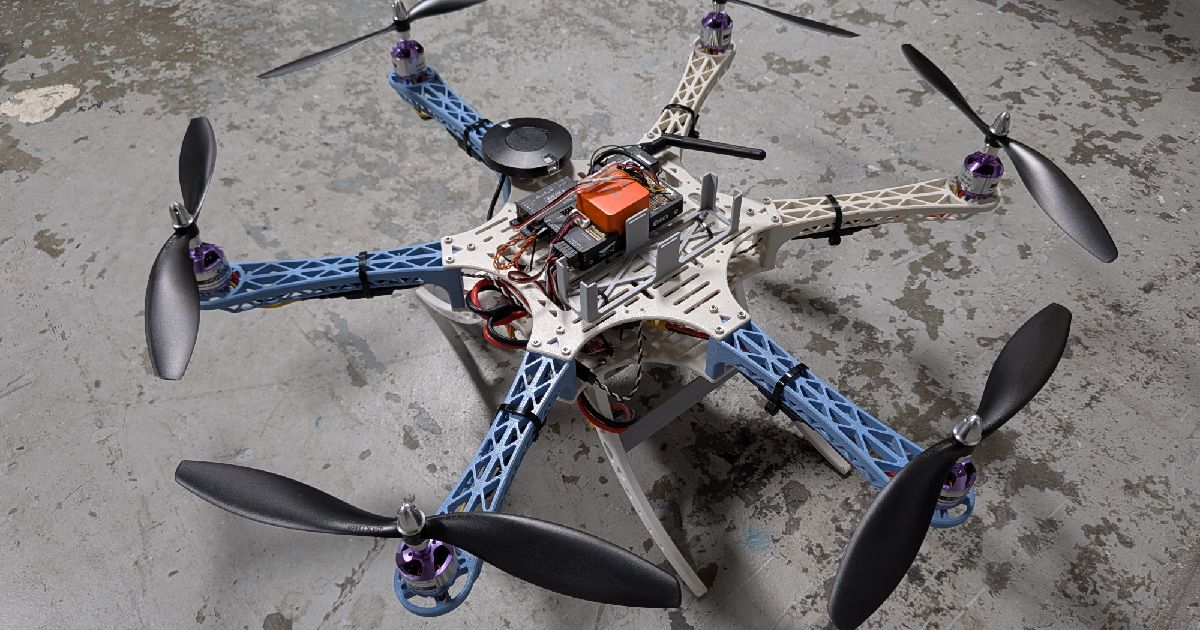
Stiff, heat-resistant structural parts where a matte finish and lower cost beat carbon fibre
Glass-fibre PA6: modulus to 5.4 GPa and HDT to 191 °C, and the thirstiest material in the whole dataset at 3.33 % equilibrium moisture. Bambu Lab and Polymaker disagree on Z strength by more than a factor of two.
PA6-GF is a stiff, heat-resistant nylon composite for tooling, fixture bodies and rigid mechanical parts. It is particularly useful where resistance to bending and tolerance of processing heat matter more than a flexible nylon feel. A documented industrial use is the full-size automotive fender plug made by Ivan Tampi Customs on a MAKEiT printer: the material remained stable during power sanding rather than gumming as PLA did.
That example concerns tooling used to create the finished panel, not a claim that the printed plug is a road-going body panel. Glass-filled PA6 can also be brittle: printed elongation can be only a few percent. It absorbs substantial moisture, which reduces stiffness and strength while changing impact behavior. Design around the conditioned material and the actual load direction rather than assuming all nylons are tough and flexible.
FDM · Polymaker PolyMide PA6-GF; historical grade, not every current PA6-GF spool · Documented case
Polymaker documents a full-size fender plug printed in PolyMide PA6-GF. The material tolerated repeated power sanding without gumming, supporting the surface preparation needed for the plug-making workflow.
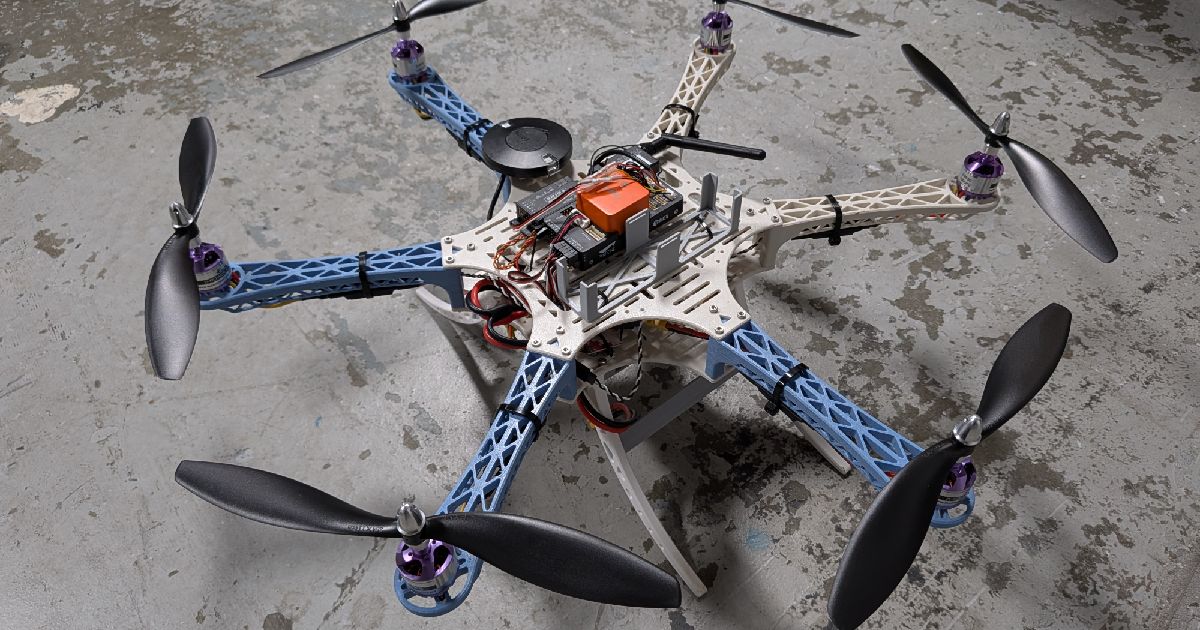
A flying hexacopter with replaceable printed arms and body. The uploader identifies Bambu PA6-GF for the frame; attached electronics and propellers are separate parts.
Listing note: “I personally used Bambu PA6-GF”
Printables listing uploaded by aeracode · CC BY-NC-SA 4.0Original listing · Checked 2026-10-17. This is an uploader report, not an independent material test.Source image · Image bytes unchanged; displayed in full. Noncommercial reuse only. ShareAlike applies to adaptations.
Representative catalog values. Check the exact grade and its linked conditions before using a setting.
260–290 (Bambu Lab)
—
—
—Enclosure required (passive)
Enclosure required (passive) — Bambu Lab specifies a 45–60 °C chamber
80 °C for 8–12 h (Bambu Lab)
80 °C for 8–12 h (Bambu Lab)
Open a topic to explore the complete data. Each value keeps its original conditions, units and dated sources.
| Property and unit | Published value and conditions | Sources and dates |
|---|---|---|
| Base polymer / chemistry | PA6 reinforced with chopped glass fibre — Polymaker's grade is 25 wt% | 2 sources
|
| Density (g/cm³) | 1.14 (Bambu Lab) and 1.20 (Polymaker Fiberon), ISO 1183 | 2 sources
|
| Typical price (USD/kg) | 1 kg-equivalent spools span 40–130; the middle of the market is about 60 | 3 sources
|
| Price range across brands (USD/kg) | 40–130 across brands; SUNLU 40, YXPOLYER 45, Polymaker Fiberon and Bambu Lab 60, 3DXTech FibreX 87, Obsidian Nylon 6+GF 130 | 5 sources
|
| Market availability (1–5) | Stocked by most mainstream brands | 5 sources
|
| Spool sizes & diameters | 1.75 and 2.85 mm; 0.5, 0.75 and 1 kg spools | 3 sources
|
| Typical applications | Stiff, heat-resistant structural parts where a matte finish and lower cost beat carbon fibre | 2 sources
|
| Property and unit | Published value and conditions | Sources and dates |
|---|---|---|
| Nozzle temperature (°C) | 260–290 (Bambu Lab) | 1 source
|
| Enclosure / chamber requirement (1–5) | Enclosure required (passive) — Bambu Lab specifies a 45–60 °C chamber | 1 source
|
| Recommended chamber temperature (°C) | 45–60 (Bambu Lab) | 1 source
|
| Bed surface & adhesion aid | PEI sheet with a glue stick, or a dedicated adhesive such as Magigoo | 2 sources
|
| Maximum volumetric flow (mm³/s; see test conditions) (mm³/s) | 10 at Bambu Lab's 130 mm/s cap on a 0.4 mm nozzle at 0.2 mm layer | 2 sources
|
| Bed-adhesion difficulty (1–5) | Needs a specific surface plus adhesive | 1 source
|
| Stringing / oozing tendency (1–5) | Moderate — retraction tuning needed | 1 source
|
| Overall printing difficulty (1–5) | Expert / industrial hardware only | 2 sources
|
| Extruder requirement | 0.6 mm nozzle recommended by Bambu Lab; 0.4 and 0.8 also supported | 1 source
|
| Property and unit | Published value and conditions | Sources and dates |
|---|---|---|
| Nozzle hardness required (1–4) | Hardened steel required — Polymaker measures brass nozzle life at about 9 h on PA6-GF25 and recommends hardened steel or ruby | 1 source
|
| Abrasiveness (1–5) | Highly abrasive — standard GF composite; Polymaker puts brass nozzle life at roughly 9 h on PA6-GF25 | 1 source
|
| Nozzle clog risk (1–5) | Very high — frequent jams without careful setup | 1 source
|
| Heat-creep / jam sensitivity (1–5) | Moderate — good heatbreak cooling needed | 1 source
|
| Hotend requirement | May require an all-metal hot end (Simplify3D) | 1 source
|
| Property and unit | Published value and conditions | Sources and dates |
|---|---|---|
| Moisture absorption (hygroscopicity) (1–5) | Very high (>2 %) — 2.56 % saturated at 25 °C / 55 % RH (Bambu Lab) and 3.33 % equilibrium (Polymaker Fiberon), the highest in the dataset | 2 sources
|
| Equilibrium moisture content at ~50 % RH (%) | 2.56 saturated at 25 °C / 55 % RH (Bambu Lab); 3.33 equilibrium (Polymaker Fiberon PA6-GF25) | 2 sources
|
| Drying temperature & time | 80 °C for 8–12 h (Bambu Lab) | 1 source
|
| Symptoms when wet | Popping and cracking during extrusion, then hard-to-diagnose defects | 1 source
|
| Effect of moisture on strength | Polymaker publishes dry and wet printed blocks for PA6-GF25 itself: at 4.57 % moisture tensile falls 80.1 → 40.2 MPa and modulus 5357 → 1794 MPa, while notched Charpy rises 10.0 → 28.0 kJ/m² | 2 sources
|
| Storage requirement | Sealed below 20 % RH with desiccant | 1 source
|
| Hydrolysis at melt temperature | Polymaker specifies an 80–100 °C dry and storage below 20 % RH; no molecular-weight loss figure is published, and the wet data it does publish is conditioning rather than melt hydrolysis | 2 sources
|
| Property and unit | Published value and conditions | Sources and dates |
|---|---|---|
| Tensile strength (XY) (MPa) | 75 ± 6 (Bambu Lab) and 80.1 ± 1.8 (Polymaker Fiberon, dry/annealed) printed XY, ISO 527; Fiberon falls to 40.2 ± 2.1 conditioned to 4.57 % moisture. Stratasys FDM PA6/66-GF30-FR gives 60.2-61.1 at break and 61.7-62.3 at yield printed XZ (ASTM D638) | 3 sources
|
| Young's modulus (MPa) | 2850 ± 260 (Bambu Lab) and 5357 ± 211 (Polymaker Fiberon, dry) printed XY, ISO 527; Fiberon falls to 1794 ± 84 conditioned. Stratasys FDM PA6/66-GF30-FR gives 5600-5830 printed XZ against 3050-3140 in ZX (ASTM D638) | 3 sources
|
| Elongation at break (%) | 2.4 ± 0.2 dry (Polymaker Fiberon) to 3.9 ± 0.8 (Bambu Lab) printed XY, ISO 527; the Fiberon grade rises to 4.2 ± 0.7 conditioned | 2 sources
|
| Flexural modulus (MPa) | 3670 ± 140 printed XY, ISO 178 (Bambu Lab) | 1 source
|
| Charpy impact, notched (kJ/m²) | 10.0 ± 0.7 printed XY dry and 28.0 ± 1.0 conditioned, ISO 179 notched (Polymaker Fiberon); Bambu Lab 7.2 ± 2.3 | 2 sources
|
| Other impact data | Charpy unnotched 27.2 ± 2.2 printed XY (Bambu Lab, ISO 179). Stratasys FDM PA6/66-GF30-FR gives Izod notched 74.6-77.1 J/m printed XZ against 17.2-22.1 in ZX (ASTM D256) | 2 sources
|
| Layer adhesion / Z tensile (MPa) | 27 ± 5 (Bambu Lab) and 60.7 ± 1.1 (Polymaker Fiberon, dry) printed Z, ISO 527 — the two makers differ by more than a factor of two; Fiberon falls to 26.3 ± 1.5 conditioned. Stratasys FDM PA6/66-GF30-FR gives 23.7-24.4 at break printed ZX (ASTM D638) | 3 sources
|
| Brittleness (1–5) | Brittle — snaps with little warning; elongation at break 2.4 % in XY | 1 source
|
| Hardness (scale-specific) (Shore A / Shore D / Rockwell) | Rockwell M88 / R117 on extruded PA66-GF30 stock (ASTM D785) | 1 source
|
| Creep resistance / sustained load (1–5) | Good. Ensinger lists high creep resistance as a headline property of extruded PA66-GF30 stock; the rating is held below Excellent because equilibrium moisture uptake of 3.33 % softens the matrix in service | 2 sources
|
| Fatigue / repeated-flex resistance (1–5) | Good. Ensinger lists high fatigue strength as a headline property of extruded PA66-GF30 stock | 1 source
|
| Elasticity / flexibility (1–5) | Rigid | 1 source
|
| Z strength as % of XY (%) | 36 (Bambu Lab) to 76 (Polymaker Fiberon), printed; Stratasys FDM PA6/66-GF30-FR gives 39-41 (ZX against XZ tensile at break, ASTM D638) | 3 sources
|
| Property and unit | Published value and conditions | Sources and dates |
|---|---|---|
| HDT at 0.45 MPa (°C) | 182 (Bambu Lab) and 191 (Polymaker Fiberon), ISO 75 at 0.45 MPa. Stratasys FDM PA6/66-GF30-FR gives 161 printed XY and 185 XZ (ASTM D648 at 66 psi) | 3 sources
|
| HDT at 1.8 MPa (°C) | 157 (Polymaker Fiberon) and 158 (Bambu Lab), ISO 75 at 1.8 MPa | 2 sources
|
| Glass transition (Tg) (°C) | 67 (Bambu Lab) and 70.4 (Polymaker Fiberon), DSC; Stratasys measures 51.5 on FDM PA6/66-GF30-FR (ASTM D7426) | 3 sources
|
| Melting point / Vicat (°C) | 214.5 (Polymaker Fiberon) and 219 (Bambu Lab) melting, DSC; Vicat 210–212 (ISO 306) | 2 sources
|
| Thermal expansion (CTE) (µm/m·K) | 48.6 on extruded PA66-GF30 stock (ASTM D696; source states 2.7e-5 in/in/°F). Stratasys measures much higher on printed FDM PA6/66-GF30-FR — 95.4 over -20 to 5 °C and 214 over 25 to 80 °C in XY (ASTM E831) | 2 sources
|
| Flammability / UL 94 | Flammable; no UL 94 rating published for the grades surveyed | 1 source
|
| Property and unit | Published value and conditions | Sources and dates |
|---|---|---|
| UV resistance (1–5) | Months outdoors before embrittlement — unstabilised polyamide yellows under UV | 1 source
|
| Chemical resistance | Withstands oils, fuels and alkalis | 1 source
|
| Water / humidity resistance in service (1–5) | Absorbs water, properties shift | 1 source
|
| Food contact | Not food-contact certified as filament | 1 source
|
| Biodegradability / compostability | Not biodegradable | 1 source
|
| Recyclability | Not accepted in household plastic collection | 1 source
|
| Electrical & ESD properties | Surface resistivity above 10¹² ohm — insulating (Polymaker Fiberon, ANSI/ESD S11.11) | 1 source
|
| Property and unit | Published value and conditions | Sources and dates |
|---|---|---|
| Fume toxicity (1–5) | Moderate — measurable VOCs and UFPs, ventilation advised | |
| VOC emission rate (µg/min) | Up to 180 caprolactam, the dominant VOC from nylon and the largest single-VOC rate in the study | |
| Ultrafine-particle emission rate (particles/min) | ≈2 × 10⁸ median for nylon — low for particles despite the highest VOC mass measured | |
| Hazardous species emitted | Caprolactam, at up to 180 µg/min from nylon filament | |
| Ventilation / filtration requirement (1–5) | Ventilated room or enclosure recommended | |
| Dust & fibre handling hazard | Glass fibre is bound in the matrix; avoid inhaling sanding dust | 1 source
|
| Property and unit | Published value and conditions | Sources and dates |
|---|---|---|
| Sanding & machining | Sands poorly — gums rather than powders | 1 source
|
| Gluing & solvent welding | Cyanoacrylate; no common solvent welds polyamide | 1 source
|
| Vapour / chemical smoothing | No practical vapour smoothing | 1 source
|
| Property and unit | Published value and conditions | Sources and dates |
|---|---|---|
| Soluble in | Formic acid, phenol, m-cresol and hexafluoroisopropanol dissolve the matrix at 23 °C, leaving the fibre; laboratory reagents. | 1 source |
| Softened or crazed by | Zinc chloride solutions stress-crack the nylon matrix, alcoholic calcium chloride dissolves it, mineral acids attack it. | 1 source |
| Solvent welding & smoothing agent | None — nylon's only solvents (formic acid, phenol, HFIP) degrade the part, and the fibre blocks surface flow anyway. | 1 source |
Values describe representative grades, not every spool. Manufacturer datasheets and independent tests retain their source labels and dates. Printed orientation, test method, conditioning and formulation can change results. Unknown values are —. A listed use is not a certification. Shore A, Shore D and Rockwell hardness are separate scales.
Historical USD/kg snapshots. Read each listing’s sale/from qualifiers, spool mass, source date, shipping and tax notes. Product figures are separate from the material summary.
$39.99 / 1 kg spool (list $44.99, back-to-school promotion), store.sunlu.com, Aug 2026; 3DJake lists the same spool at $38.99 excl. VAT
25 % glass fibre on a reusable spool rated for 110 °C drying. The cheapest PA6-GF found by a wide margin.
Open product listing ↗| Density (g/cm³) | 1.269 (SUNLU product page; the test standard is not stated) |
|
|---|---|---|
| Nozzle temperature (°C) | 270–290 (SUNLU) |
|
| Bed temperature (°C) | 60–70 with glue (SUNLU) |
|
| Tensile strength (XY) (MPa) | 89 ± 8 (SUNLU product page; the test standard is not stated) |
|
| Elongation at break (%) | 12.5 ± 3 at break (SUNLU product page) |
|
| Flexural strength (MPa) | 176 ± 8 (SUNLU product page) |
|
| Flexural modulus (MPa) | 6130 ± 300 (SUNLU product page) |
|
| Charpy impact, notched (kJ/m²) | 10.5 ± 2.5 XY (SUNLU product page; notched or unnotched is not stated) |
|
| Melting point / Vicat (°C) | 225 melting temperature (SUNLU product page) |
|
$44.99 / 1 kg spool, yxpolyer.com, Aug 2026
No technical data sheet is published. YXPOLYER publishes no specification of any kind for this filament: the product page carries marketing bullets only, and yxpolyer.com has no downloads, data-sheet or technical section.
Open product listing ↗$29.99 / 0.5 kg spool = $59.98/kg, Polymaker product catalogue, Aug 2026
Handle fiberon-pa6-gf25. 25 wt% glass fibre; 3.33 % equilibrium moisture, the highest in the dataset.
Open product listing ↗| Density (g/cm³) | 1.20 (ISO 1183) |
|
|---|---|---|
| Nozzle temperature (°C) | 280–300 |
|
| Bed temperature (°C) | 40–50 |
|
| Equilibrium moisture content at ~50 % RH (%) | 3.33 equilibrium water absorption |
|
| Tensile strength (XY) (MPa) | 80.1 ± 1.8 dry (printed XY, ISO 527); 40.2 wet |
|
| Young's modulus (MPa) | 5356.9 ± 211.0 (printed XY, ISO 527) |
|
| Elongation at break (%) | 2.4 ± 0.2 dry (printed XY, ISO 527); Z 4.0 |
|
| Flexural strength (MPa) | 133.8 ± 4.7 dry (printed XY, ISO 178); Z 99.9 |
|
| Flexural modulus (MPa) | 4314.2 ± 120.6 dry (printed XY, ISO 178); Z 2849.5 |
|
| Charpy impact, notched (kJ/m²) | 10.0 ± 0.7 dry (printed XY, ISO 179, notched); 28.0 wet |
|
| Other impact data | Charpy unnotched 27.4 kJ/m² XY, 16.2 kJ/m² Z (printed dry, ISO 179) |
|
| Layer adhesion / Z tensile (MPa) | 60.7 ± 1.1 (printed Z, ISO 527) |
|
| Z strength as % of XY (%) | 76 (printed Z 60.7 vs XY 80.1 dry, ISO 527) |
|
| HDT at 0.45 MPa (°C) | 191 (ISO 75, 0.45 MPa) |
|
| HDT at 1.8 MPa (°C) | 157 (ISO 75, 1.8 MPa) |
|
| Melting point / Vicat (°C) | 214.5 melting (DSC); Vicat 211.7 (ISO 306) |
|
| Flammability / UL 94 | UL 94 HB at 1.5 mm |
|
| Electrical & ESD properties | Surface resistivity >10^12 Ω (ANSI/ESD S11.11) |
|
$59.99 / 1 kg spool, us.store.bambulab.com, Aug 2026
HDT 182 °C at 0.45 MPa; saturated water absorption 2.56 %.
Open product listing ↗| Density (g/cm³) | 1.14 (ISO 1183) |
|
|---|---|---|
| Nozzle temperature (°C) | 260–290 |
|
| Bed temperature (°C) | 80–100 |
|
| Equilibrium moisture content at ~50 % RH (%) | 2.56 saturated at 25 °C / 55 % RH |
|
| Tensile strength (XY) (MPa) | 75 ± 6 (printed XY, ISO 527) |
|
| Young's modulus (MPa) | 2850 ± 260 (printed XY, ISO 527); Z 1950 |
|
| Elongation at break (%) | 3.9 ± 0.8 (printed XY, ISO 527); Z 2.3 |
|
| Flexural strength (MPa) | 120 ± 6 (printed XY, ISO 178); Z 51 |
|
| Flexural modulus (MPa) | 3670 ± 140 (printed XY, ISO 178); Z 2300 |
|
| Charpy impact, notched (kJ/m²) | 7.2 ± 2.3 (printed XY, ISO 179, notched) |
|
| Other impact data | Charpy unnotched 27.2 kJ/m² XY, 4.1 kJ/m² Z (printed, ISO 179) |
|
| Layer adhesion / Z tensile (MPa) | 27 ± 5 (printed Z, ISO 527) |
|
| Z strength as % of XY (%) | 36 (printed Z 27 vs XY 75, ISO 527) |
|
| HDT at 0.45 MPa (°C) | 182 (ISO 75, 0.45 MPa) |
|
| HDT at 1.8 MPa (°C) | 158 (ISO 75, 1.8 MPa) |
|
| Glass transition (Tg) (°C) | 67 (DSC) |
|
| Melting point / Vicat (°C) | 219 melting (DSC); Vicat 210 (ISO 306) |
|
$65.00 / 750 g spool = $86.67/kg, 3dxtech.com product catalogue, Aug 2026
Handle fibrex-nylon-6-gf-1.
Open product listing ↗| Density (g/cm³) | 1.35 (ISO 1183) | |
|---|---|---|
| Spool sizes & diameters | 1.75 mm; 750 g and 2 kg |
|
| Nozzle temperature (°C) | 260–280 |
|
| Bed temperature (°C) | 60–75 |
|
| Hotend requirement | Hardened steel nozzle, 0.4 mm diameter minimum |
|
| Drying temperature & time | 90 °C for 4 h |
|
| Tensile strength (XY) (MPa) | 62.8 at break (printed XY, ISO 527) | |
| Young's modulus (MPa) | 4261 (printed XY, ISO 527) | |
| Elongation at break (%) | 6 at break (printed XY, ISO 527) | |
| Flexural strength (MPa) | 72 (printed XY, ISO 178) | |
| Flexural modulus (MPa) | 3600 (printed XY, ISO 178) | |
| HDT at 0.45 MPa (°C) | 186 (ISO 75, 0.45 MPa) | |
| Glass transition (Tg) (°C) | 70 (DSC) | |
| Electrical & ESD properties | Surface resistance >10^9 Ω/sq (ASTM D257) |
$130.00 / 1 kg spool, 3dxtech.com product catalogue, Aug 2026
Handle obsidian-gf-pa6-1. TDS specimens printed XY flat on a Markforged Onyx One at 0.125 mm layer, 100 % infill; the sheet is for the 15 % glass loading.
Open product listing ↗| Density (g/cm³) | 1.22 (ISO 1183) | |
|---|---|---|
| Nozzle temperature (°C) | 265–285 |
|
| Bed temperature (°C) | 90–110 |
|
| Hotend requirement | Hardened steel nozzle |
|
| Drying temperature & time | 90 °C for 4 h |
|
| Tensile strength (XY) (MPa) | 85 at break (printed XY, ISO 527) | |
| Young's modulus (MPa) | 4600 (printed XY, ISO 527) | |
| Elongation at break (%) | 5.8 at break (printed XY, ISO 527) | |
| Flexural strength (MPa) | 128 at yield (printed XY, ISO 178) | |
| Flexural modulus (MPa) | 4700 (printed XY, ISO 178) | |
| HDT at 0.45 MPa (°C) | 176 (ISO 75, 0.45 MPa) | |
| Glass transition (Tg) (°C) | 70 (DSC) | |
| Electrical & ESD properties | Surface resistance >10^9 Ω/sq (ASTM D257) |